The Boxes You Never Unpacked: What to Do With Them Now
You moved in June and six boxes are still sealed in the spare room. That is not a discipline problem — it is the part of a move with no deadline attached. Here is how to finish it.

On this page
It is the middle of August, and there are still six boxes in the spare room.
You moved in June. The kitchen got unpacked that first weekend because you had to eat, and the bedroom got unpacked because you had to sleep. Everything that was not urgent got carried into the spare room, or the garage, or the back of a closet, and it has been there ever since — sealed, labeled in marker with something like MISC, slowly becoming furniture.
This is not a discipline problem. Almost every move ends this way, because the last boxes are the ones with no deadline attached to them. Nobody needs them by Tuesday. So they wait, and waiting is free, and then it is August.
Here is what to actually do with them, in an order that works whether you have a free afternoon or fifteen minutes.
Two months of not needing it is information
If you have not needed what is in a box since June, you know something now that you did not know in June: nothing in there is part of your daily life.
That is not the same as saying it should go. Winter coats are not part of your daily life in August either. But it changes the question. The question is no longer where does this belong. It is which of these three is it:
Seasonal or occasional — you will want it, on a date you could roughly name.
Kept on purpose — you will not use it and you are keeping it anyway, which is a perfectly legitimate answer that nobody needs to justify.
Unresolved — you did not decide in June and you have not decided since.
The first two are most of the volume and neither is hard. The third is the small pile that has actually been costing you a room.
Open all of them before you decide anything
The tempting move is to relocate the sealed boxes somewhere better — the garage, the top of a closet, a unit across town. Do not do that yet. A box you have not opened in two months is a box you will not open in two years, and moving it into paid storage converts a mild annoyance into a monthly bill. If a unit genuinely is the answer for some of this, work out what it actually needs to hold first.
Open every one. You do not have to empty it, sort it, or decide anything yet. Cut the tape, look inside, and write on the outside what is genuinely in there — the real contents, not the category you guessed at on moving day.
A box labeled MISC in your own handwriting is a box you will keep avoiding, because MISC means an unknown number of decisions. A box labeled "cables, chargers, router bracket" is a five-minute job you can do on a weeknight without bracing for it. The label is doing almost all of the work here, which is equally true when you are packing in the first place.
This pass usually takes under an hour for a spare room's worth, and it changes the shape of the job completely. Afterwards you are not facing six sealed boxes. You are facing one box of cables, two boxes of kitchen equipment you have duplicates of, a box of books, a box of paperwork, and one box you genuinely have to think about.
What to write on the outside
The room it should end up in, if you already know.
Three to five real contents, never a category. "Cables, chargers, router bracket" beats "electronics" every time.
The date you opened it, so that in four months you know this is the pass you already did.
Sort in one direction only
With everything open and labeled, work out of the boxes and never between them. Moving items from one box into another box feels like progress and is not — it is the same volume with fresh tape on it.
Four destinations, and only one of them is difficult:
Has a home now. There is a place for it in this house and the place has room. Put it there today, not in a pile by the door.
Belongs with the seasonal items. Keep it boxed. Label it properly and put it where the seasonal boxes already live, rather than wherever there is a gap.
Leaves. Sell it, donate it, hand it to somebody who wants it, or discard it. Get it out of the house the same week, or it quietly comes back.
Undecided. One box, labeled and dated, and the subject of a section further down.
The fifteen-minute version
Not everyone has a free afternoon, and the job does not actually require one. It requires the same pass broken into pieces small enough that you will still do them on a bad week.
Pick one box. Cut the tape.
Take out anything with an obvious home and put it there. Do not reorganize the destination while you are standing in it — that is a different job and it will eat the whole fifteen minutes.
Take out anything that is leaving and put it straight in the car.
Relabel what is left with the real contents and today's date.
Stop.
One box a night is six nights. Six nights is not a project, and unlike the free afternoon you have been waiting for since June, it exists.
The duplicates are the part that pays you back
Somewhere between the move and now, you needed a corkscrew, could not find the corkscrew, and bought a corkscrew. Then the same happened with a phone charger, a tape measure, and the good scissors. Two months of that adds up, and the originals are all sitting in the boxes.
This is worth doing deliberately rather than noticing in passing. As you open each box, keep a running list of anything you have replaced since the move. It is the one part of this job with a same-day payoff: the second-best version leaves, the good one goes back in the drawer, and you stop buying the third.
It is also the clearest argument for keeping any record at all. Nobody buys a second tape measure because they wanted one. They buy it because the first was unfindable, which is a search problem wearing a shopping problem's clothes.
Paperwork gets its own session
If one of the boxes is paperwork, take it out of this job entirely and give it an afternoon of its own. Documents are the one category where a mistake is expensive and a missing page causes months of trouble, and they are badly served by a tired hour at the end of a Saturday.
Sort them by what happens if you lose them rather than by what they are about — the full method is here, including which of them need to be reachable in a hurry and which only need a photograph.
The box you cannot decide about
One box. Not one per room and not one per category — one, because the limit is the entire mechanism. Without it, undecided quietly becomes the answer to everything and you finish the day having moved possessions from the floor to a shelf.
Label it, write the date on it, and put it somewhere you walk past rather than somewhere you will not.
Then photograph what goes into it before you close it, and note where each item came from. Most of what makes an undecided item hard is not the item itself — it is having to hold the decision in your head every time you see it. A photograph holds it for you, and it means you can answer "do we still have Dad's camera" without cutting any tape.
Give it a real date. A season, not "eventually". When that date arrives, whatever is still inside has gone eight months without being needed, and that is a far easier conversation to have with yourself than the one you were avoiding in June.
Doing this once, instead of after every move
The reason this happens is not laziness. It is that a sealed box is opaque, and an opaque box is a decision you are being asked to make with no information in front of you. Everything above is one idea applied four times: make the contents visible and the work gets small.
The same holds for the next move. If you want the labeling to survive it, the useful part is not the marker — it is the record behind it. Photograph the contents as each box is filled, and a sealed box stays searchable months later. Cratify does this with a QR code on the box: scan the code and see what is inside without opening it, and QR label printing is on every tier, including the free Basic one. It is the difference between MISC and a list.
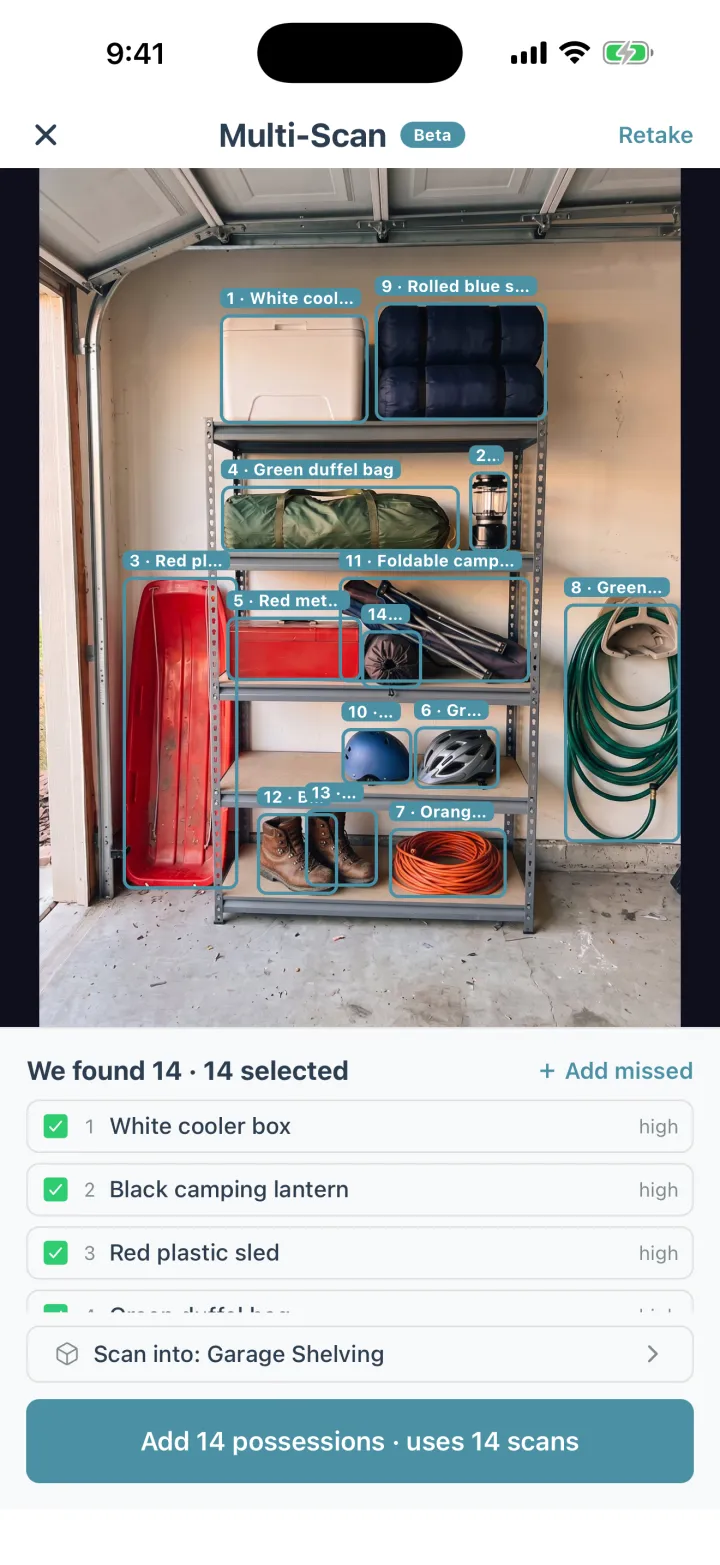
Multi-Scan names up to 15 possessions from one photo.
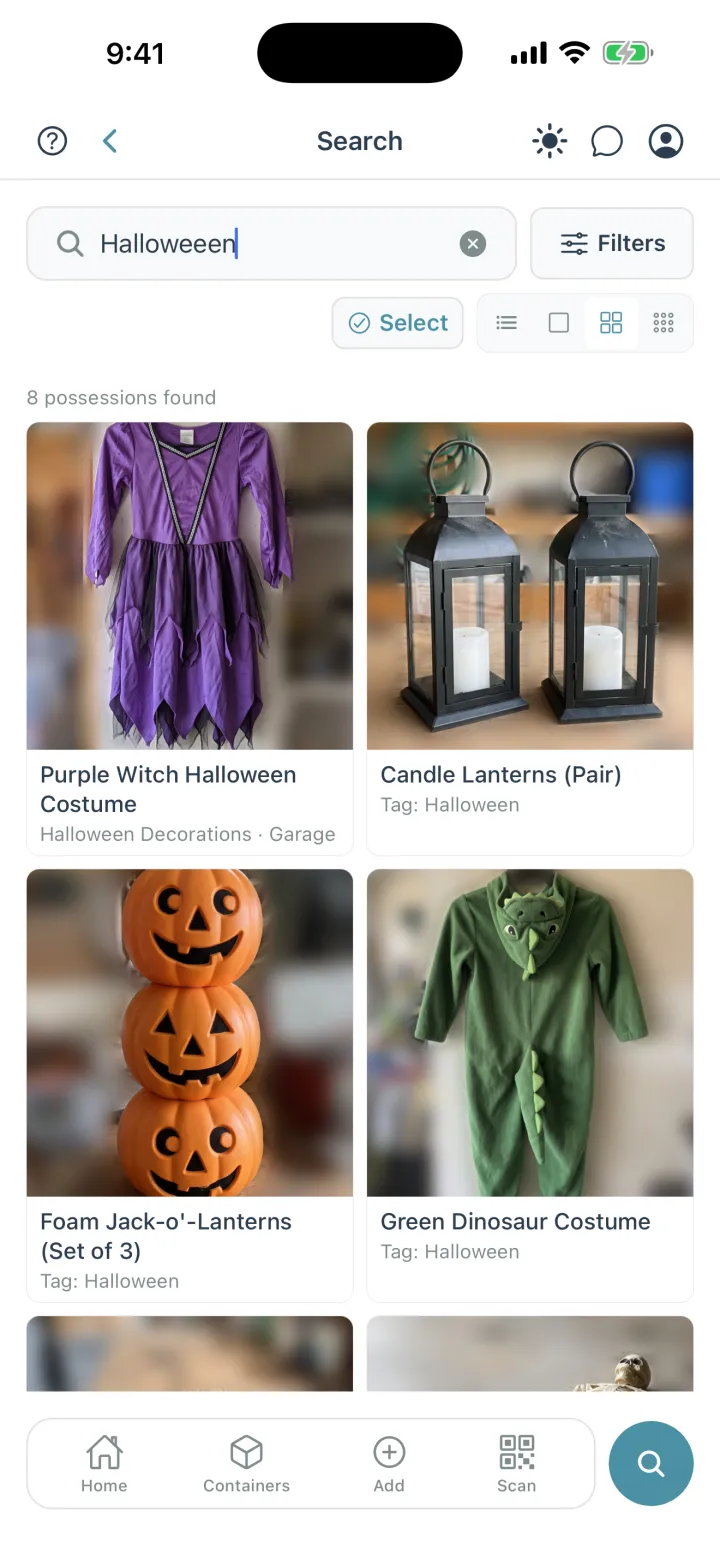
Search forgives typos: “Halloweeen” still finds every Halloween possession.
And if you have arrived here two weeks after a move rather than two months, the order is different and considerably easier — start here instead.
The six boxes in the spare room are not a character flaw. They are the last ninety minutes of a move that almost everybody stops ninety minutes early. Cut the tape and most of them stop being a problem the same afternoon. Cratify is free to try.
Know what is in the box without opening it
Photograph each box as you seal it, and a QR code on the lid answers what is inside — Cratify is free to try.