How to Organize Toys So Cleanup Stops Being a Fight
It is eight o'clock and the floor is two inches deep in toys. The fix is not a better shelf — it is fewer toys within reach, one box per activity, and half of it stored elsewhere.
On this page
- Toys are a volume problem first
- Sort by how a child plays, not by what the toy is
- Put the container where the four-year-old is
- Half of it should be out of the room
- The pieces problem: was this ever complete?
- What is worth a record, and what is not
- The habit is one song long
- Start by taking half of it out
It is eight o'clock and the floor is a layer.
Not a mess exactly — a layer, about two inches deep, made of one puzzle, most of a train track, four books, a single shoe, and a scattering of small hard pieces that belong to sets you cannot identify from standing height.
You ask for a cleanup. What follows is a negotiation, then a slow shuffle, then everything gets swept into one large box in the corner — which is where it all was yesterday, and where none of it will be findable tomorrow. By Saturday the puzzle is missing four pieces and nobody knows whether to keep it.
Toys are the hardest part of a house to organize, and the reason is not volume. It is that the person expected to put them away is four years old, and almost every system written about this was designed by an adult who was not in a hurry.
Here is what actually holds up.
Toys are a volume problem first
Before there is a sorting question, there is a counting one. Most play areas hold two or three times more than gets played with, and every extra toy costs something real: it makes cleanup longer, it makes finding harder, and it makes the whole room feel like a job.
The fastest improvement available here is not a better shelf. It is fewer toys within reach.
Take out anything in three categories, and do it while the kids are elsewhere:
Outgrown. Too young for them now, and not sentimental.
Incomplete past use. A board game missing its board is not a game.
Never chosen. If it has not been picked up since spring, it is furniture.
Outgrown and never-chosen go to donation or into a box for a younger sibling. Broken goes out. This one pass usually clears a third of the room, and everything after it gets easier.
Sort by how a child plays, not by what the toy is
The most common system is by category: vehicles here, animals there, building sets in the third box. It photographs beautifully and it fails within a week.
It fails because a child does not retrieve by category. They retrieve by activity — the one they build with, the one with the tracks, the one with the small people. Category sorting also asks for a decision at cleanup time, from the exact person who least wants to be making decisions.
Sort by play instead. One box per activity:
Building — blocks, magnetic tiles, the construction sets.
Track and vehicles — the pieces that only work together anyway.
Small figures and their gear — dolls, animals, the accessories that go missing.
Pretend and dress-up — the kitchen pieces, the costumes, the doctor kit.
Art — kept separate, and kept closed.
Books get their own shelf and never share a box with toys. They come out too often, and they are the one category a child can genuinely re-shelve alone.
The test for any category you invent: could a five-year-old put a piece away without asking? If they have to ask, the system is for you rather than for them.
Put the container where the four-year-old is
A box a child cannot reach is a box an adult has to fill, every night, forever.
Open at the top, and low. No lid on anything used daily. A lid is one more step at the worst possible moment.
Wide rather than deep. Deep means digging, and digging means the whole box ends up on the floor.
A picture on the front, not a word. A photo of what belongs there works before reading does, and it works for a babysitter too.
Closed and high for everything else. Anything not in daily use goes in a closed labeled box, up where it stays out of the daily churn.
That split is what makes the room work: a small number of open boxes at knee height, and everything else closed and above eye level.
Half of it should be out of the room
Volume grows on its own — birthdays, holidays, relatives who mean well. The system that keeps up with it is rotation.
Put roughly half of what survived the cull into closed labeled boxes, and store them somewhere else: the top of a closet, under a bed, a shelf in the basement. Every few weeks, swap one box for another.
Three reasons this works better than it sounds:
A toy that has been away for six weeks comes back as a new toy. Interest resets without anything being bought.
Cleanup gets shorter in direct proportion. Half the toys, half the floor.
You find out what is actually played with. A box that comes back untouched is a box you can donate without guilt.
Treat the swap as a deliberate event rather than something that happens gradually, exactly like the seasonal gear changeover. Otherwise the boxes stay closed, get pushed to the back, and quietly become storage.
The pieces problem: was this ever complete?
Every play area has a shelf of maybes. The puzzle with an unknown number of pieces. The board game whose box has been crushed for two years. The building set that came with a booklet and probably most of its parts.
Nobody throws these out, because nobody is certain they are incomplete. So they hold space and never get played with, which is the worst of both.
Fix it once, at the only moment it is easy — when a set is complete. Count it, photograph what is in it, and write the count on the box. From then on the question has an answer. A puzzle that is 43 of 48 is a donation. A puzzle that is 48 of 48 is a Saturday afternoon.
What is worth a record, and what is not
Most toys are not worth cataloguing. They are inexpensive, they get outgrown, and a record of every plastic figure is a chore that collapses inside a month.
Two parts of this room genuinely are worth it, and both are the parts that generate arguments.
The first is the rotation boxes, because they are closed and out of the room, which is another way of saying invisible. Photograph what goes into one and the AI fills in each item's details for you, then print a QR label for the outside — a scan shows the contents without opening the box or fetching the step stool. QR label printing is on every tier, including the free Basic one. Every box also carries a permanent three-word name that survives being renamed, which matters more than it sounds like when three identical boxes are on one shelf.
The second is ownership, because in a house with more than one child it is the source of most of the noise. Cratify has a belongs-to field, and it works on boxes as well as on individual items — so a box, a shelf or a set of blocks can carry the name of the person it belongs to, along with the history of who it belonged to before. That is the same job as sorting kids' clothes by size, and it settles the same argument.
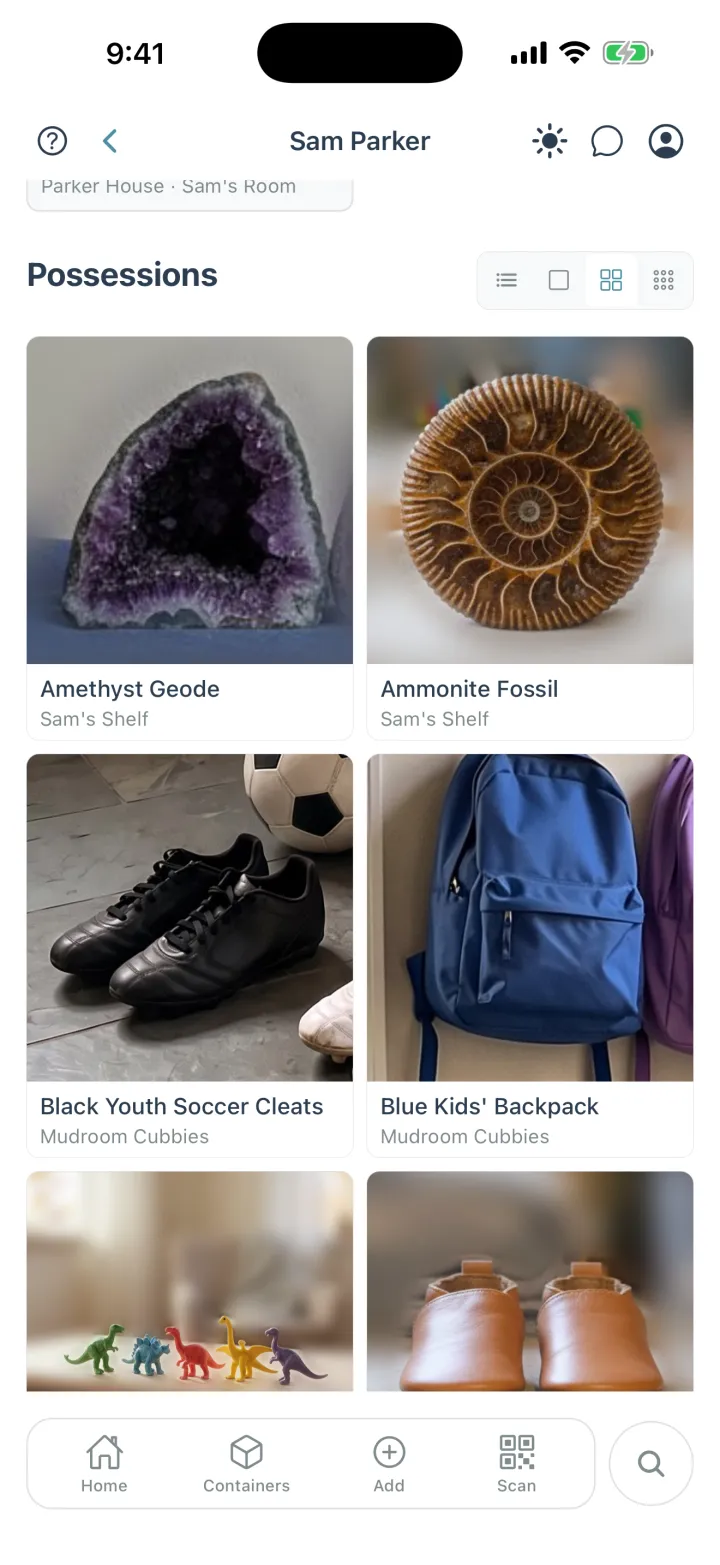
Each person gets a page with what's theirs, kids included.
Everything on the open shelves stays uncatalogued forever, and that is correct.
The habit is one song long
The room does not stay sorted because of the boxes. It stays sorted because of one rule attached to a moment that already exists.
Pick a song. It plays once, at the same point every evening, and everything goes back into its own box before it ends. Three minutes, once a day, at the only moment when the whole household is already standing in the room.
It works because you removed the deciding. Every category has one box and every box has one place, so putting something away is a movement instead of a judgment call — and movements survive a Thursday in a way judgment calls do not.
Anything with no box goes on the shelf by the door, and when that shelf is full it leaves the house.
Start by taking half of it out
If you change one part of this room, take half the toys out of it and put them in closed labeled boxes somewhere else. That single change does more for the evenings than any shelf you could buy.
The rest is the same idea in smaller shapes. One box per activity. Everything daily at the height of the person who uses it. Nothing stored where you cannot read what is inside. It takes an afternoon, it costs nothing, and the room is quieter by Tuesday. Cratify is free to try.
Know what is in the closed boxes
Photograph a rotation box once, then a scan of its QR label shows what is inside without opening it — Cratify is free to try.