How to Keep Track of Gifts You Buy Early and Actually Find Them
Buying gifts early only pays if you can find them in December. One hiding place, a photo before you hide it, one checkable list per person, and a note when it leaves.

On this page
- Forgetting where you hid it is the smaller failure
- Pick one hiding place and refuse to invent a second
- Record it before you hide it, not after
- One list per person, checked off
- Set a date to reconcile, and make it early
- Mark it as it leaves, or next year starts blind
- What does not earn a record
- Start with what is already hidden
It is the 22nd of December and you are standing in the hall closet with a flashlight. You bought your sister's present in September, because you saw it, and it was right, and it was cheaper then than it is now. You remember the purchase clearly. You remember being pleased with yourself for weeks afterward. What you cannot remember is where you put it.
Buying gifts early is the correct move and almost nobody gets rewarded for it. The savings are real and the calm is real, and both are erased the moment a well-hidden present stays hidden. The problem was never the shopping. It is that you built a small, secret, deliberately unfindable inventory over three months and kept the entire record of it in your head.
Forgetting where you hid it is the smaller failure
The one everybody expects is the location failure. You know you bought it, you cannot find it, and you lose an evening searching your own house while pretending to look for something else.
The second failure is quieter and costs more. You forget you bought it at all. In November you see the same item, think that would be perfect, and buy it a second time — and the first one surfaces in January, still in its bag, behind the winter coats.
There is a third that only appears in a house with more than one child, and it does the most damage on the actual morning. You lose track of the balance. You know roughly what you have bought and you do not know that one kid has four presents and the other has one, until they are both sitting on the floor at seven in the morning finding out at the same moment you do.
All three are one failure in different costumes. You have an inventory. You are just not keeping it anywhere.
Pick one hiding place and refuse to invent a second
This is the rule that does the most work and it costs nothing.
One place. A single shelf, a single closet, a single labeled box on the top of a wardrobe. Everything bought early goes there and nowhere else, from the first purchase in August to the last one in December.
The reason this fails for most people is not that they disagree with it. It is that the one place fills up, or a present is too large for it, or it arrives while somebody is home and has to go somewhere fast. So a second hiding place gets invented in a hurry in November, under pressure, and is never spoken of again. That improvised spot is where the lost present always is.
If you need a second location, decide on it in advance, in daylight, and write it down next to the first. A closet is a container in its own right, and if the space itself is the obstacle, the fix is upstream: a closet you can actually use holds a gift shelf without a fight. It also helps that the same closet is usually where the holiday decorations live, so you are already going in there in December.
Record it before you hide it, not after
The habit is small and it has to happen at one specific moment: between the front door and the hiding place, while the bag is still in your hand.
Photograph the present, then hide it. The photo does two jobs. It proves the purchase happened, which kills the duplicate problem outright, and it reminds you what you actually bought — because by December a September purchase has decayed into a vague memory of a color and a price.
Photographing the item and letting the details get filled in from the photo is faster than typing a description of something you are about to wrap. The same photo habits that work for a home inventory apply here, with one addition: get the box or the label in the frame, because in three months you will want the size and the model and not just the shape.
Then record where it went. Search draws on the details of each possession and the containers it lives in, so a present recorded into the hall closet answers the December question in five seconds instead of an evening. That is the entire return on a twenty-second habit.
One list per person, checked off
The balance problem needs a different shape than the location problem, and a list is what solves it.
Collections are lists that span locations and containers, and you can check items off them. One collection per recipient is the version that works: your sister, your father, each kid, the two people at work you always forget until the last week. What you have bought sits on the list. What you have not is the empty space underneath it, which is the part you cannot see when the record lives in your head.
A possession can also belong to a person, which is a second way to mark who a present is meant for without opening a list at all.
The value of this is not the record. It is that in mid-November you can look at seven lists in about a minute and see, honestly, that you have bought four presents for one child and one for the other — at a point in the year when that is still an easy afternoon to fix rather than a problem you discover on the day.
Set a date to reconcile, and make it early
Put a date in the calendar in the first week of December. Not a reminder to shop. A reminder to check.
Open the lists, walk to the hiding place, and match what is physically there against what the record says is there. Two useful failures show up in that ten minutes. Something on the list is not in the closet, which means it was moved, or it was given early, or it never actually arrived from the order you placed in October and you have not noticed for eight weeks. And something in the closet is not on any list, which means you bought it for someone and never wrote down who.
Both are fixable on the first of December. Neither is fixable on the twenty-third.
Mark it as it leaves, or next year starts blind
This is the step everybody skips, and it is the one that pays.
When a present is given, mark it as given rather than deleting the record. A possession can be archived with a reason, and the reason is the useful part: given to Dad, December 2026. What you are building is a record of what you gave to whom, which is the only real defense against the most common gift failure of all, which is buying somebody a slightly worse version of what you already bought them two years ago.
A record of arrivals with no record of departures drifts wrong in one direction. By the second year it describes a closet that does not exist.
What does not earn a record
Not all of it, or you will stop in week two.
Wrapping paper, gift bags, ribbon and the box of cards do not need a record. They need a place, and the place is the same closet.
Three categories earn one. Anything bought more than a month before it is given, because that is long enough to forget. Anything expensive enough that buying it twice would genuinely hurt. And anything for a person you buy for every year, because that is where the repeat happens.
Everything bought in the last week of December is exempt. You are not going to forget those and you are not going to have time.
Start with what is already hidden
You almost certainly have two or three presents in the house right now, bought in the last month, that are already relying entirely on your memory.
Go find them and record those three. Not the whole system, not a plan for the season — the three that already exist, photographed and written down in about a minute. The habit only has to survive until the next purchase, and by then it is just what you do when you come through the door. Cratify is free to try.
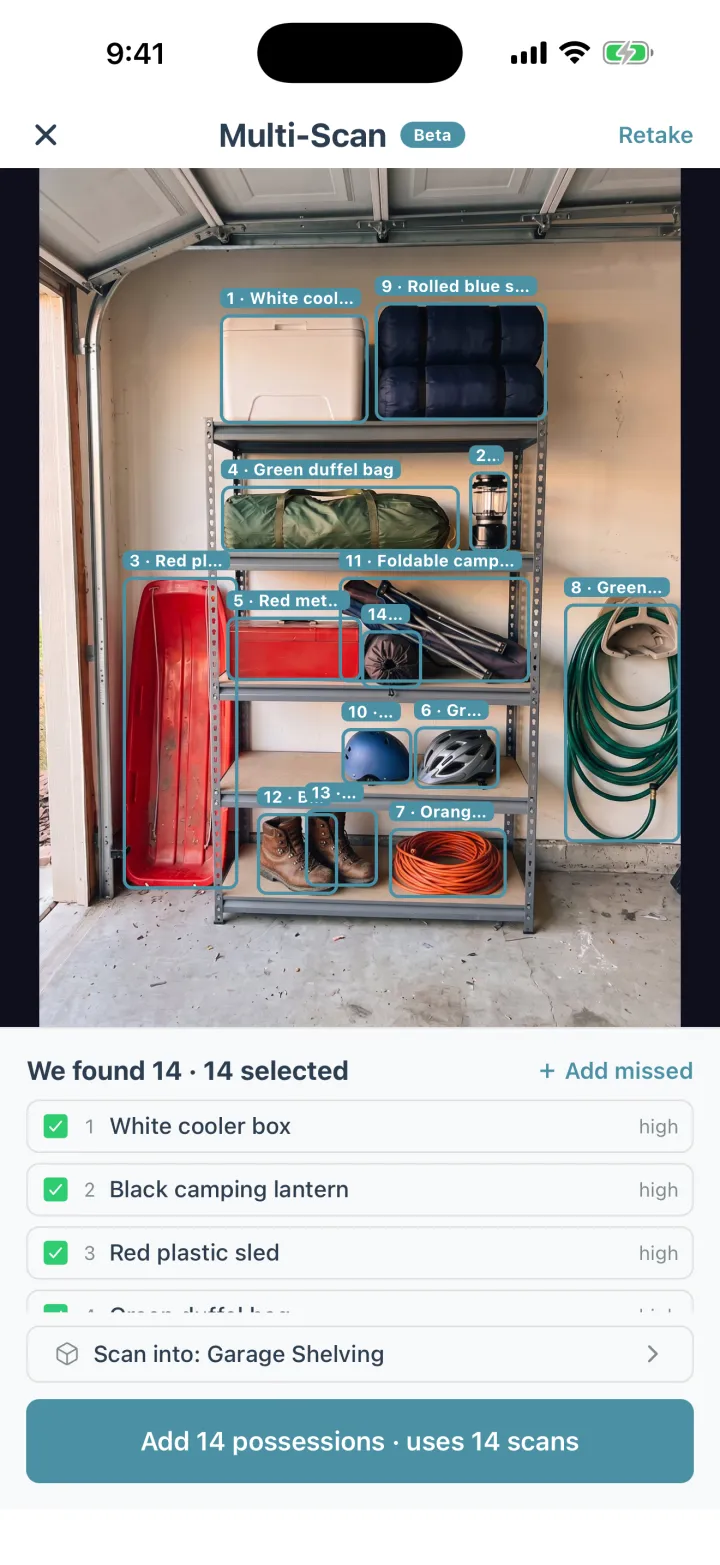
Multi-Scan names up to 15 possessions from one photo.
The present you already bought
Photograph it before you hide it, and a search in December tells you which closet. Cratify is free to try.