How to Store Holiday Decorations So You Can Find Them Next Year
Holiday decorations get packed in January by someone with no patience left, for a person unpacking in November. Pack for that person instead.

On this page
- Pack for the unpacking, not for the closing
- Sort by when it comes out, not by what it is
- Fragile items get one layer and a label that says so
- Lights are a knot you can prevent in January
- What is worth a record here, and what is not
- Label a box in a way that survives being reused
- Where the boxes live decides what survives the year
- Start with the box you dread
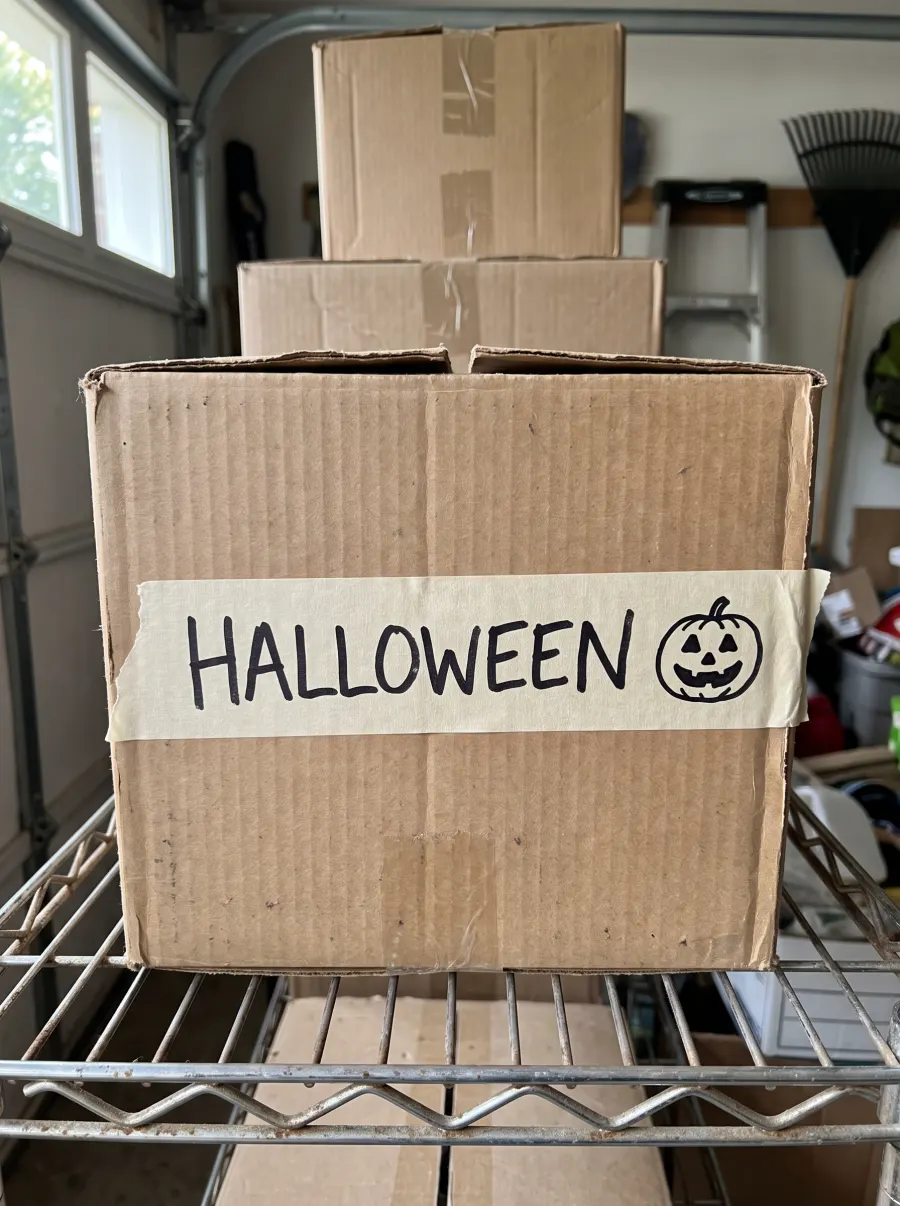
The boxes come down from the attic on a Saturday in November, four of them, every one labelled the same way in the same marker: HOLIDAY. You open the first one looking for the stockings and find tree lights. You open the second and find tissue paper, most of it wrapped around nothing. The stockings turn up in the fourth box, underneath a wreath that has been flat since 2023.
Nothing in that pile was packed carelessly. Every one of those boxes was filled in early January by someone who was tired of the whole business and wanted the room back — working fast, with no patience left. That is the real problem with holiday storage: it gets packed at the worst possible moment, for a reader eleven months away who the packer will never meet, and who turns out to be themselves.
So the useful version of this is not how to pack decorations neatly. It is how to pack in January for the person unpacking in November. Everything below is that one idea applied.
Pack for the unpacking, not for the closing
In January the goal is to make everything fit: fewer boxes, tighter, done. In November the goal is to find one specific item without opening all of them.
Those two goals fight, and the November goal should win. Packing happens once, in an afternoon. Finding happens over and over across six weeks, usually with a ladder involved. It is better to have six boxes you can tell apart than four you cannot.
That means leaving air in a box on purpose, and it means a box is allowed to be half full if the half it holds belongs together. Density is not the goal here. Density is the reason the wreath is flat.
Sort by when it comes out, not by what it is
The standard sort is by type — ornaments together, lights together, outdoor together. It survives the packing and fails the first weekend, because nobody decorates by category. Decorating happens in waves, and the waves are roughly the same in every house:
Outside first: the door, the porch, the outdoor lights.
Then the tree: the stand, the tree lights, the ornaments.
Then the rest of the house: the mantel, the table, the stockings.
Then the small pile that only comes out for the day itself.
Pack in those groups and the boxes stop being interchangeable. One box is the outside. One is the tree. One is the house. One is the day. Anyone in the household can bring down the outside box on the first cold Saturday without needing a guided tour of the attic, and everything meant for later stays closed until later.
This is the change that fixes the most holiday storage, and it costs nothing beyond doing the same sort in a different order.
Fragile items get one layer and a label that says so
Ornaments break for a boring reason: weight lands on top of them. The fix is not better padding, it is a shallower box — one layer of fragile items, padding above and below, and nothing stacked in the depth that is left.
That produces more boxes than the tight-packing instinct wants, which is the point. Write what breaks on the outside of the box, on the side rather than the top, because a stacked box hides its own lid. The person carrying the extension cords needs to know before they set them down.
Lights are a knot you can prevent in January
Wind each string onto something rigid before it goes in. A rectangle of cardboard with a notch cut at each end works as well as anything sold for the purpose, and a loose coil becomes a knot in transit no matter how neatly it was coiled.
Then test each string before packing rather than after unpacking. January you knows which string went dark halfway through the season. November you does not, and finds out on the ladder. A dead string gets replaced or discarded in January — not stored for a year and rediscovered at the worst possible moment.
Last: pack the lights with the display they belong to, rather than with each other. Tree lights in the tree box, outdoor lights in the outside box. Sorting by "lights" guarantees you carry every string to every room.
What is worth a record here, and what is not
Not every ornament. A catalogue that detailed would stop being updated in the first hour, and it would not answer any question you actually have in November.
Three parts earn a record.
What is in each box. Photograph the open box before you close it. The AI fills in the details from the photo, and a search draws on the details of each possession and the containers it lives in — so "stockings" comes back with the box it is in and the room that box is in, which is the whole question you were otherwise going to answer with a ladder.
The expensive and the irreplaceable. The pre-lit tree, the outdoor projector, anything carrying a serial number. A receipt is its own kind of possession carrying the purchase date, which is what you want in year three when the pre-lit tree lights half of itself.
The list of what should exist. A collection is a list you build yourself that spans locations and containers, and you check items off as you take them out — so the outdoor set becomes a manifest rather than a memory. That answers the real November question, which is never "where are the extension cords" but "did we own extension cords, or did we borrow them."
Categories and tags carry the rest — which holiday, which room, what came from whom — so a box is searchable without any single ornament needing a paragraph written about it.
Label a box in a way that survives being reused
Holiday boxes get reused every year and their contents shift every year. A marker on tape describes the season it was written in, and by the third year the label and the contents have quietly parted ways.
A QR label handles the reuse problem, because the code points at a record you edit rather than at words you wrote once. Every box also carries a permanent three-word name that survives a rename, so the box that was the ornaments and is now the outside set is still the same box in the record rather than a new mystery.
Whatever you label with, put it on the side. Stacked boxes hide their tops, and a label you have to unstack the pile to read is a label nobody reads.
Where the boxes live decides what survives the year
The box is not the risk. The room is.
Attic heat softens candles and lets adhesive give up, so anything wax, anything photographic, and anything held together with glue does badly up there. A basement does the opposite kind of damage, because damp reaches cardboard and paper first. A garage manages both in the same week.
Sort the storage the way you would when you store summer gear for winter: the sturdy, sealed, replaceable items go to the harshest room, and the fragile or irreplaceable ones stay inside the house in a closet. If the attic is where yours live, its rules matter more than the boxes do; if it is the basement, the damp is the whole problem.
Start with the box you dread
There is one box in every house that is simply loose: a garland, a tangle, three ornaments with no hook, and a bag of batteries. It is the box that made last November take an afternoon.
Do that one first, in January, while you are already annoyed and already have the tape out. Sort it into the waves with everything else and it stops existing.
The rest is one habit: pack for the person who opens the box, not for the one who closes it. That person is you, eleven months out, on a ladder, in the cold, and they will be grateful. Cratify is free to try.
The boxes you close in January
Photograph a box before you tape it and a search in November tells you which one the stockings are in — Cratify is free to try.