Where to Donate Household Items, Sorted by What You Have
The donate bag has been in the trunk since June. Here is where household items actually go, group by group, and how to get the whole pile out of the house in one trip.

On this page
The bag has been in the trunk since June. It started in the hall closet, moved to the floor by the front door, and graduated to the car on the theory that you would drop it off on the way somewhere. It has been to the grocery store with you eleven times. Next to it is a lamp you meant to give away in spring, and in the garage there is a box marked donate in your own handwriting that you no longer entirely trust.
Deciding to let something go is the hard part of decluttering, and almost every guide stops there. The donate pile is where the decision goes to wait. Here is how to work out where donated household items actually go, category by category, and how to get them out of the house in one trip instead of eleven.
Why the donate pile stalls
A donate pile stalls for a simple reason: it has no destination. A bag of mixed possessions does not belong anywhere in particular. Some of it a thrift store will take, some of it they will not, and part of you suspects that the lamp might be worth something. So the bag waits for a free afternoon that never quite arrives.
The fix is to stop treating it as one pile. Sort the pile by where each part is going, and every part gets a destination with an address and opening hours.
Pull out the one or two possessions you think might be worth selling, like the lamp, and give them a deadline of their own. If they are not listed for sale by Friday, they rejoin the donate pile. A maybe with no end date is how a bag ends up riding around in the trunk all summer.
Sort by destination, not by room
Before anything goes in the car, empty the bag and the box onto the floor and split them into groups by where they are headed. Most donate piles fall into five or six groups.
Clothes, shoes and linens
Kitchen and household goods
Books, toys and games
Furniture and large items
Electronics, cables and batteries
Items nobody will take, which go to recycling or the trash
It takes about twenty minutes, and it turns one errand you keep postponing into a few small ones you can actually finish.
Where each group usually goes
Rules vary by town and by organization, so treat this as a starting map and check the specific place before you load the car.
Clothes, shoes and linens
Charity thrift stores take most clean, wearable clothing. Shelters and community closets often want specific items, such as coats in fall and new socks all year, so a quick call can send your bag where it is needed most. Worn towels and old bedding that a store would not sell are often welcome at animal shelters and rescues.
Kitchen and household goods
Thrift stores take most working kitchen equipment, dishes and small appliances. Pack glass and ceramics in a box with newspaper, not loose in a bag. A full set of dishes or a stocked kitchen box can be especially useful to a refugee resettlement group or a program helping people move into their first home, if one operates near you.
Books, toys and games
Libraries often accept books for their sale shelves. Schools, daycares and children's waiting rooms sometimes want toys and games in good condition. Check that puzzles and games have their pieces before you give them away; a puzzle with three pieces missing is a puzzle somebody else throws out.
Furniture and large items
Many charities offer free pickup for furniture in good condition, but pickup slots can be booked out for a week or two, so schedule it before you start clearing the room. Building-material reuse stores often take doors, cabinets, light fixtures and leftover tile. Many donation centers turn away mattresses, child car seats, cribs and anything that has been recalled, so ask first.
Electronics, cables and batteries
Some thrift stores accept working electronics and some do not. Many towns run electronics recycling drop-offs or collection days, and some retailers take old devices and batteries for recycling. Wipe and reset phones, tablets and computers before they leave, and keep loose batteries out of the donation bag entirely.
Book the trip before you start
The most reliable way to empty a donate pile is to give it a deadline with a time on it. Book the furniture pickup, put the thrift store drop-off in the calendar as an appointment, and do the sorting the evening before. A booked slot gets done. An intention to stop by sometime this week becomes a bag in the trunk.
If you are planning a sale first, decide where the leftovers go before the sale starts; our guide to organizing a garage sale and what to do with the leftovers covers that half of the job.
Ask for a receipt and keep it
Many charities will give you a receipt if you ask. Ask, write the date on it, and keep it with your other records rather than in the glove box. A receipt is the only proof later of what you gave and when, and it is much easier to collect at the drop-off than to reconstruct a year from now.
Keep a short list of what left the house
A month after a big clear-out, someone will ask where the good baking dish went, or whether the folding table was donated or lent to a neighbor. Without a record, the answer is a guess. A short list fixes that: what it was, where it went, and the date.
Some households keep this on paper taped inside a cupboard door. Others keep it in the same place as the rest of their home inventory, which has the advantage that the inventory stays accurate. A list of possessions you no longer own is one of the main ways an inventory goes out of date.
Where an app helps
In Cratify, a collection is a list that spans locations and containers, and you can check each entry off as you go. Make a collection called donate while you sort, add each possession as it goes into the pile, and check it off when it leaves. Whatever is still unchecked at the end of the day is what is still in the car.
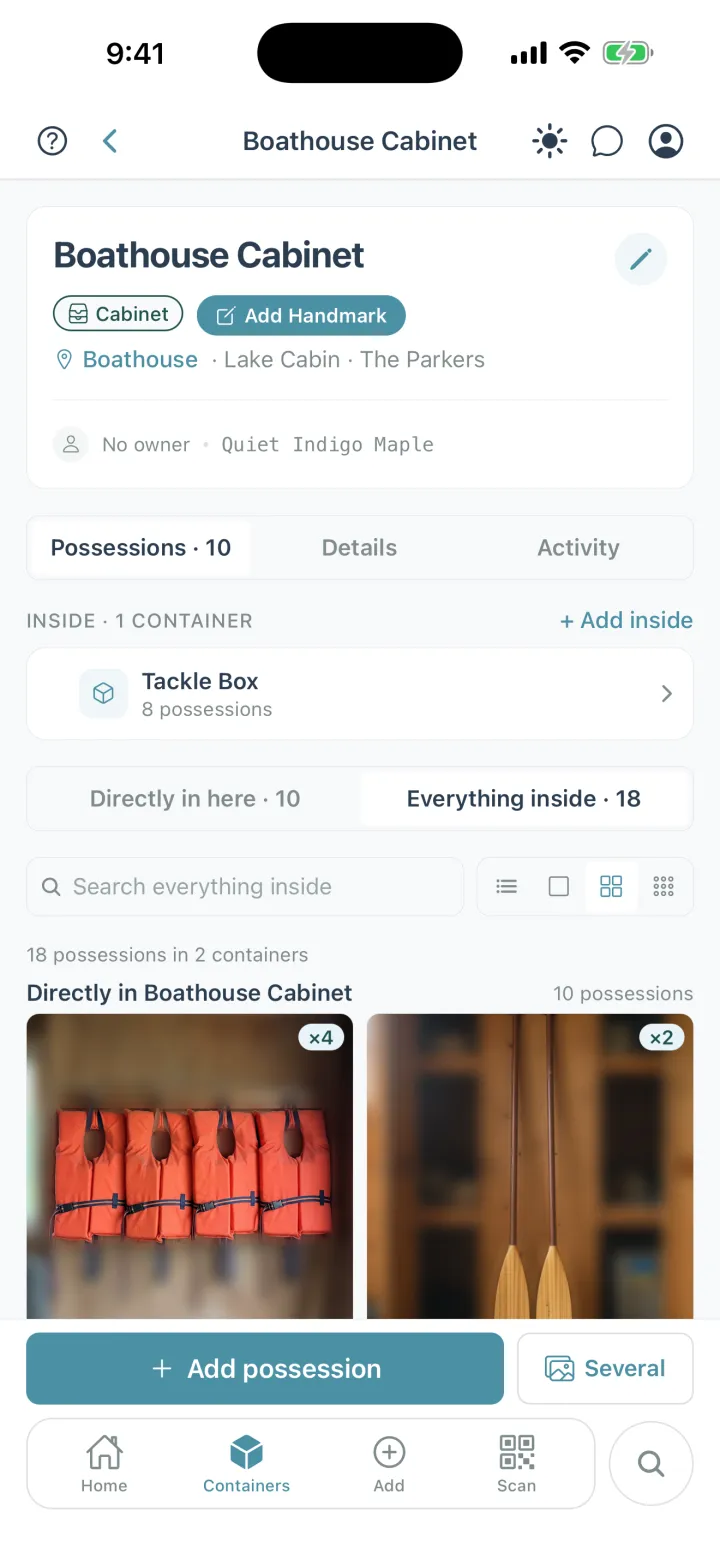
Containers inside containers, with everything inside listed.
When a possession is gone for good, you can archive it with a reason, such as donated to the library, rather than deleting it. The record stays, so the question of where something went has an answer. A possession you are not sure about yet can be marked temporarily removed with a note, which keeps it from quietly disappearing while you decide.
A collection can also be exported as a PDF or printed, which gives you a list of what you gave away to keep beside the receipts.
What is left after the last trip
Some possessions will not find a taker. Broken small appliances, stained textiles and single shoes usually belong in recycling or the trash, and it is fine to let them go there. A donation center that receives items it cannot sell often has to pay to throw them away, so giving it only what someone can use is the kinder choice.
Once the trunk is empty, the space you cleared at home stays clear. If you are working through the whole house, where to start when the whole house needs organizing has a plan for the next room. And if a list of what left and where it went would help, Cratify is free to try.
Know what left and where it went
Make a donate list, check possessions off as they leave, and keep the record. Cratify is free to try.