How to Organize a Home Gym When Workouts Move Indoors
Gather your workout equipment into one corner, keep heavy weights low and in pairs, give bands and small accessories one Box, and keep a list so you stop rebuying.

On this page
It's the second week of November and it's dark by five, so the evening run has moved indoors. The yoga mat is rolled up behind the bedroom door. One 15-pound dumbbell is under the bed and the other is somewhere in the garage. The resistance bands are in a coat pocket, the foam roller is in the guest room, and the jump rope turns up a week later in the car. Nothing is missing, exactly. It's just in six places, and the ten minutes you had to work out went on finding it.
A home gym doesn't need a spare room or a rack system. It needs every piece of equipment you actually use in one place, stored so the heavy pieces are safe and the small pieces don't scatter, and a short list of what you own so you stop buying a third set of bands. Here's how to set that up in an afternoon.
Start with what you actually use
Before you buy a single shelf or hook, gather every piece of workout equipment in the house into one spot on the floor. Check the garage, the basement, under the beds, the hall closet and the car. Then sort it into four groups:
Weights: dumbbells, kettlebells, a barbell and plates, ankle weights, a weighted vest.
Mats, bands and small accessories: yoga mats, resistance bands and loops, a jump rope, sliders, a yoga block, lifting gloves, a timer.
Machines and large pieces: a treadmill, an exercise bike, a rower, a bench, a pull-up bar.
Recovery and care: foam rollers, a massage ball, towels, a spray bottle and cloths for wiping down.
Now be honest about the last month. Put anything you haven't touched since summer in a separate pile. Some of it will come back into rotation over the winter, and some of it is the ab wheel you bought in January and used twice. Decide which before it takes up a shelf.
This is also where the duplicates show up. Two jump ropes. Three loop bands in nearly the same resistance. A second yoga mat that's thinner than the first. Keep the one you reach for, and set the rest aside to donate or give to someone who'll use it.
Pick one spot and check the floor
The best spot is the one you'll actually walk into on a cold, dark evening. For most people that's a corner of the basement, a section of the garage, a spare room or the end of a bedroom. Four checks decide whether a spot works:
Floor: heavy weights belong on a solid floor, ideally with a rubber mat under them to protect it. Dropping a kettlebell on bare tile or hardwood is how you learn this the hard way.
Space: you need room to move, not just room to store. Lay the mat down and swing your arms before you commit to the corner.
Temperature: an unheated garage gets cold enough in winter that metal handles are unpleasant to grip and you'll find a reason not to go out there. If the garage is your only option, keep the mat and bands indoors and carry them out.
Power: treadmills and bikes with screens need an outlet nearby. Read the manual for what it says about extension cords before you plug one in.
If the garage is also where the car lives, the guide to organizing a garage so you can park in it covers how to carve out one zone without losing the parking space. A basement corner works the same way, and how to organize a basement covers keeping equipment up off a floor that might get damp.
Give each group one home
Weights
Heavy goes low. Keep dumbbells and kettlebells on the floor or on the bottom shelf of a sturdy unit, never above waist height, where a slip means a dropped weight on a foot or a cracked shelf. Store dumbbells in pairs, side by side, lightest to heaviest from left to right, so you can see at a glance which pair is missing. Plates go on a stand or flat in a stack, never leaned against a wall where a child can pull them over.
Mats, bands and small accessories
Roll mats and stand them upright in a corner, or hang them from a wall hook. Small accessories are the ones that scatter, so give them one lidded Box or one Drawer: bands, loops, the jump rope, gloves, sliders and the timer all live there and go back there. Hang long resistance bands from a hook so they don't tangle.
Machines and large pieces
Leave enough clearance behind a treadmill and around a rower for the manual's safety distance. Many treadmills and benches fold, and a folded treadmill against the wall gives you back the floor for mat work. Keep the manual, the safety key and the receipt together, since you'll want all three the day it makes a noise.
Recovery and care
Foam rollers and the massage ball sit next to the mat. Keep a small stack of towels and the wipe-down spray on a shelf at hand height, so cleaning the bench is easier than skipping it.
Keep a list of what you have
Duplicates happen because you buy equipment online, away from the corner where it lives. A short list you can read from your phone fixes that. Write down:
Weights by pair and size: two 10-pound dumbbells, two 15s, one 25-pound kettlebell.
Bands by color and resistance, since the colors don't mean the same resistance across sets.
Machines with the model number, the purchase date and where the receipt is. The guide to tracking appliance warranties and receipts covers how to keep those together.
Where each piece lives: the floor by the wall, the bottom shelf, the accessories Box, the hook.
A ten-minute reset, once a week
Ten minutes on Sunday keeps the corner usable for the week ahead.
Put every weight back in its pair, in order.
Coil the bands and the jump rope and drop them back in the accessories Box.
Wipe down the bench, the handles and the mat.
Check the floor mat under the weights for wear or anything that has slid out of place.
Note anything that broke or ran out, like a snapped band or the last of the wipes.
Where an app helps
If you'd rather keep the list somewhere other than a sticky note on the wall, here's how it works in Cratify. The basement corner or the spare room is a Room, the shelving unit is a Shelf container, and the accessories Box sits on that Shelf. Containers nest, so the Shelf's view lists the possessions on it and in every container nested inside it, with totals.
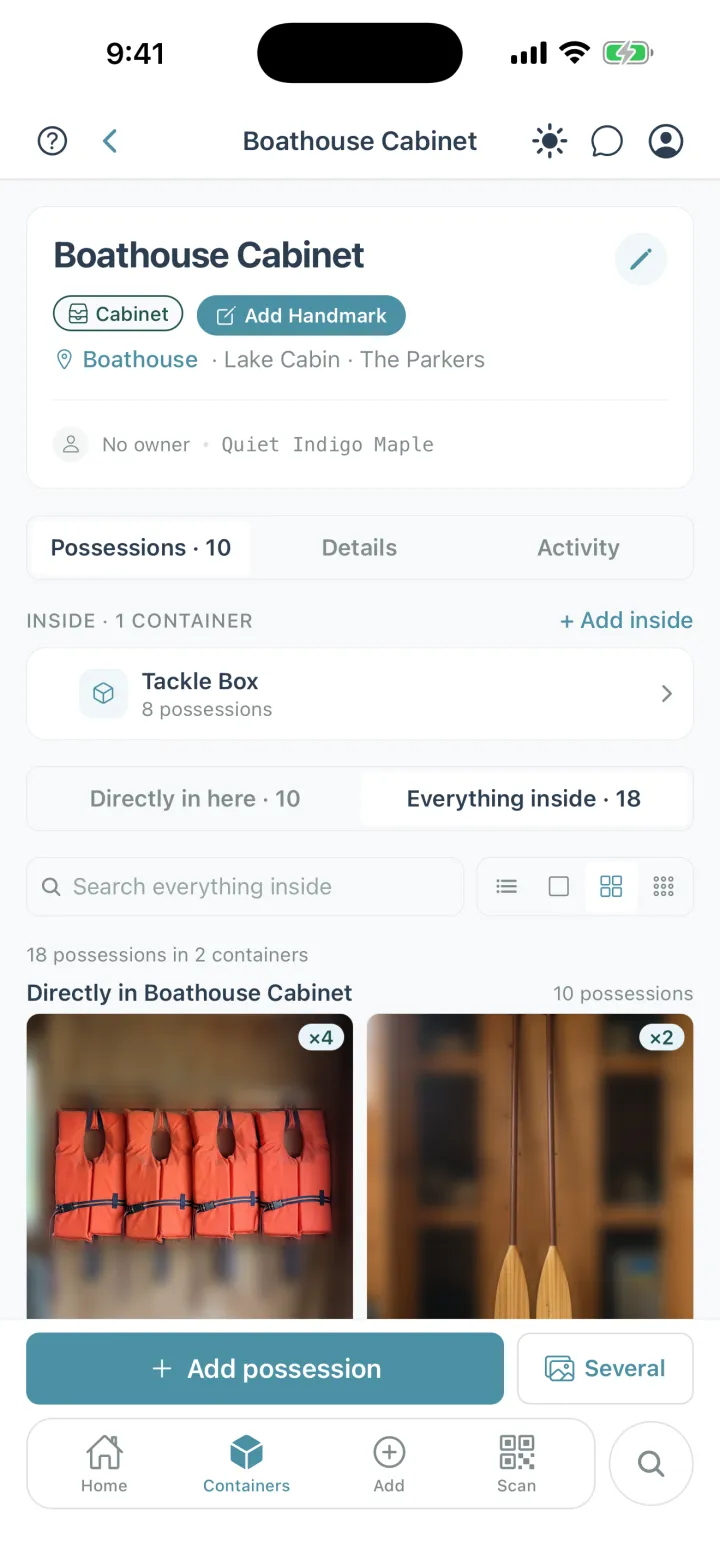
Containers inside containers, with everything inside listed.
Each piece of equipment is an Item. Photograph it, and AI identification fills in a name and category, with a confidence percentage on screen so you can correct either before you save. A pair of 15-pound dumbbells can be one entry with a quantity of two instead of two separate entries. The treadmill's receipt can be a Receipt possession carrying the purchase date and amount, and its manual a Document. Search draws on each possession's details and the container it lives in, so searching for the jump rope tells you which Box it's in.
If more than one person uses the equipment, items and boxes can belong to a person, so it's clear whose bands are whose. And a Collection is a list that spans containers, with a check-off on each entry. Make one for a travel workout bag, add the bands, the jump rope and the sliders, and check each one off as you pack.
The short version
Gather every piece of workout equipment into one spot and sort it into weights, small accessories, machines and recovery gear. Pick a corner with a solid floor and room to move, and keep heavy weights low and in pairs. Give the small accessories one Box or Drawer, keep each machine's manual and receipt together, and write down what you own, by size and by where it lives. Ten minutes a week keeps it that way. Cratify is free to try.
Know which Box the jump rope is in
Photograph your equipment, keep pairs as one entry with a quantity, and search before you buy. Cratify is free to try.