How to Organize a Home Office So You Can Find the Cable
The HDMI cable is in one of four drawers and you have already checked two. A home office fails by layering, not by filling — here is the afternoon pass that separates it out.

On this page
- A home office is four rooms wearing one hat
- Clear the surface before you open a single drawer
- One home per category, and only one
- Cables get their own container, and it gets labeled
- The paper, and the part of it that matters
- What is worth recording, and what is not
- The five-minute reset
- The room is only as good as its worst drawer
The HDMI cable is in one of four drawers, and you have already checked two of them.
It is a Tuesday, the call starts in six minutes, and somewhere in this room is the adapter that makes the monitor work. You know you own it. You have owned it for two years. You bought a second one in March for exactly this reason, and right now you cannot find either.
A home office goes wrong differently from every other room in the house. A garage gets full. A closet gets crowded. A home office gets layered — school forms on top of tax paperwork on top of a drawer of cables from devices that left the house in 2021. Almost nothing in it is obviously junk, which is why almost nothing ever leaves.
Here is a pass that sorts it in an afternoon, and the one habit that stops the afternoon becoming an annual event.
A home office is four rooms wearing one hat
Before you move anything, notice what this room is actually being asked to do. Most home offices are holding down four jobs at once:
A workspace — the surface you work on and the equipment it needs.
A filing cabinet — the household's paperwork, which has to live somewhere.
A supply closet — pens, paper, printer ink, packing tape, batteries.
An electronics graveyard — the cables, chargers, adapters and retired devices nobody has decided about.
They fail as a group. The tape is under the tax return, the tax return is behind the router box, and the desk is unusable because it is holding all three. Sorting this room means separating those four jobs and giving each one a container of its own — which is a different job from tidying, and a much more durable one.
Clear the surface before you open a single drawer
Start with the desk itself, and be strict: the surface holds only what you use every working day. Everything else comes off, into a pile on the floor, and gets dealt with in the next pass.
This feels backwards — you are making a mess to fix a mess — but an empty surface is the only honest measurement of how much of this room is actually in use. Most people find it is four items and a lamp.
The same argument that applies in a closet applies here: do not buy containers yet. A drawer organizer bought before you know what is going in the drawer is a way of formalizing the current arrangement, and the current arrangement is the problem.
One home per category, and only one
Now the pile on the floor. Sort it into the four jobs above, then give each one a fixed home — a drawer, a shelf, a cabinet, a box on the shelf. What matters is not which container you pick. It is that there is exactly one.
The rule sounds obvious and gets broken constantly. Batteries live in the desk drawer and in the kitchen. Packing tape lives in the office and in the garage. Every category with two homes gets searched in the wrong one first, forever, and gets re-bought roughly once a year, because both homes look empty from the doorway.
The order that works
Daily equipment — laptop, monitor, headphones, the charger you actually use. Top drawer, or on the surface.
Supplies you reach for weekly — pens, notepads, tape, stamps. One drawer, divided only if it needs it.
Paper that has to be kept. Its own drawer or file box, and it gets its own section below.
Cables and spares. One container, and ideally not a drawer. See below.
Sentimental and undecided. One box, labeled, on a shelf. When it is full, it is full.
That fifth container is doing more work than it looks like. Every room like this holds ten or fifteen items nobody can decide about — the camera that still works, the certificate, the drive that might have photographs on it. Without a home of their own they end up in the good drawers, and the good drawers are the ones you need on a Tuesday.
Cables get their own container, and it gets labeled
The cable drawer is the worst-performing square foot in most homes, and it fails for a specific reason: cables are identical from above. A drawer of coiled cables is a drawer with no information in it. You have to lift each one out to learn anything, so you check the first three and give up.
Two changes fix most of it:
- Stand them up rather than laying them flat. Coiled, secured with a tie, and stored vertically in a box, cables read like files — you see all of them at once instead of the top layer.
- Label the connector end, not the middle. A strip of tape reading "monitor" on the plug is legible while the cable is still in the box.
Then be ruthless, once: any cable you cannot identify, and any charger whose device left the house, goes into a bag for electronics recycling. An unidentifiable cable is not free to keep — it costs you the four minutes you spend on it every time you search the box.
A container of cables is also the clearest case in the house for a label that says what is inside without anything being opened. Even a strip of tape listing the four items in the box beats opening it, and writing it takes half a minute.
The paper, and the part of it that matters
Paperwork is where a home office quietly turns into a filing problem. The full method has its own guide and is worth reading before you buy a single folder. The short version, for the purposes of this room:
Sort by what happens if you lose it, not by what it is about.
Anything irreplaceable — passports, deeds, titles, certificates — goes in one place you can reach in a hurry.
Anything kept only in case it is needed — statements, manuals, old receipts — can be photographed and the paper recycled. That is where most of the volume is.
The receipts and the warranties are the ones that repay the effort. A home office is where a household's electronics live, and electronics are the category most likely to fail inside a warranty period you cannot prove. Keeping the receipt attached to the item, rather than in a shoebox with three years of grocery slips, is the difference between a claim and a shrug.
What is worth recording, and what is not
Do not catalog the pens.
The half of this room worth a record is the equipment and the paperwork: the monitor and what it cost, the spare keyboard, the printer and which ink it takes, the router the internet company will eventually want back, the drive with the old photographs on it. That is maybe twenty items, and every one of them is expensive, replaceable only with effort, or something you will one day be asked to produce a receipt for.
That is the half Cratify is built for. Photograph a shelf or a drawer and the AI fills in each item's details for you. Give the drawer or the cabinet a QR label and a scan shows what is in it without anything being opened — and QR label printing is on every tier, including the free Basic one. Receipts and documents are their own possession types, carrying the amount and the purchase date, so a warranty and the item it belongs to stay attached to each other. And because search reads an item's details along with the container it lives in, "where is the HDMI cable" becomes a question with an answer.
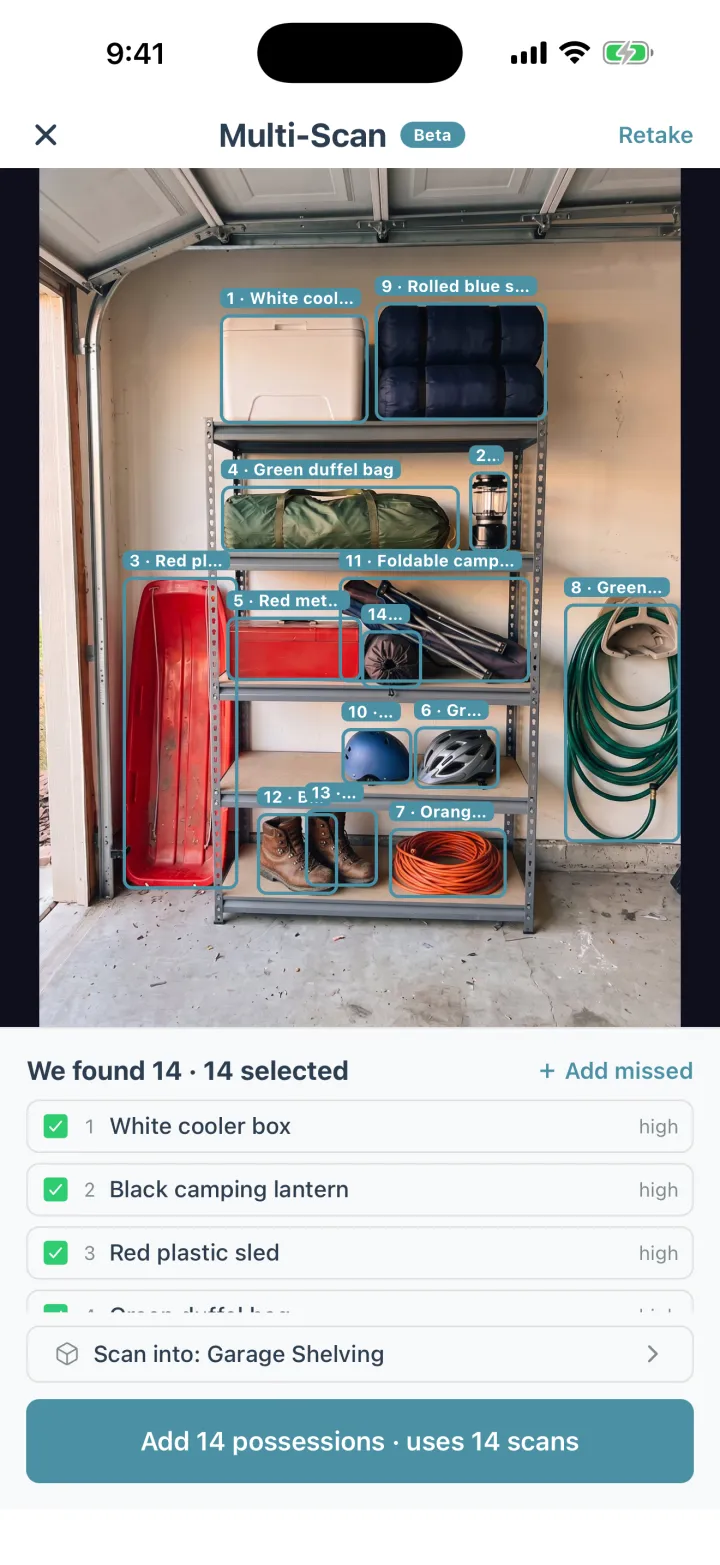
Multi-Scan names up to 15 possessions from one photo.
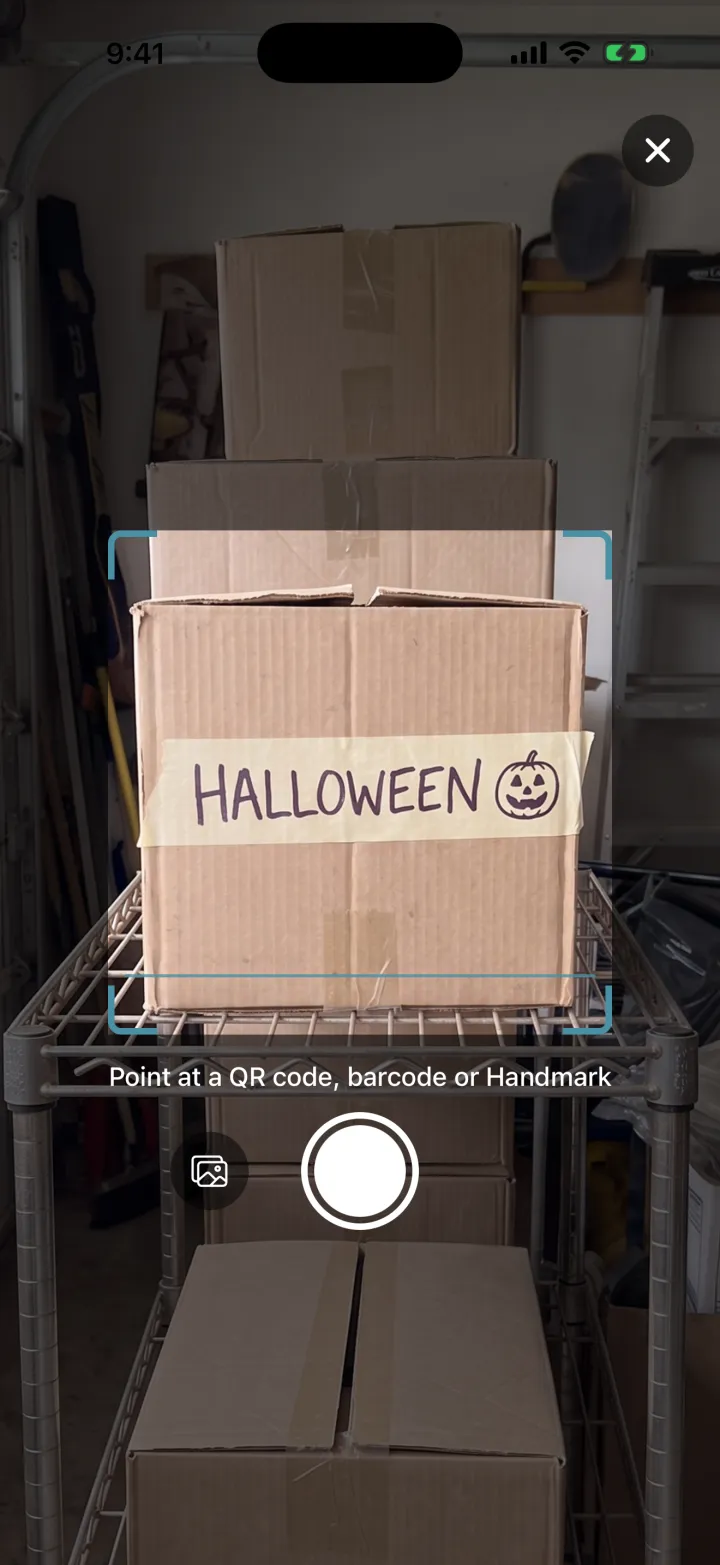
Scan reads QR labels, barcodes and what you already wrote on the box.
The pens, the sticky notes and the printer paper stay unrecorded forever, and that is correct. A record you have to maintain for consumables is a chore, and chores like that fail inside a month.
The five-minute reset
An office does not stay sorted because of the system. It stays sorted because of one recurring five minutes.
At the end of the working week: everything on the surface goes back to its one home, the paper that arrived this week gets filed or recycled, and anything with no home either gets one or gets let go. That is the whole routine. Five minutes on a Friday holds a room that took an afternoon to fix.
It works for the same reason the one-home rule works. Every item in the room already has a decided destination, so putting it away is a movement rather than a decision — and movements survive a Friday afternoon in a way decisions do not.
The room is only as good as its worst drawer
If you fix one part of this room, fix the cables. The cable box is where the whole room's failure is concentrated: a container with no information in it, holding items you cannot tell apart, searched under time pressure. Fix that one and the room feels different the same afternoon.
The rest is the same idea in different shapes. One home per category. Nothing stored where you cannot see what it is. A surface that holds only today's work. None of it needs a system anyone has to maintain, and all of it survives a Tuesday six minutes before a call. Cratify is free to try.
Find the cable without opening every drawer
Photograph the drawer once and a QR label tells you what is in it — Cratify is free to try.