How to Organize a Laundry Room So You Stop Re-Buying Detergent
You are holding a fourth bottle of stain remover, and there are three more behind the detergent. A laundry room is a corridor with shelves — here is the hour that fixes it.

On this page
- The room is a corridor, and that is the whole problem
- Empty it, including the shelf you cannot see
- Sort by how often it leaves the room
- The cabinet above the machines needs a front row and nothing behind it
- Most of what is in here is not laundry
- The two most expensive items in the room
- What is worth a record, and what is not
- The habit is one load long
- Start with the cabinet you cannot see into
You are standing in front of the cabinet above the dryer, holding a fourth bottle of stain remover.
It was on sale. You were fairly sure you were out. You were not — there are three more behind the detergent, pushed to the back of a shelf that sits above eye level, where nothing has been visible since the day it was put away. This is the fifth or sixth time this has happened, always with a different product, always for the same reason.
A laundry room fails in a way no other room in the house does. A garage gets full and looks full. A closet gets crowded and you can see it. A laundry room is a corridor with shelves — you pass through it several times a week carrying something in both hands, and you have never once stood in the middle of it and looked up. The room is small enough that it never feels like a project, and awkward enough that nothing in it is where you can see it.
Here is an hour that fixes it, and the one habit that keeps it fixed.
The room is a corridor, and that is the whole problem
Every other room you organize has a moment where you stand in the doorway and take it in. The laundry room does not get one. You come in holding a hamper, you put the load in, you leave. Your hands are full in both directions and your eyes are on the machine.
Three consequences follow from that, and they explain most of what is wrong with the room:
Nothing gets returned properly, because returning something properly needs a free hand.
The high shelf becomes a void. Anything above eye level in a room you never look up in is functionally not there.
The room absorbs overflow from the rest of the house. It has a door, it has shelves, and nobody entertains in it — so the lightbulbs, the paint, the school supplies bought in bulk and the extension cords all end up here.
Fixing the room means fixing those three, in that order. Buying a drawer organizer fixes none of them.
Empty it, including the shelf you cannot see
Take everything out. All of it, onto the floor or the top of the machines — including the high shelf, which needs a step stool and is the entire reason the room got this way.
This takes about fifteen minutes and it is the only part that cannot be skipped. You are not tidying; you are running the one measurement that matters, which is what is actually in here. Almost everyone finds the same two results: several duplicates of a consumable, and a category of items that has no business being in a laundry room at all.
Write the duplicates down as you find them. Four stain removers, two of the same dryer sheets, an unopened box of detergent behind an open one. That list is what the room has been costing you, and it is more persuasive than any argument for keeping it sorted.
Sort by how often it leaves the room
The instinct is to sort by category — cleaning here, tools there. It is the wrong axis for a room this small. Sort instead by how often something leaves the room, because that is what decides where it should live.
Every load. Detergent, whatever you use on stains, dryer sheets. At the front, at chest height, reachable with one hand full.
Every few weeks. Machine cleaner, the mesh bags, the lint brush, spare buttons. Middle shelf, or a drawer.
Twice a year. The high shelf — seasonal, spare, and the overflow you decided to keep.
Never, and it should not be here. A box by the door, and it leaves today.
The one-hand test is the rule that matters in this room. If you cannot reach it while holding a hamper, you will put it down somewhere else instead, and somewhere else is how the top of the dryer became a shelf.
The cabinet above the machines needs a front row and nothing behind it
The cabinet over the washer and dryer is the worst-performing square foot in most homes. It is above eye level, it is deep, and it is where the duplicates were hiding — not because anyone hid them, but because a deep shelf you cannot see into holds one row of information and stores three.
Two changes fix most of it:
- One row deep, always. Whatever does not fit in a single visible row goes into a labeled box on the high shelf as backup, never behind the front row where it turns invisible.
- Label the shelf edge, not the bottle. A strip of tape on the shelf naming what belongs there is legible from the floor. A label on a bottle is legible only once you are already holding it.
A closed box you can read beats an open shelf you cannot see into, every time — which is the same argument that fixes a basement, and it fixes this room for the same reason.
Most of what is in here is not laundry
The pile on the floor will have a category in it that surprised you. Lightbulbs. Batteries. The camping stove. Two bags of clothes the kids grew out of in March.
None of it has to leave the house. Some of it genuinely has nowhere better to go, and a laundry room with a high shelf is a reasonable home for it. What it has to do is get decided about and put in a labeled box, rather than living loose among the detergent.
Two categories are worth handling properly while you are already in here:
- The off-season. If the high shelf is holding seasonal items, that is a real job for it, and it works far better as a deliberate swap than as accumulation.
- Outgrown clothing. It arrives in this room by the nature of laundry and then stalls there. Sorting it by size and season is a twenty-minute job, and it stops the bags multiplying.
The two most expensive items in the room
Everything above is about consumables. The washer and the dryer are a different problem, and they are the reason this room deserves a record at all.
They are among the most expensive appliances in the house, and they are the two most likely to fail inside a warranty period. When one does, the questions are always the same: when did we buy it, what did it cost, is it still covered, and where is the receipt. Keeping the receipt attached to the appliance itself, rather than in a drawer holding three years of paper, is the difference between a covered repair and paying for one.
Photograph the model and serial plate while you are standing there. It is on the back panel or inside the door, it takes half a minute, and it is the first detail every service call asks for.
What is worth a record, and what is not
Do not catalog the detergent.
The half of this room worth recording is short: the washer, the dryer, their receipts and manuals, the iron or the steamer, and whatever the high shelf is holding on behalf of the rest of the house. That is a handful of items and a box or two, and every one of them is either expensive or invisible.
That is the half Cratify is built for. Photograph a shelf and the AI fills in each item's details for you. A washer or a dryer can be modeled as what it actually is — Appliance is one of the container types, alongside Cabinet, Shelf and Drawer — and an appliance container can link to a possession carrying its value and its receipt, so the machine and the paperwork that covers it stay attached to each other. Receipts and documents are their own possession types, carrying the amount and the purchase date. And a QR label on the backup box means a scan shows what is inside without the step stool — QR label printing is on every tier, including the free Basic one.
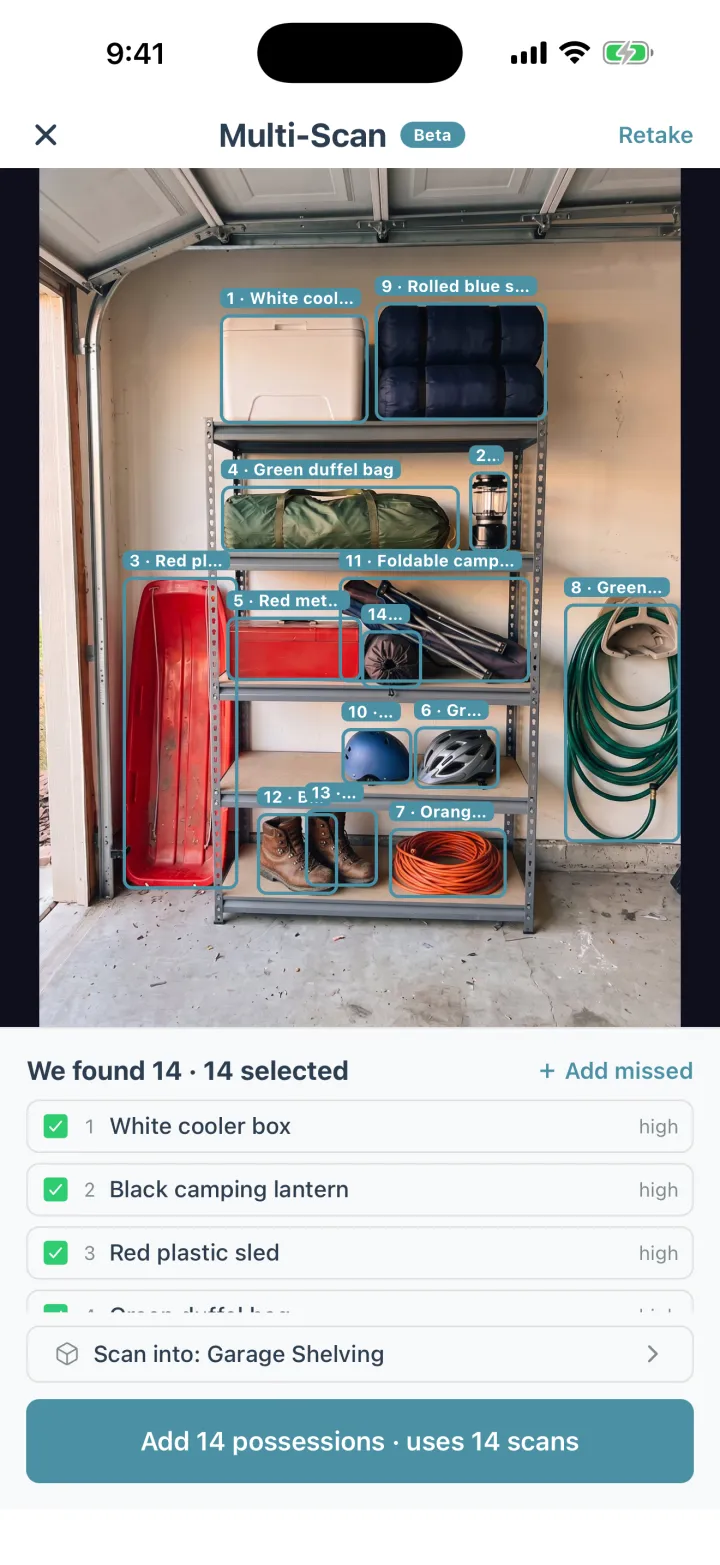
Multi-Scan names up to 15 possessions from one photo.
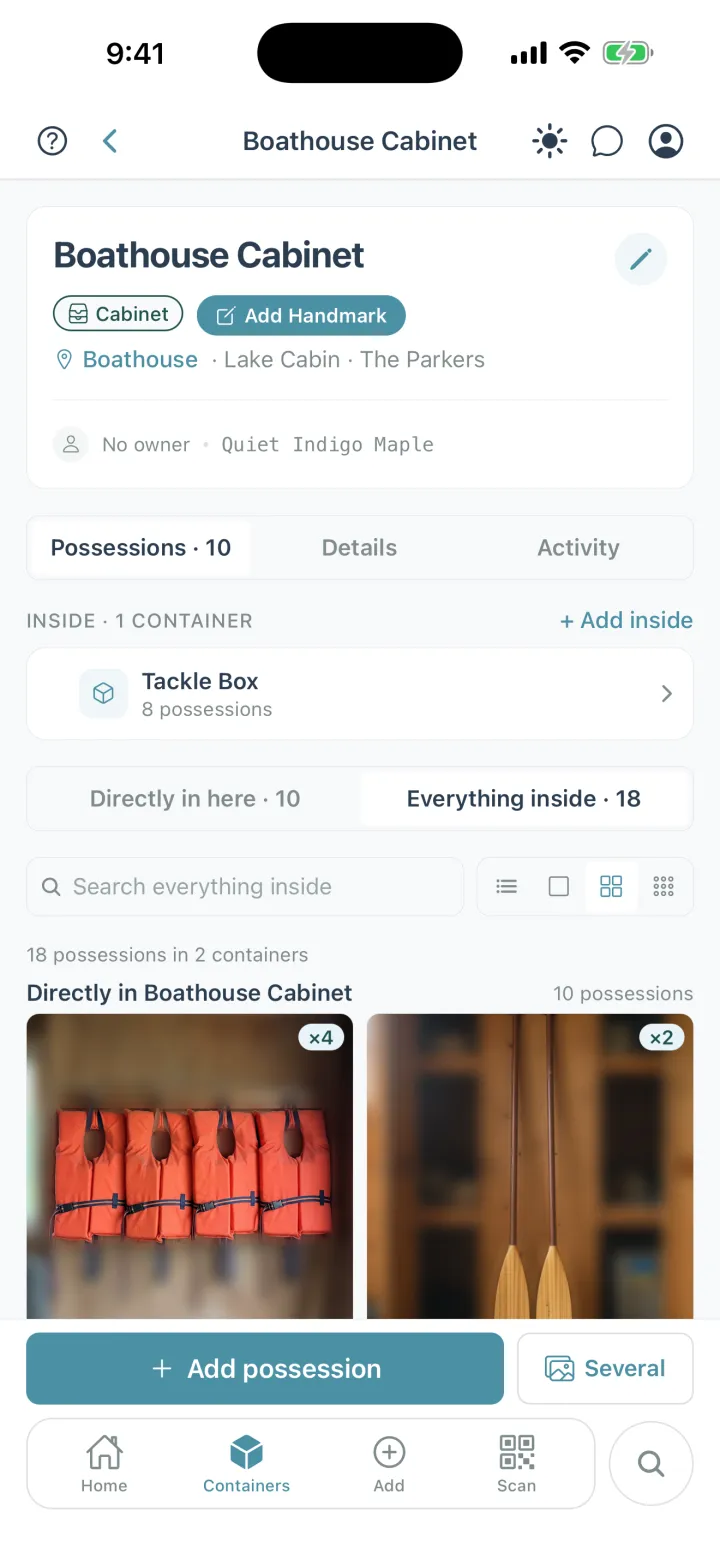
Containers inside containers, with everything inside listed.
The detergent stays unrecorded forever, and that is correct. A record you have to update every time you use half a bottle is a chore, and chores like that fail inside a month.
The habit is one load long
The room does not stay sorted because of the shelves. It stays sorted because of one rule attached to something you already do.
While the washer is filling, put back whatever is out. That is the entire routine — half a minute, several times a week, at a moment you are already standing there with nothing else to do. Everything in the room has one decided place now, so putting it away is a movement rather than a decision, and movements survive a Tuesday in a way decisions do not.
Anything out that has no place goes in the box by the door. When the box is full, it leaves.
Start with the cabinet you cannot see into
If you fix one part of this room, fix the shelf above eye level. That is where the duplicates are, that is where the money has been going, and it is the only part of the room genuinely hidden from someone standing in the middle of it.
The rest is the same idea in smaller shapes. One visible row, front to back. Everything reachable with one hand. Nothing stored where you cannot read what it is. It takes an hour, it costs nothing, and the next time stain remover is on sale you will know whether you need it. Cratify is free to try.
Stop buying detergent you already own
Photograph the shelf once and a QR label shows what is on it — Cratify is free to try.