How to Organize a Mudroom So Mornings Stop Being a Search
It is 7:42 and somebody cannot find a shoe. A mudroom has one job — holding what leaves the house every day — and here is the hour that fixes it.

On this page
- The mudroom has one job, and it is not storage
- Whatever is on the floor is a missing hook
- Give every person one column, not one shelf
- Three layers, sorted by how often something leaves
- The backpack is a paper problem wearing a bag
- What is worth a record by the door
- The habit is thirty seconds at the door
- Start with the floor
It is 7:42 on a Tuesday and somebody cannot find a shoe.
Not both shoes — one. The other is by the door, where it was kicked off sixteen hours ago. In the next four minutes a backpack will turn up under a coat, a permission slip will surface damp from the bottom of it, and everyone will leave the house slightly angrier than they needed to be. Tomorrow it happens again in a different order, with a different item missing.
A mudroom is where the house meets the outside, and it is the only room used at speed, by everyone, twice a day, with nobody in it long enough to think. That is why most advice about it fails. A room used in a hurry cannot be organized around good intentions.
Here is an hour that fixes it, and the one rule that keeps it fixed.
The mudroom has one job, and it is not storage
A mudroom is not a small closet and it is not a shallow garage. It has exactly one job: hold what leaves the house every day and comes back. Shoes, coats, bags, keys, the dog's leash, and whatever the season adds — cleats in September, mittens in January.
Everything else in there is a squatter. The returns nobody has shipped, the case of bottled water, the vacuum, the sports bag from a season that ended in June. None of it goes out the door on a weekday, and every one of them is holding space that belongs to something that does.
So the first pass is not tidying. It is eviction. Take out anything that does not leave the house on a normal weekday and come back the same day, and put it in a box against the wall. That box goes somewhere else in the house before you finish — most of what lands in it belongs to a closet, a basement, or a shelf in the garage.
The room gets dramatically easier the moment it is only doing its one job.
Whatever is on the floor is a missing hook
Look at the floor. Whatever is sitting on it is telling you something exact: that item has no home within arm's reach of the door, so the floor became its home.
Take that literally, because it turns a vague mess into a short list of fixes.
Shoes on the floor — no shoe shelf at the height a person actually kicks a shoe off.
Coats over a chair back — hooks too high, too few, or behind something.
Bags in the doorway — nowhere at floor level meant for a bag, so the doorway is it.
Keys and sunglasses migrating — no single dish or drawer everyone agrees on.
The answer is almost always hooks, and almost always lower than you would have put them. A coat gets hung when the hook is where the hand already is. An adult hook at fifty-eight inches and a child's hook at forty is not a decorating decision — it is the difference between a coat on a hook and a coat on the floor.
Give every person one column, not one shelf
The most common mudroom mistake is sorting by category: all the shoes here, all the coats there, every bag on that shelf. It photographs well and it fails at 7:42, because nobody leaves the house needing all the shoes. They need their shoes, their coat and their bag, in one reach.
Sort by person instead. Each person gets a vertical column — a hook, the shelf above it, the floor space below it — and that column is theirs entirely.
A morning becomes one stop instead of three. Everything one person needs is in one place, at one height.
Responsibility is legible. An empty hook belongs to somebody by name, and so does a pile.
It survives a bad week. When the room slips it slips one column at a time, rather than everywhere at once.
If the space is too narrow for columns — plenty of entryways are a door and four feet of wall — the same idea stacks vertically: one shelf per person, tallest at the top, with a hook under each shelf edge.
Three layers, sorted by how often something leaves
Once each person has a column, the room still has to hold the rest. Three layers, and what separates them is frequency.
Daily. In the columns, at hand height. Today's coat, today's shoes, the bag.
Weekly. Low and middle shelves, one labeled box each: the dog's supplies, the reusable bags, the library returns, the gear that goes out on Saturdays.
Seasonal. The top shelf, in closed labeled boxes. Snow gear in July, sun hats in January, the spare gloves.
The top shelf is where this goes wrong. It sits above eye level in a room nobody stands still in, so anything left open up there is invisible inside a month. Closed boxes with the label facing out, and treat the changeover as a deliberate swap twice a year rather than something that happens gradually and never quite finishes.
If there is an entry closet, that is where the overflow coat problem actually lives, and it answers to the same treatment as any other closet in the house — fewer coats, not better hangers.
The backpack is a paper problem wearing a bag
The bag on the hook is rarely the issue. What is inside it is.
Every weekday a backpack delivers paper into the house at the exact moment nobody has time to read it: the field trip form due Friday, the reading log, the picture that took an hour and matters enormously to somebody four feet tall. It gets set on the counter, migrates to a pile, and is found in November.
Put the decision at the door, where the paper arrives. One shallow tray per person for paper that needs an adult, emptied nightly, and a separate route for the artwork and the papers worth keeping, which is a different job and a slower one. The mudroom's part is small and non-negotiable: paper does not sleep in the bag.
What is worth a record by the door
Most of a mudroom is not worth cataloguing. Shoes get outgrown, coats get worn out, and a record of either is a chore that fails within a month.
Two parts of the room genuinely are worth it, and both are the parts that cause arguments.
The first is ownership. A mudroom is the one room where nearly everything belongs to a specific person, and where nobody can ever remember whose is whose once it has been outgrown or borrowed. Cratify has a belongs-to field, and it works on containers as well as on individual items — so a box, a shelf or a pair of cleats can carry the name of the person it belongs to, and the history of who it belonged to before. That answers the January question of whether these boots are the ones that already got handed down.
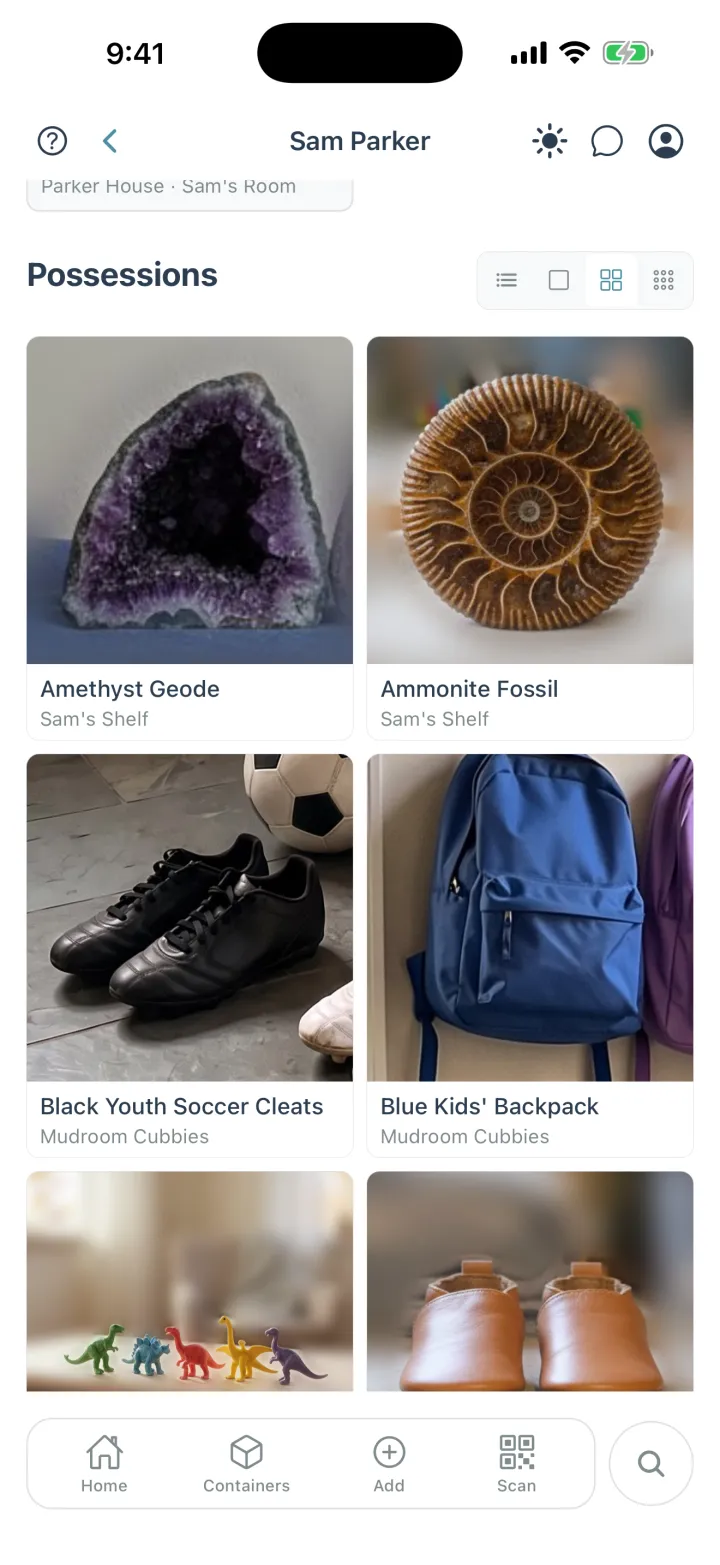
Each person gets a page with what's theirs, kids included.
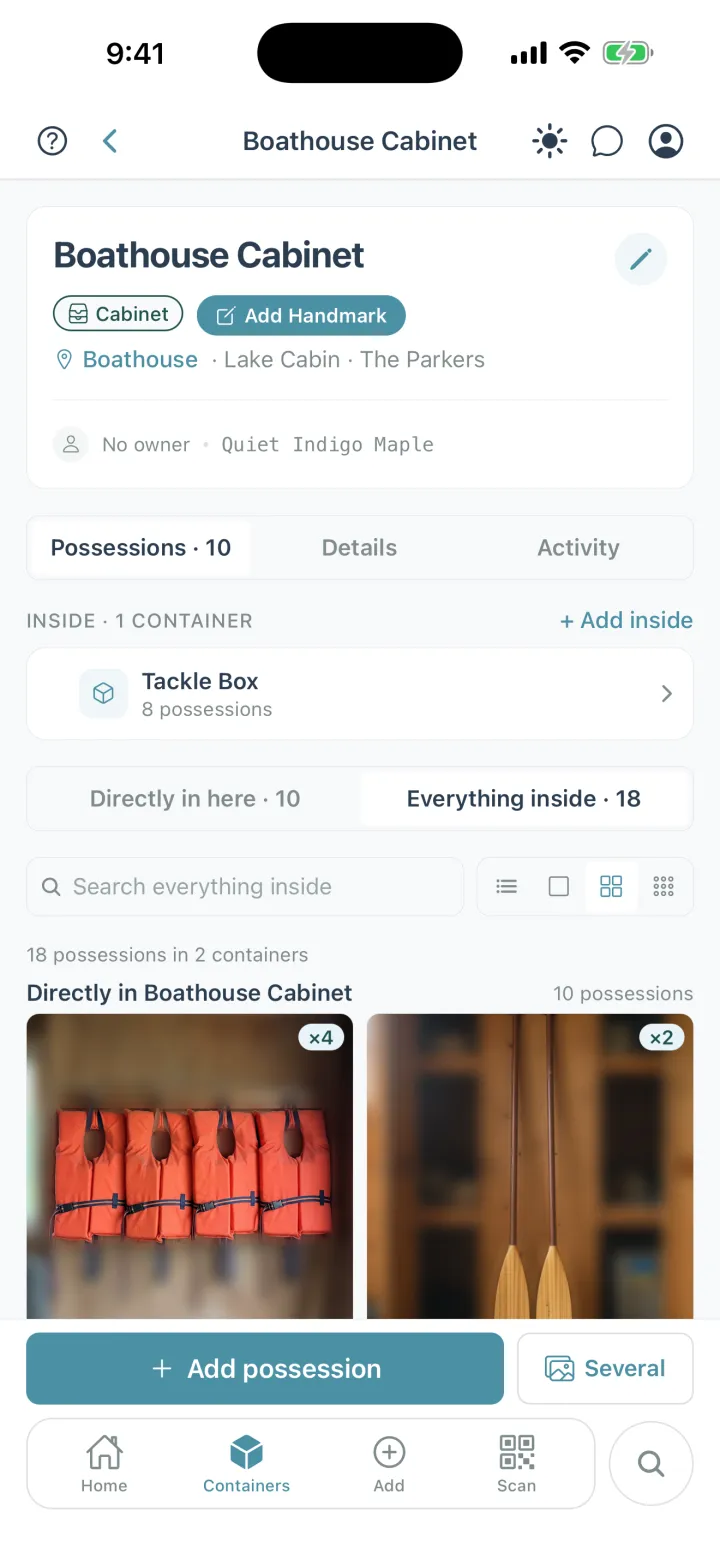
Containers inside containers, with everything inside listed.
The second is the seasonal boxes, which are only invisible because they are closed. Photograph what goes in one and the AI fills in each item's details for you, then print a QR label for the outside — a scan shows the contents without opening the box or fetching a step stool. QR label printing is on every tier, including the free Basic one. Every box also carries a permanent three-word name that survives being renamed, which matters more than it sounds like when two identical boxes are on one shelf.
That is a handful of records covering the two questions this room reliably generates. The daily layer stays uncatalogued forever, and that is correct.
The habit is thirty seconds at the door
The room does not stay sorted because of the hooks. It stays sorted because of one rule attached to a moment that already exists.
Coming in, before anything else: coat on your hook, shoes on your shelf, paper out of the bag and into the tray. Thirty seconds, once a day, at the only moment when everything is already in your hands.
It works because you removed the deciding. Every item has one place and that place belongs to one person, so putting it away is a movement instead of a judgment call — and movements survive a Thursday in a way judgment calls do not.
Anything with no place goes in the box against the wall, and when the box is full it leaves.
Start with the floor
If you fix one part of this room, clear the floor and add hooks where the floor was doing the hooks' job. That single change fixes the mornings more than any shelf you could buy.
The rest is the same idea in smaller shapes. One column per person. Everything reachable at the height of the person who uses it. Nothing stored where you cannot read what it is. It takes an hour, it costs nothing, and the next Tuesday morning is quieter. Cratify is free to try.
Know whose backpack that is
Photograph the shelf by the door once and every item can carry the name of the person it belongs to — Cratify is free to try.