How to Organize LEGO: Sorting, Storing and Tracking Sets
Sort LEGO by how your house builds: sets kept whole with their instructions, loose bricks sorted by piece type in shallow drawers, and a short list of what you own.

On this page
The box comes out of the closet on a Saturday morning: a clear plastic tub the size of a small suitcase, holding what used to be fourteen sets. Somewhere in there is the gray hinge piece the spaceship needs, the instructions for the fire station, and three minifigures whose heads have migrated to other bodies. Your kid wants to rebuild the spaceship. Forty minutes later you're both on the floor, sifting, and the spaceship is still only a picture on a box that went out with the recycling two years ago.
LEGO collections grow in bursts: a birthday, a holiday, a grandparent who knows what's popular. Each new set arrives in numbered bags with its own instructions, and within a month it has joined the pile. Organizing LEGO isn't about finding the perfect drawer system. It's about deciding how the bricks get used in your house, then setting up storage and a short list that match. Here's how to do it, and how to get it done before the next wave of sets arrives in December.
Start with how the bricks get used
There are two kinds of LEGO households, and most are a mix of both.
- Set builders follow the instructions, build the model, display it or play with it, and sometimes take it apart to build it again. They need each set's pieces and instructions kept together.
- Free builders tip the whole collection onto the floor and invent. They need pieces sorted so the right one turns up fast, and they rarely care which set a brick came from.
Watch how the bricks actually get used for a week before buying storage. A sorting system built for a free builder frustrates a set builder, and the reverse is just as true. Many families end up with both: sets worth keeping intact stored by set, and the rest in one shared, sorted collection.
Sorting by set
Keep a set together if it gets rebuilt, if it's on display, or if it might be sold or passed on one day. A complete set with its instructions is worth far more, to a buyer or a younger cousin, than a pile of the same pieces.
Give each set its own container: a zip-top bag for a small set, a shoebox-sized box with a lid for a large one.
Put the instructions in the same container, lying flat, or in a folder kept beside it.
Label the container with the set number and name, both printed on the original box and on the cover of the instruction booklet.
Keep the set's minifigures in a small bag inside the container, so they don't drift into other sets.
If a set is missing pieces, write down which ones on a note that lives in the container. That note is what you'll need when you order replacements, and it's far easier to write while the gap is fresh than to work out from the instructions a year later.
Sorting by piece
For a free-building collection, sort by what the piece is, not by its color. Builders look for a shape first, such as a 1x4 plate, and then a color, so a drawer of plates in every color is faster to search than a drawer of red pieces in every shape.
Don't sort too finely at the start. Begin with five to eight groups, and split a group only when it gets too big to search:
Bricks
Plates and tiles
Slopes
Technic pieces, axles and pins
Wheels, tires and vehicle parts
Minifigures and their accessories
Specialty pieces: windows, doors, plants and decorative parts
Small, shallow drawers work better than deep ones. A deep container becomes a pile you have to dig through, while a shallow drawer shows its whole contents at a glance. A set of plastic parts drawers on a shelf holds a surprising amount, and it keeps small pieces off the floor.
How to sort a big mixed pile
If the collection is already one big pile, sort it in passes rather than trying to finish in one sitting.
Pull out the minifigures and instruction booklets first. They're the hardest pieces to replace and the easiest to damage.
Separate any built models you plan to keep intact, and set them aside by set.
Do a rough first pass into your five to eight groups on a large tray or a sheet spread on the floor, which keeps small pieces from rolling under the sofa.
Do a second pass within a group only if that group is too big to search.
Label each drawer or box on the front, with a photo of a sample piece if young builders use it.
Sort in short sessions. An hour at a time keeps the job from becoming a weekend-long project nobody finishes, and kids are far more willing to help when they can see the end.
Where the built models go
Built models are display pieces, and they need a different home from loose bricks. A shelf at eye level, out of direct sun, keeps them visible, since sunlight can fade and yellow some colors over time. Dust is the other problem: a glass-front cabinet keeps a shelf of models clean, and a soft paintbrush cleans the ones on open shelves.
When a model comes off display, decide whether it goes back into its own container or into the shared sorted collection. If a set is being broken up, write that down, so you know later which sets are no longer complete.
Keep a list of what you own
Once a collection passes a few dozen sets, nobody remembers what's in it. A list answers the questions that come up every few months: do we already have this set, which sets are complete, where is the fire station, and which ones are worth keeping. For each set, record:
The set number and name
Whether it's complete, and which pieces are missing if not
Whether you still have the instructions
Where it's stored: which shelf, drawer or box
Who it belongs to, if more than one person builds
What you paid and when, for larger sets and sets no longer sold in stores
Large sets and sets that have gone out of production can be among the more valuable possessions in a house. Keep the receipt and a few photos of the built model and its box. The guide to home inventory for insurance covers what a complete record includes.
Make room before the holidays
December is when most collections grow, so late November is a good time to sort. A few steps before the new sets arrive:
Decide where new sets will live before they're opened, so the first build doesn't end up on the pile.
Set aside an empty container for each set you expect, and label it once you know what it is.
Check your list before buying, especially if grandparents and other relatives are shopping too, so nobody gives a set you already own.
Pass on sets nobody builds anymore, complete with their instructions, to a younger cousin or a donation center that accepts toys.
If the rest of the toy collection has also gotten out of hand, the guide to organizing toys covers the rest of the playroom. Board games tend to collect in the same closet, and the guide to cataloging a board game collection uses the same approach for them.
Where an app helps
A list on paper or in a spreadsheet works well for a small collection. If you'd rather keep it on your phone, here's how it works in Cratify. Each set can be a possession with up to five photos, so the built model, the box art and the missing-pieces note sit together. Photograph a set and AI identification suggests a name and category, and you can correct any detail it gets wrong. A quantity on a possession covers the case where you own two of the same set.
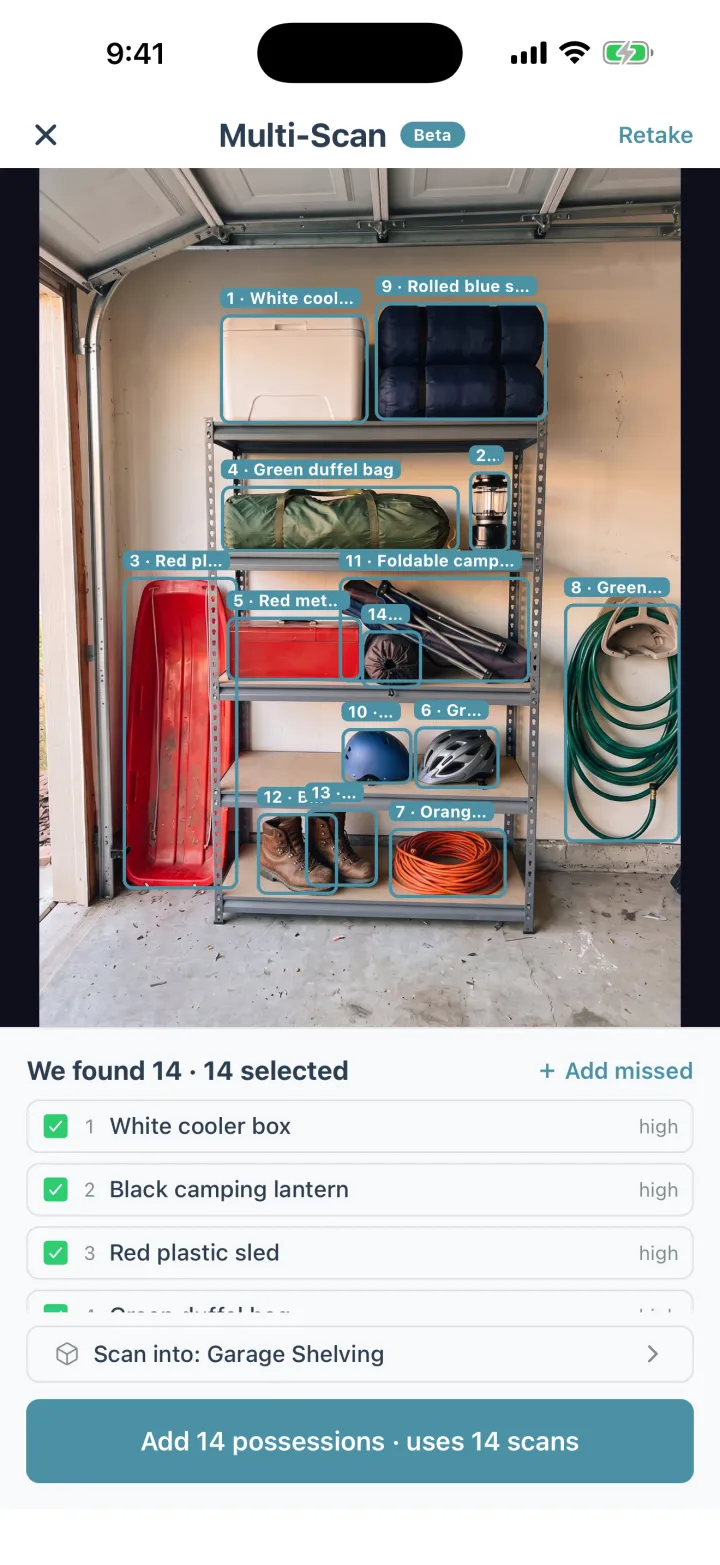
Multi-Scan names up to 15 possessions from one photo.
Containers in Cratify can be a Drawer, a Box, a Shelf or a Cabinet, and a drawer can sit inside a cabinet, so the parts drawers are recorded the way they actually stand in the closet. Each set can belong to a person, which helps when siblings share a shelf. A collection can serve as a want list, or as a check-off list for sets that need pieces. Search draws on each possession's details, so the fire station turns up by its name or by its set number if you recorded it. For a valuable set, a Receipt possession records the amount and purchase date, and a collection can be exported as a PDF.
The short version
Decide whether your house builds sets or free-builds, and store to match: sets in their own labeled containers with their instructions, loose bricks sorted by piece type in shallow drawers. Sort a big pile in passes, starting with minifigures and instructions. Keep a list of sets, where each one is stored and what it's missing, and make room before December's new sets arrive. Cratify is free to try.
Know which sets are complete
Record each set with photos, where it's stored and which pieces are missing. Cratify is free to try.