How to Store a Lawn Mower for Winter
Deal with the fuel, scrape the deck, change the oil and sharpen the blade, then store the mower somewhere dry with its parts and manual in one box. It starts in spring.

On this page
- Read the manual before you start
- Deal with the fuel first
- Clean under the deck
- Change the oil while you're there
- Look after the blade
- Battery mowers and riding mowers
- Choose where it spends the winter
- Keep the parts and the manual together
- Write down what it needs in spring
- Where an app helps
- The short version
It's the last mow of the year, a gray Saturday at the end of October, and the mower goes back where it lives: pushed into the corner of the garage with a quarter tank of gas, a crust of wet grass packed under the deck, and the same oil it had in May. In April someone pulls the cord eight times, then twelve, then gives up and loads it into the car for a repair shop with a three-week wait, right when the grass needs cutting.
Storing a lawn mower for winter takes about an hour, and nearly all of that hour is the same five jobs: deal with the fuel, clean the deck, change the oil, look after the blade, and put it somewhere dry. Do them in that order on the last mowing day and the mower starts in spring.
Read the manual before you start
Mowers differ in the details that matter most here, so find the manual first, or look up the model number on the manufacturer's website. The model number is usually on a sticker on the deck or the frame near the engine. The manual answers three questions this post can't: how the manufacturer wants the fuel handled over winter, which oil and how much, and which way the mower can be tipped without flooding the air filter with oil.
Deal with the fuel first
Gas left in a mower over winter goes stale. It loses the parts that help it ignite, and ethanol blends can draw in moisture and leave gummy deposits in the carburetor. That's the most common reason a mower that ran fine in October won't start in April.
There are two standard approaches, and manuals differ on which they want:
- Stabilize it. Add fuel stabilizer to the tank at the rate on the bottle, then run the engine for five minutes so treated fuel reaches the carburetor. Many manuals then ask for a full tank, which leaves less air inside for condensation.
- Run it dry. Let the engine run until it stops on its own, so there's no fuel left in the tank or the carburetor to go stale.
Either way, work outdoors with the engine cool, and never pour old fuel onto the ground or down a drain. A gas can of last summer's fuel is household hazardous waste, and most towns have a drop-off day or site for it.
Clean under the deck
Before you touch the blade or tip the mower, pull the wire off the spark plug so the engine can't start by accident while your hands are underneath. This is the one safety step that's never optional.
Then tip the mower on its side, with the air filter and the carburetor facing up unless the manual says otherwise. Scrape the packed grass off the underside of the deck with a putty knife or a stiff brush. Wet clippings left there all winter hold moisture against the steel, and that's where a deck rusts through. Brush off the top of the engine too, especially around the cooling fins, and empty and rinse the grass bag so it dries before it goes away.
Change the oil while you're there
Old oil carries acids and grit from a season of running, and it's better drained before the mower sits for five months than after. Change it with the engine slightly warm, when the oil runs out more easily, using the type and amount in the manual.
Take the old oil to a recycling point. Many auto parts stores and recycling centers accept used motor oil.
While the oil is draining, look at the air filter. If it's caked with dust, clean or replace it now, and check the spark plug: a plug with a crusted, blackened tip is cheap to replace and easier to do in October than in April with the grass already long.
Look after the blade
A dull blade tears grass instead of cutting it, and the torn tips turn brown. Winter is the easiest time to deal with it, because the sharpening shops are quiet and you have months to get it back.
With the spark plug wire still off, mark the underside of the blade so it goes back on the right way up.
Wedge a block of wood against the blade so it can't turn, and loosen the bolt.
Sharpen it yourself with a file, or take it in. Either way, check it's balanced before it goes back on, because an unbalanced blade shakes the whole mower.
Replace it outright if it's bent or cracked, or if sharpening has worn it thin.
Battery mowers and riding mowers
Battery mowers
A battery mower skips the fuel and oil steps, but the battery needs its own care. Take it off the mower and store it indoors somewhere cool and dry, not in a cold garage. Most manufacturers ask for a partial charge rather than full or empty, and the right level varies, so follow the manual. Never charge a battery that's still cold; let it come up to room temperature first. Clean the deck exactly as above, after removing the battery or the safety key.
Riding mowers
A riding mower gets everything above, plus its starter battery. Disconnect it, or take it out and store it somewhere it won't freeze, and keep it topped up with a battery maintainer if the manual recommends one. Check the tire pressure before it's parked, and take the key out and put it somewhere you'll remember.
Choose where it spends the winter
The best place is dry, covered and out of the way. A garage or a shed works well. Avoid two spots. One is anywhere near a furnace, a water heater or an appliance with a pilot light, because a mower with fuel in it gives off vapor. The other is outside under a plastic tarp, which traps condensation against the engine. If it has to stay outside, use a breathable cover and get it off the ground.
Think about the order the garage empties in winter, too. In most garages the snow shovel and the snow blower need the spot by the door from November to March, and the mower can go behind them. If the shed is where it lives, the guide to organizing a shed covers giving the mower its own space, and the garage guide covers zoning a garage so the car still fits. The bike that shares the garage has its own winter routine.
Keep the parts and the manual together
The mower is easy to find in spring. The spare spark plug, the right oil and the manual are not. Put them in one small box with a label and keep it on a shelf beside the mower.
The manual, or a note with the model number and where to find the manual online.
A spare spark plug and air filter in the right sizes.
The oil type and amount, written on the inside of the lid.
The sharpened blade, wrapped in cardboard, if it hasn't gone back on yet.
The key and the safety key, for mowers that have them.
Write down what it needs in spring
While the mower is clean and you can see it properly, make a short list: a blade that needs replacing, a wheel that wobbles, a pull cord that's fraying, a grass bag with a torn seam. Tape the list to the box. Then the parts can be ordered over the winter instead of in the first warm week, when everyone else is ordering them too.
Write down the serial number while you're at it. It's usually on the same sticker as the model number. Keep it with the receipt if you still have one; a mower is often still under warranty for a year or more after purchase, and both numbers are what a repair shop or the manufacturer asks for first. The guide to tracking appliance warranties and receipts covers keeping those together.
Where an app helps
In Cratify, the mower can be a possession with its photos, and its model number and serial number in its details. Photograph it once and the details are filled in from the photo, with a confidence percentage you can check and correct. The receipt can be stored as a Receipt with its amount and purchase date, and the manual as a Document.
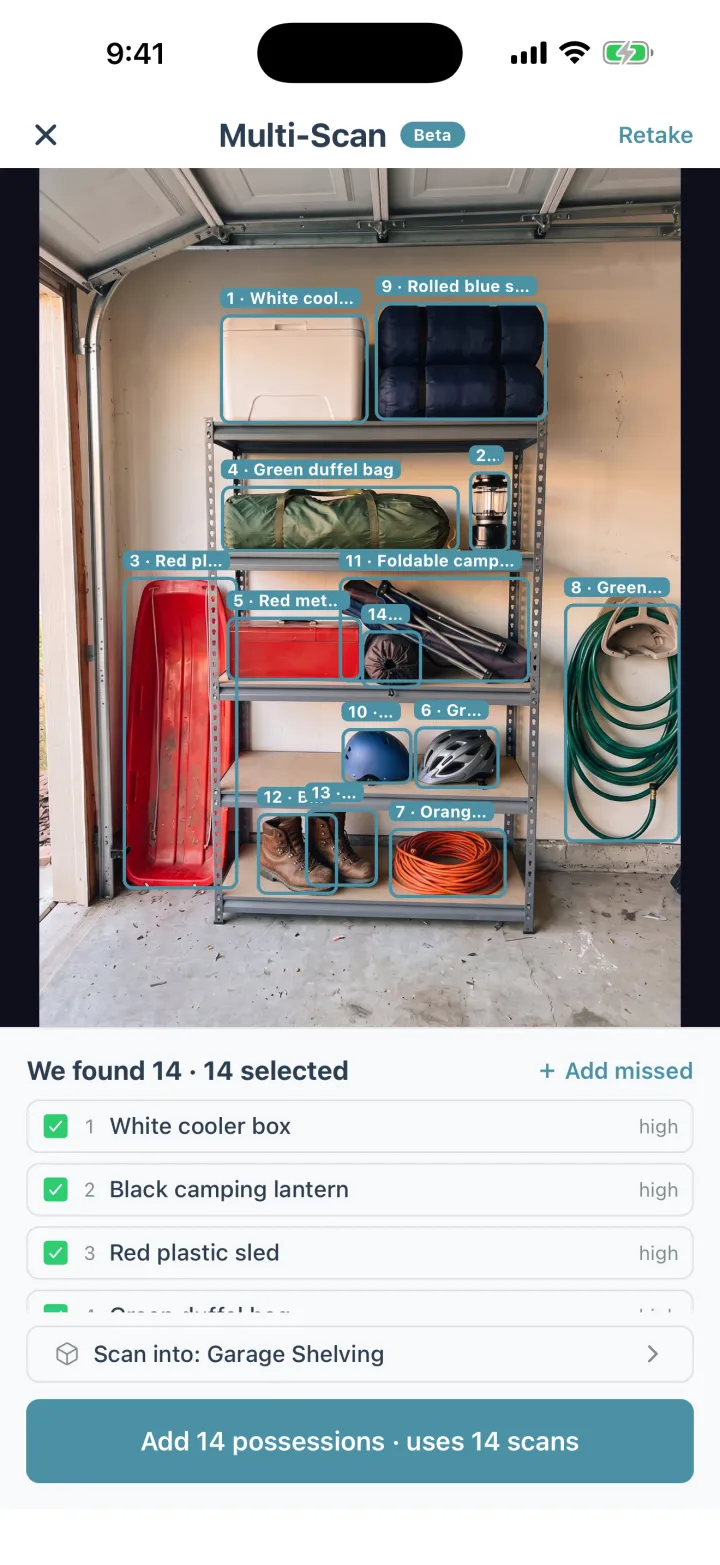
Multi-Scan names up to 15 possessions from one photo.
The box of parts can be a Box container in the garage or the shed, so the spare spark plug turns up in a search for "mower" in April.
None of this is needed to store the mower well. It only means the answers are on your phone in spring instead of on a sticker under the deck.
The short version
Find the manual. Stabilize the fuel or run the tank dry, then pull the spark plug wire. Scrape the deck, change the oil, check the filter and the plug, and sharpen the blade. Store it somewhere dry, away from pilot lights, with the parts and the manual in one labeled box beside it, and a list of what it needs taped to the lid. Cratify is free to try.
Find the spark plug and the manual in April
Record the mower, its receipt and its box of parts, then search for them in spring. Cratify is free to try.