Out of Sight, Out of Mind: How to Remember What You Store
Closed storage looks tidy and hides everything. Sort what has to stay in view, give what you mean to use one open spot, and make the rest readable from outside.
On this page
The second bottle of olive oil turned up in March, behind the rice, three months after you bought a third. The good wool scarf spent the whole winter in a box on the top shelf of the hall closet while you wore the scratchy one. The watercolor set you bought for a rainy weekend is still sealed, in a drawer you open twice a year. None of it was lost. You knew exactly where each one was on the day you put it away. Then the door closed, and it stopped existing.
That is out of sight, out of mind, and it is the most common complaint about tidy storage. A shelf of closed boxes looks calm and organized. It also hides everything, and whatever you cannot see, you stop using, stop counting and eventually buy again. The fix is not to leave every possession out on the counter. It is to decide what has to stay in view, and to make the rest visible without opening anything.
Why closed storage makes possessions disappear
Memory runs on cues. You remember the blender because you see it every morning. You forget the waffle maker because it lives in the cabinet above the fridge, which you never open, so nothing in your day points at it.
Closed storage removes the cue. That is exactly its job for possessions you do not need to think about, like the spare duvet or the holiday dishes. It is the wrong job for possessions you mean to use. The trouble starts when both kinds get packed into the same boxes, behind the same doors, and the ones you meant to use disappear along with the rest.
So the first step is not buying containers. It is sorting by how often you want to be reminded.
Decide what has to stay in view
Pick one room and sort what is stored there into three groups. A kitchen or a closet takes about 20 minutes.
In use: possessions you reach for every day or every week. These stay in open storage at eye level, where you see them without trying.
Meant to use: possessions you want to use but keep forgetting, such as the watercolor set, the cookbook you bought in January, or the board game saved for family nights.
Kept, not used: seasonal, sentimental or spare possessions you do not need to think about until a date comes around. These can go behind a door, as long as you can find them.
Most homes store the middle group the same way as the third. That is the mistake. A possession you want to use should never be stored like a possession you want to forget.
Give the middle group one open spot
Choose one shelf, one tray or one corner of a counter for the meant-to-use group, and make it the most visible spot in the room. A shallow tray by the front door for library books and the return that has to go back. One kitchen shelf at eye level for the food that needs eating first. A hook by the door for the bag you keep meaning to take to the pool.
Keep that spot small. An open shelf holding 40 possessions is as invisible as a closed cabinet, because the eye stops reading it after the first few. A spot that still works as a reminder holds about a dozen possessions at most.
Rotate instead of adding
When a new possession joins the open spot, one leaves it: used up, put away properly or given away. The spot stays the same size, so it stays readable. If the same possession has sat there for two months untouched, it has told you something, and it belongs in the third group or out of the house.
Make closed storage visible from the outside
The kept-not-used group goes behind doors and lids, and that is fine as long as the outside of the storage tells you what is inside.
Label with contents, not categories
A box labeled Kitchen tells you almost nothing at the moment you need the fondue set. A label that lists the four or five main possessions inside does: fondue set, waffle maker, cake stands, piping bags. Write the list on the side that faces you when the box is on the shelf. A label on the lid is invisible the moment another box goes on top.
Use clear containers where they fit
Clear boxes do part of the work for you, which is why they are the usual advice for this problem. They help most on shelves at eye level and in the pantry, where you can read the contents from across the room. They help much less on a top shelf, at the back of a deep closet or under a bed, because a clear box is only clear if you can see it. The same reasoning runs through what to store under the bed: storage you cannot see into needs a record, or it is as good as gone.
Take one photo before the lid goes on
A photo looking down into an open box records what a label cannot fit. It takes 10 seconds and answers the question you will actually ask in six months, which is whether the long extension cord is in this box or in the garage.
Keep one list you will actually see
Labels and photos only help once you are standing in front of the right cupboard. The harder question is the one you ask in a store aisle: do I already own one of these?
That calls for a record you can check from anywhere. On paper it is a short list taped inside a cupboard door, naming each closed container, where it sits and the main possessions inside. Keep it to the containers you rarely open, because those are the ones memory drops first. Update it whenever possessions move, which in most homes means twice a year, when the seasons turn.
The goal is not to inventory the whole house in one sitting. It is to make the out-of-sight places checkable without opening them, so the third bottle of olive oil never gets bought.
The usual out-of-sight traps
Every home has the same handful of places where possessions vanish. Check these first.
The back of the pantry shelf, where the older jar hides behind the newer one. Put new groceries at the back and pull older ones forward; how to organize a pantry covers the rest of that shelf.
The crisper drawer and the bottom of the freezer. A short note on the fridge door listing what is down there does more than any organizer.
The top shelf of the closet, where the good sweater waits out the season you needed it for. Organizing a closet without buying more organizers covers what deserves that shelf.
The cabinet above the fridge, home to the appliances you bought for one recipe.
The far corner of the basement or attic, where boxes go when nobody has decided about them yet.
Where an app helps
A record of what you own is the one reminder that works from anywhere, including the store aisle. In Cratify you photograph possessions and the details are filled in from each photo, with a confidence percentage you can check and correct. Each possession sits in a container, inside a room, inside a location, so the record shows the closed box on the top shelf as plainly as the open shelf on the counter.
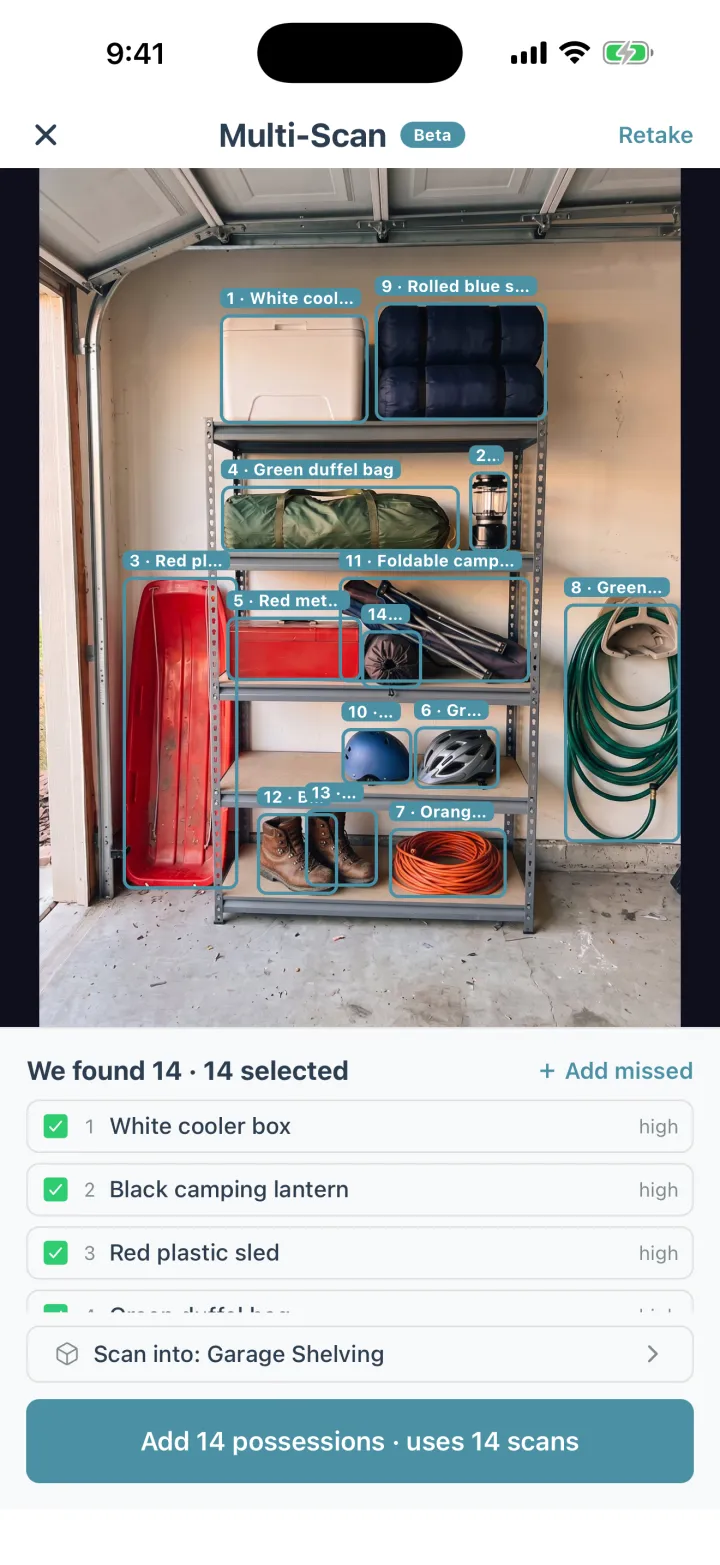
Multi-Scan names up to 15 possessions from one photo.
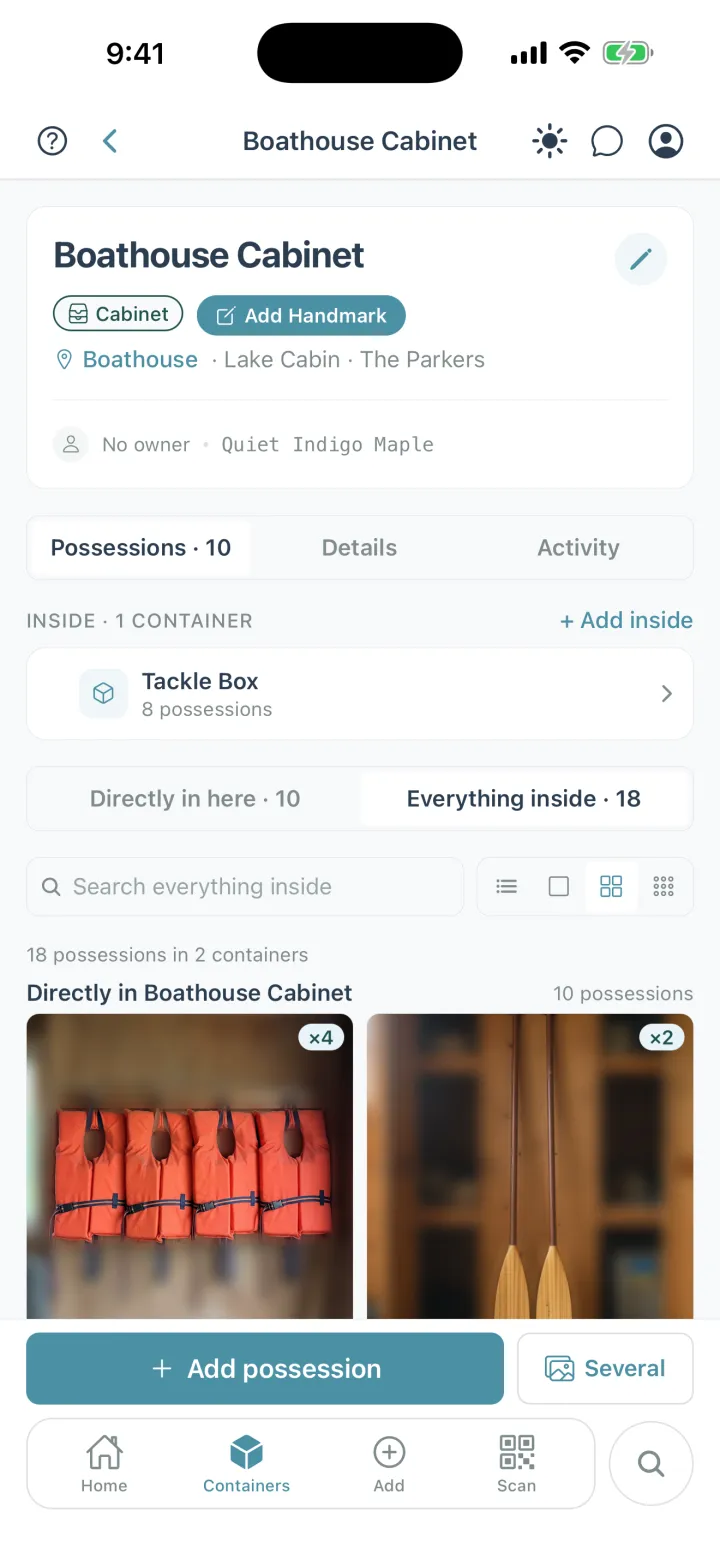
Containers inside containers, with everything inside listed.
Search draws on the details of each possession and the container it lives in, so typing fondue set tells you which box and which cabinet before you climb up to look. For the meant-to-use group, a collection works as a short list that spans containers, and you can check possessions off as you take them out.
The short version
Out of sight, out of mind is a sorting problem before it is a storage problem. Keep what you use in view, give what you mean to use one small open spot, and put the rest behind doors with labels that list the contents and a record you can check from anywhere. If a record like that would help, Cratify is free to try.
Know what is behind every door
Record what goes into each closed box and cabinet, then search from anywhere instead of opening every door. Cratify is free to try.