What to Store Under the Bed and What Never Belongs There
Under-bed storage is for possessions you use once a season or less. Here is what belongs under the bed, what never does, and how to set it up so every box is findable.

On this page
The bed in the spare room has 11 inches of clearance, and at some point in the last three years everything without a home went under it. There is a flattened duffel bag, a roll of wrapping paper, two pairs of boots you forgot you owned, a set of sheets for a mattress you no longer have, and a shoebox you are fairly sure holds tax papers. Nobody has looked under there since spring.
Under-bed storage is some of the most useful space in a home and some of the easiest to lose track of. The problem is not the space. It is that you cannot see into it, so whatever goes under there stops existing until the day you need it. Here is what actually belongs under the bed, what does not, and how to set it up so you can find a possession without lying on the floor with a flashlight.
The rule for storage you cannot see into
Under the bed, the top shelf of the closet, the cupboard above the fridge, the far corner of the attic: these are the places where storage stops being storage and becomes forgetting. They all run on one rule.
Anything that goes into storage you cannot see into needs a record, or it is as good as gone.
The second half of the rule decides what qualifies. Possessions you reach for once a season or once a year belong in blind storage, because the effort of pulling out a box is small next to how rarely you do it. Possessions you reach for every week or every month do not, because a box you have to drag out every Tuesday soon stops getting put back.
A quick test: if you will need it in the next 30 days, it does not go under the bed.
What belongs under the bed
Good under-bed candidates are flat or soft, used rarely, and not harmed by months in the dark.
Off-season clothes and shoes, packed when you swap wardrobes
Spare bedding, guest sheets and extra pillowcases
Wrapping paper, gift bags, ribbon and cards
Gifts you bought early and are hiding until a birthday or the holidays
Outgrown children's clothes you are keeping for a younger sibling
Keepsakes in a sealed box, such as letters, cards and a child's first shoes
Flat seasonal sports gear, like a wetsuit or ski gloves
If you swap clothes twice a year, under the bed is a natural home for the half you are not wearing, and our guide to swapping summer and winter clothes walks through the swap itself. If gifts are going under there, keeping track of gifts you buy early covers how to find them again in December.
What does not belong under the bed
Some possessions are a poor fit for the dusty gap under a mattress, however much room there is.
Anything you use weekly, including shoes in rotation and exercise gear you actually use
Food of any kind, which draws pests
Original documents you might need in a hurry, such as passports, birth certificates and insurance papers
Valuables you would want to grab in an emergency
Anything heavy enough that sliding it out is a struggle
Possessions that react badly to humidity or dust, like loose photographs or electronics without a case
That shoebox of tax papers is the clearest example. Paperwork you might need on short notice belongs somewhere you can reach standing up, not in the place you check last.
Measure before you buy anything
Most under-bed setups fail before anything goes into them, because the boxes do not fit. Measure the clearance from the floor to the lowest point of the bed frame, not to the mattress, and subtract about an inch so a box slides without catching. Then measure the depth from the edge of the bed to the wall, or to the center line if you can reach from both sides.
Shallow boxes with lids do most of the work here. Lids keep out dust, and a box you can slide out without lifting the mattress is a box you will actually open. Boxes on wheels help on carpet. Flat zippered bags suit bedding and soft clothes, though they are harder to stack and harder to label.
If the bed sits too low for anything useful, bed risers add a few inches of clearance. Check that they are rated for the bed and the people sleeping in it before you raise it.
Set it up so every box is findable
One category per box
Mixing categories is how a box becomes a mystery. Keep off-season sweaters in one box, wrapping supplies in another and guest sheets in a third. A box that holds one kind of possession can be labeled in two words and understood at a glance.
Label the end that faces out
Label the short end of each box, the end you see when you kneel by the bed, not the lid. A lid label is invisible once the box is under the frame. Write the category and the season or occasion: winter sweaters, gift wrap, guest sheets for the double bed.
Put the least-used boxes in the middle
Under a bed there is prime space and dead space. The edges you can reach without moving anything are prime. The middle, under the center of the mattress, is where you need a broom handle or a second person. Put the once-a-year boxes there, like keepsakes, and keep the twice-a-year boxes at the edges.
Photograph the contents before the lid goes on
A label tells you what a box is for. It does not tell you what is in it. Before you close a box, take one photo looking down into it. That photo answers the question you will actually ask in November, which is whether the gray scarf is in this box or the other one.
Keep a record of what is under there
The label and the photo only help if you can find them later. A short written list does the job on paper: the box, where it sits, and what is inside, kept somewhere you will look, like the inside of the closet door. Update it each time you swap seasons, because that is when possessions move in and out.
The record matters most for the boxes in the middle. Those are the ones you are least likely to open on a hunch, so they are the ones where knowing beats checking.
Then do one honest check twice a year, when the seasons turn. Pull every box, vacuum the floor under the bed, and take out anything that no longer earns its space. If the room is a guest room that doubles as storage, our guide to organizing a guest room covers the rest of it.
Where an app helps
In Cratify, the bedroom is a room inside your home location, and each under-bed box is a container in it, so a possession is recorded exactly where it sits. You can photograph possessions and the details are filled in from each photo, with a confidence score you can check and correct. Every box gets a permanent three-word name, and you can print a QR label for it on every plan, including the free one.
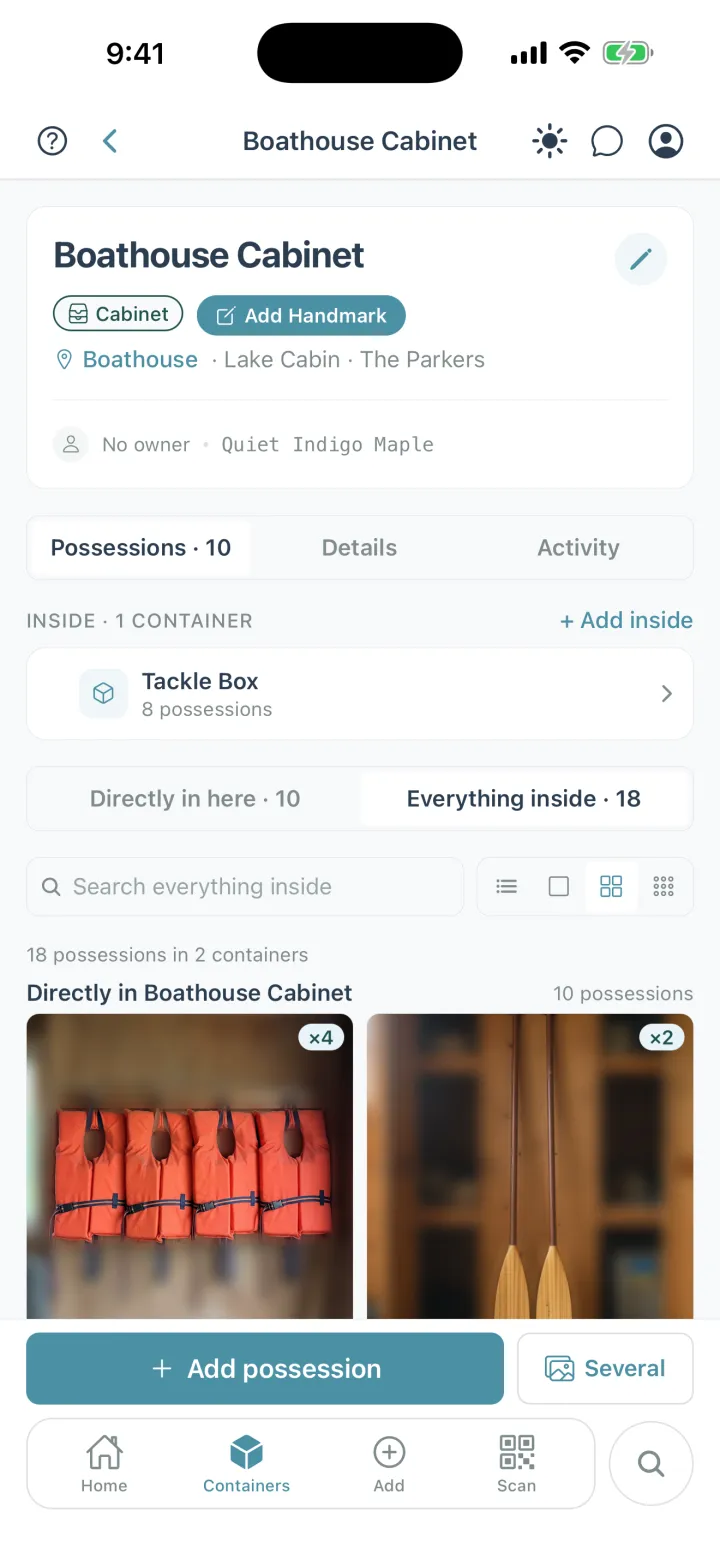
Containers inside containers, with everything inside listed.
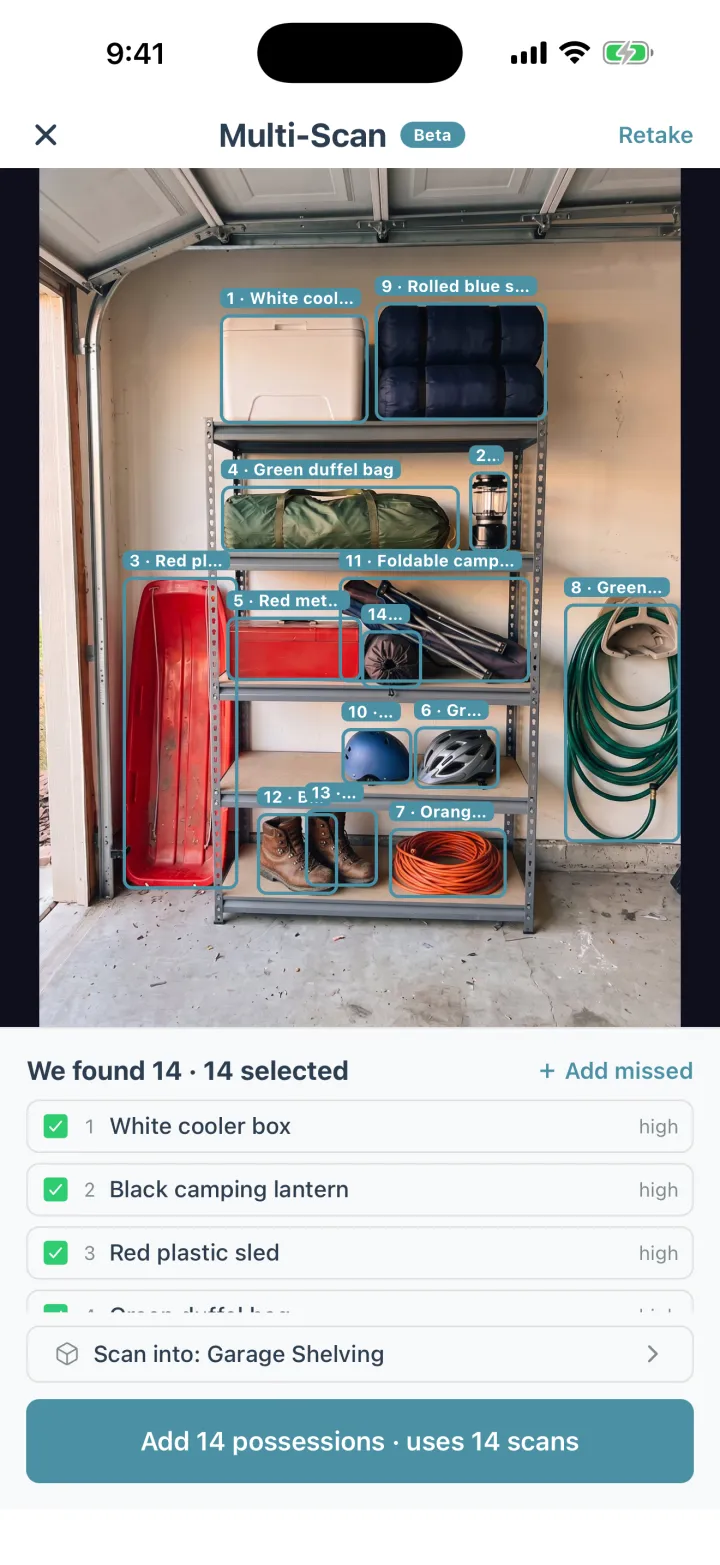
Multi-Scan names up to 15 possessions from one photo.
Search draws on the details of each possession and the container it lives in, so typing gray scarf tells you which box under which bed. When you pull the winter boxes out in November, a possession that leaves for the season can be marked temporarily removed with a note, so its place in the record is kept while it is out.
The short version
Under the bed is for possessions you use once a season or less, packed one category to a box, labeled on the end that faces out, and written down somewhere you will look. Anything you need monthly, anything you might need in a hurry and anything that dislikes dust lives somewhere you can see. If a record of every under-bed box would help, Cratify is free to try.
Know what is under every bed
Record each under-bed box and what is inside it, then search instead of digging. Cratify is free to try.