How to Organize a Trading Card Collection and Find Any Card
Three binders, a drawer of loose packs and a shoebox under the bed. Here is how to organize a trading card collection so you can find any card and protect the ones that matter.

On this page
It starts with a shoebox. Maybe it is the one from your own childhood, found on a closet shelf with a rubber band around each stack. Maybe it is your kid's collection, which has grown from a single starter deck into three binders, a drawer of loose packs and a pile on the desk that nobody is allowed to touch. Either way, someone asks whether you have a particular card, and the honest answer is that it would take an afternoon to find out.
A trading card collection is hard to keep organized because it grows in small pieces. A pack here, a trade there, a stack from a cousin who cleaned out a closet. None of those moments feels like the time to sort, so the collection ends up in four places and nobody knows exactly what is in it. Here is how to organize a trading card collection so you can find any card, protect the ones that matter, and keep it that way as it grows.
Start with what you have, not how you will store it
The tempting first move is to buy storage: binders, boxes, sleeves by the hundred. Hold off. Until you know roughly how many cards you have and what kinds, you will buy the wrong sizes and too many of them.
Gather every card into one place first. Check the closet shelves, the desk drawers, the glove box, the backpacks and the jacket pockets. Put everything on a table or a clean floor, still in its stacks, and get a rough count. You do not need an exact number yet. You need to know whether you are dealing with five hundred cards or five thousand, and whether they are mostly one game or sport or a mix.
Sort before you store
Sort in passes rather than trying to put every card in its final spot in one go. Each pass splits the pile into fewer, cleaner stacks, and it is much easier to stop and pick up again later.
First pass: by game, sport or brand
Separate baseball from basketball, one card game from another. Collections that mix several kinds become far easier to manage once each kind has its own section.
Second pass: by set or series
Within each kind, sort by set, series or year. Most cards print this on the front or back. Collectors who care about completing sets will want this level anyway, and it is the order most checklists and price references use.
Third pass: the cards that matter
Pull out the cards you care about most. That might be the rare ones, the ones with sentimental value, the signed ones, or simply your kid's favorites. This short stack is the one that deserves the best protection and the most careful record. The rest can be stored in bulk.
Protect the cards worth protecting
Cards are paper, and paper is damaged by the same few causes over and over: bending, moisture, heat, sunlight and rubbing against other cards.
Put every card you care about in a soft penny sleeve first. It keeps the surface from scratching.
Put sleeved cards that matter most into a rigid top loader or a side-loading binder page, so they cannot bend.
Store bulk cards upright and snug in purpose-made card storage boxes, never loose in a drawer where they slide and curl.
Throw out the rubber bands. They dent the edges of the top and bottom cards in a stack, and over time they dry out and stick.
Keep the whole collection in a room that stays at normal indoor temperature and humidity, out of direct sun, and off the floor. Attics, garages and basements are where cards go to warp.
If you use binders, store them standing upright like books rather than stacked flat, which presses the pages and can leave ring marks on the cards nearest the spine.
Give the collection one home
Most collections live in too many places. The binders are on a bookshelf, the bulk boxes are in a closet, the new packs are on the desk, and the duplicates are in a shoebox under the bed. Pick one shelf, one closet or one cabinet and keep all of it there, with a small spot set aside for new arrivals that have not been sorted yet.
Label every box and binder on the spine with what is inside: the game or sport, the set and the year range. A label that says only cards is not a label. The same approach that works for cataloging a book collection works here: the shelf is the map, and each spine tells you where to look.
Keep a list you can search
The single most useful tool for a card collection is a list of what you own. Without one, every question about the collection means pulling out the boxes. With one, it means a few seconds of searching.
Your list does not have to cover every common card on day one. Start with the stack of cards that matter from your third pass. For each card, record the name, the set and year, any condition notes, and which binder or box it lives in. Then add bulk cards a set at a time, as you have the patience for it. A list of your best two hundred cards is useful today. A perfect list of all five thousand that you never finish is not.
If you also keep a vinyl record collection or a shelf of board games, the same habit applies: catalog the part you care about first, and let the rest catch up.
Track the cards that leave the house
Cards move. They go to trade nights, to a friend's house to show off, out in the mail to be graded, and into a sibling's binder by mistake. Each of those is a card that can quietly disappear.
Keep a short note for every card that leaves: what it is, where it went, who has it and when it should be back. When you bring a trade stack to a card night, write down what is in the stack before you go and check it again when you get home.
Where an app helps
A paper list works until it lives in a notebook on the shelf at home while you are standing at a trade table trying to remember whether you already have a card. A list on your phone goes where you go.
In Cratify, the shelf or cabinet where the collection lives is a container in a room, and each box on it is a container too, so every card is recorded where it actually sits. Photograph a card and the details are filled in from the photo, with a confidence score shown that you can check and correct, and you can stage up to 20 photos in one batch. Identification prefers the categories and tags you already use, so a collection sorted by set stays sorted that way. Valuable cards can be marked Expensive or Fragile, and a receipt for a card you bought can be kept as its own record with the amount and purchase date.
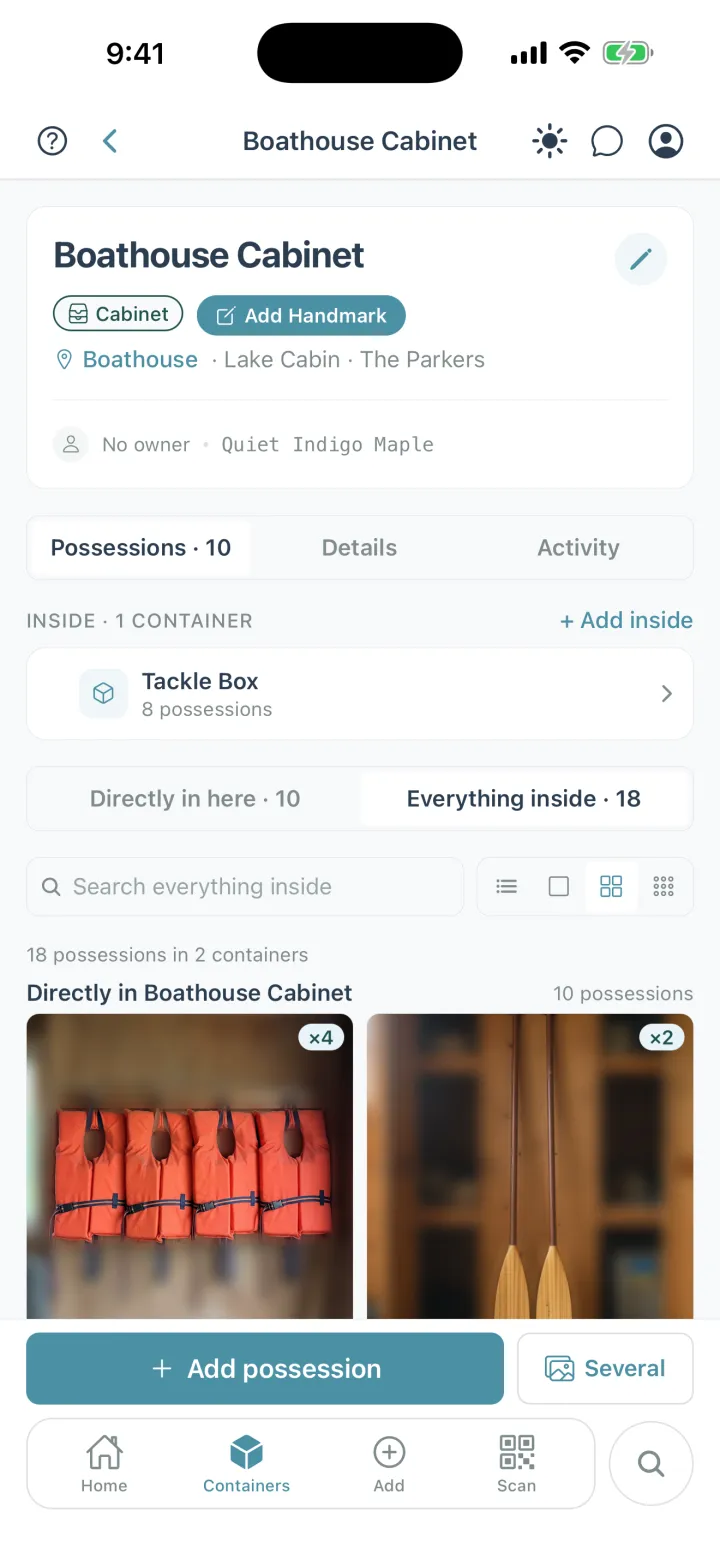
Containers inside containers, with everything inside listed.
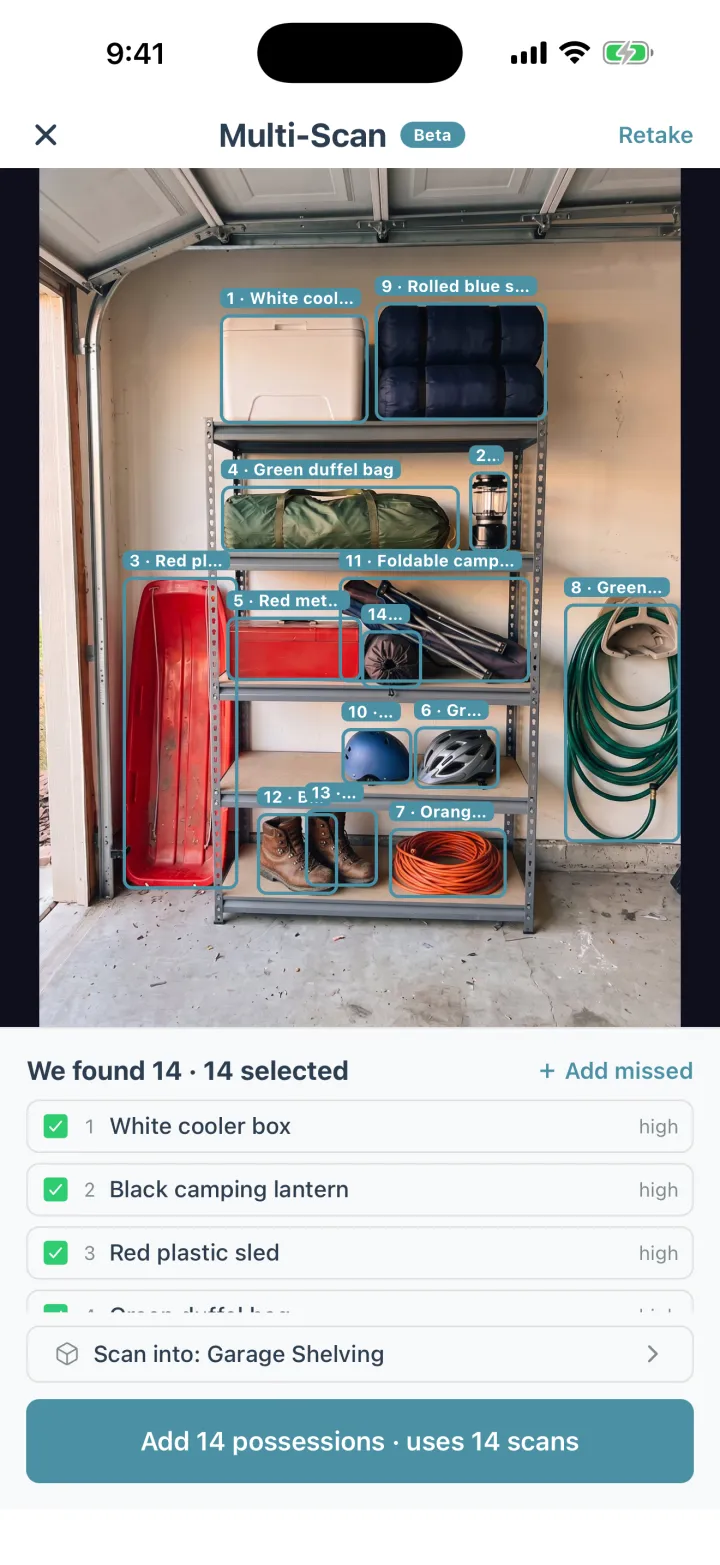
Multi-Scan names up to 15 possessions from one photo.
A collection works as a trade stack: it can span every box and binder on the shelf, and you check cards off as they go into your bag. When a card goes out to be graded or lent to a friend, mark it temporarily removed with a note saying where it is. Each child's cards can belong to that child, so the sibling question has an answer. Search covers the whole inventory, and scanning the QR label on a box shows what is inside without opening it.
A fifteen-minute habit after every pack or trade
New cards are where a tidy collection falls apart, so give them a short routine. After opening packs or coming home from a trade, sort the new cards into their sections, sleeve the ones that matter, update the list, and put the trade stack away. Fifteen minutes now saves an afternoon of searching later.
If the collection is valuable enough that losing it would hurt, the same records are worth keeping for the reasons in our home inventory guide for insurance. Photos and a list made today are far easier than reconstructing a collection from memory.
The goal is simple: when someone asks whether you have that card, you can answer before they finish the question. If a searchable list would help, Cratify is free to try.
Know which cards you already have
Record each card, the box or binder it lives in and who has it on loan, so the whole collection is one search. Cratify is free to try.