How to Organize a Yarn Stash So You Stop Buying the Same Gray
Sort a yarn stash by weight, fiber and color, keep every ball band and dye lot with its skein, and store wool where moths, sunlight and damp can't reach it.

On this page
It's the last week of October, the holiday knitting list is three names long, and you're sure there's a sweater's worth of gray worsted somewhere in the house. You check the closet shelf, the basket by the couch and the box under the guest bed. You find two skeins of gray in two different dye lots, and four skeins of a blue you don't remember buying. The yarn shop has a sale on Saturday. You go, and you buy more gray.
A yarn stash goes wrong in a predictable way. It grows a few skeins at a time, it lands wherever there's room, and the labels that tell you what each skein is drift away from the skein. Here's how to sort a stash so you can see what's in it, how to store wool so moths don't find it first, and how to keep it sorted once the next sale comes around.
Bring it all into one room first
Gather every skein from every shelf, basket, drawer and project bag, and lay it out on a bed or a clean floor. It's the only way to see the whole stash at once, and most knitters and crocheters who do it find yarn they'd forgotten and yarn they bought twice.
Set aside three piles as you go:
Yarn with no project and no pull, the skein you wouldn't knit with now
Leftovers under about 50 yards, which are good for stripes, pom-poms and mending
Skeins with signs of moths: small holes, fine webbing, or lengths that snap when you tug them
The first pile can go to a friend, a school, a craft group at a senior center, or a donation center that takes craft supplies. The second pile gets one bag of its own. The third gets dealt with before it goes near the rest, which is covered below.
Sort by weight, then fiber, then color
Color is the instinct, and it's the wrong first cut. Patterns ask for a weight before they ask for a color, so sort that way and the stash answers the question you'll actually ask: do I have enough DK for this?
Lace and fingering, including sock yarn
Sport
DK
Worsted and aran
Bulky and super bulky
Within each weight, group by fiber, because wool, cotton, acrylic and blends behave differently and need different storage. Color comes last, inside each fiber group. A shelf sorted this way reads at a glance: the worsted wool is on the second shelf, and the grays are on the left.
Keep the ball band with the yarn
The paper band around a skein is the most useful part of the stash and the first part to go missing. It carries the fiber content, the weight, the yardage, the suggested needle or hook size, the care instructions, the color name and the dye lot.
The dye lot matters most. Skeins dyed in different batches can differ in shade enough to show as a stripe across a sweater, which is why patterns tell you to buy enough of one lot for the whole garment. Two skeins of "the same gray" from different lots are, for a large project, two different yarns.
When you wind a skein into a cake, tuck the band into the center or keep the two in one small bag. When a band is already lost, write what you know on a tag: the fiber if you're sure of it, an estimated yardage, and "lot unknown."
For any yarn you have several skeins of, note the total yardage. A pattern asks for yards, not skeins, and a single skein can hold anywhere from under 100 yards to more than 400, depending on the weight.
Store it away from moths, light and damp
Moths
Clothes moth larvae eat animal fibers: wool, alpaca, mohair, cashmere and silk, and the blends that contain them. Cotton, linen and acrylic on their own are largely left alone. The larvae prefer dark, undisturbed places, which describes the bottom of most stashes.
Store animal fibers clean and dry, in sealed zip bags or lidded plastic boxes that close tightly. Cedar blocks and lavender sachets smell nice, but they're a mild deterrent at best and won't stop moths already in the yarn. Check the stash a few times a year, because moths do the most damage where nobody looks.
For yarn you suspect, and for secondhand yarn coming into the house, seal it in a bag and put it in the freezer for about a week before it joins the rest. Treat the moth pile from your sort the same way, or let it go.
Light and damp
Sunlight fades dyed yarn, unevenly, starting with whichever side faces the window. Keep open shelves out of direct sun, or keep the yarn in closed boxes. Damp is the other risk. A basement or an exterior wall can leave yarn musty or mildewed, and a sealed bag holds damp in as well as it keeps moths out, so store yarn in a dry room and make sure it's fully dry before you bag it.
Give every project its own bag
A project in progress is where yarn leaves the stash without being used. Give each one a bag that holds the yarn, the needles or hook, the pattern, and a note of where you stopped. When a project stalls, the yarn is still accounted for, and you don't buy a second pair of 4mm needles because the first pair is inside a half-finished hat.
Planned projects work the same way. Holiday gift knitting starts about now, so pull the yarn for each gift into its own bag with the recipient's name on it. If you're buying gifts early as well, the guide to keeping track of gifts you buy early covers the rest of the list.
Needles, hooks and notions
Sort needles and hooks by size, since a pattern always asks for a size. A roll or a case with labeled pockets works for straight needles and hooks, and interchangeable tips and cables do well in a case with one pocket per size. Stitch markers, tapestry needles, a row counter and a tape measure go in one small box that travels with the current project, with a spare set kept in the stash.
If the yarn shares a room with fabric, paint and paper, the guide to organizing a craft room covers the whole space.
Keep the stash list current
A sorted stash stays sorted until the next sale. What keeps it that way is a short list and a few habits:
Before you buy, check the list for the weight, the fiber and the yardage you need.
When yarn comes home, add it to the list with its yardage and dye lot before it goes on the shelf.
When a project is finished, update what's left, or move it to the leftovers bag.
Twice a year, check the animal fibers for moths. Pairing it with the seasonal clothes swap works well, since it's the same check.
The list can be a notebook, a spreadsheet or an album of photos. It only has to be quicker to check than the shelves.
Where an app helps
A labeled shelf and a notebook will do the job. If you'd rather search than open boxes, here's how it works in Cratify.
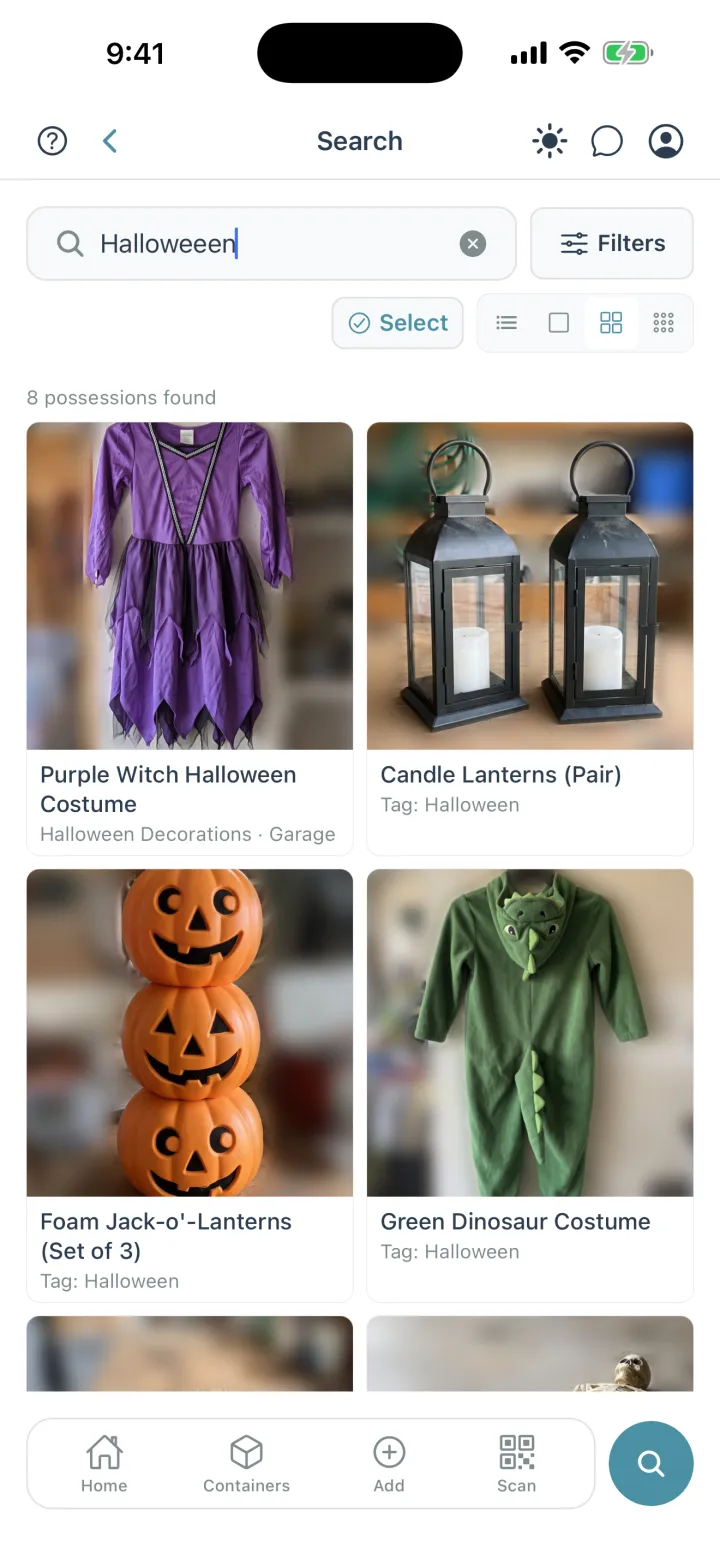
Search forgives typos: “Halloweeen” still finds every Halloween possession.
Containers come in types, including Box, Shelf, Closet and Drawer, and they can nest, so the boxes on a closet shelf sit inside that shelf, and the shelf lists the possessions in every box with totals. Photograph a skein and AI identification fills in its name and category, with a confidence percentage on screen so you can correct either. Several mode takes up to 20 photos in one batch, which suits a shelf of worsted. Identification prefers the categories and tags you already use, so tags for weight and fiber stay consistent from one skein to the next.
Ten skeins of one yarn can be one entry with a quantity instead of ten. Write the yardage and dye lot into the description, and they're there when a pattern asks. A collection for each project lists its yarn and needles, and you can check each one off as you pull it from the stash. Search draws on each possession's details and the container it's in, so a search for gray worsted can lead you to the right box.
The short version
Bring the whole stash into one room, sort it by weight, then fiber, then color, and keep each ball band with its yarn. Store wool and other animal fibers clean, dry and sealed, check them for moths twice a year, and give each project its own bag. Check the list before the next sale. Cratify is free to try.
Know what's in the stash before the sale
Photograph each skein, note the box it lives in, and search the stash before you buy more. Cratify is free to try.