How to Store Camera Gear So It's Ready When You Need It
Store camera gear indoors with steady temperature and moderate humidity, keep silica gel in every bag, store batteries half charged, and keep a list of every lens.
On this page
It's Thanksgiving morning, and someone wants a family photo before the food goes cold. The camera comes down from the top of the bedroom closet. The battery is flat, the spare is flat too, and there's a faint haze inside the zoom lens that wasn't there in the spring. The fast portrait lens you wanted isn't in the bag at all. It's in the other bag, or it's still with your brother-in-law from his trip in August.
Camera gear is easy to store badly. It's expensive, it's made of glass, rubber and electronics, and most of it sits unused for weeks at a time. The damage comes from three places: the wrong spot in the house, batteries left to drain, and no record of which bag holds which lens. Fix those three and the camera is ready the morning you need it.
Where to store camera gear
Store cameras and lenses in the living part of the house, where you'd be comfortable yourself. In rough order of preference:
A shelf in a bedroom or hall closet. It's dark, it's indoors, and the temperature stays steady.
A drawer or cabinet in a home office, away from a window and a radiator.
A dedicated shelf in a guest room closet, if that's where the camera bags already live.
Avoid the basement, the attic, the garage and the car. Basements are often damp, attics swing from hot to cold, garages collect dust, and a car in summer gets hot enough to damage batteries and the grease inside a lens. Keep gear off the floor and away from exterior walls, which run colder and damper than the middle of a room.
Control humidity without a special cabinet
Humidity is the biggest risk on this list. Damp, still air is what lets mold grow inside a lens, and once mold etches the glass it's an expensive repair. Very dry air is hard on rubber grips and seals. The middle ground is what you want, and around 40 to 50 percent relative humidity is the range most often recommended.
Buy a small hygrometer and leave it on the closet shelf for a week. It costs very little and tells you what the spot is really like.
Keep a few silica gel packets in each camera bag or case, and dry them out or replace them when they're saturated. Many packets change color when they're spent.
Don't seal gear in an airtight box while it's damp from a shoot. Let it dry in the open first.
If you live somewhere humid and the hygrometer reads high all summer, a dry cabinet or a sealed case with a larger desiccant canister is worth the money.
Use the gear every few weeks if you can. A lens that gets light and moving air through it is less likely to grow mold than one sealed in the dark for a year.
Batteries, memory cards and caps
Batteries
Take the battery out of the camera if it'll sit for more than a few weeks. Lithium-ion batteries keep best partly charged, at roughly half, in a cool, dry place, rather than stored full or run flat. Put the terminal covers back on, or keep spares in a small battery case, so they can't short against keys or coins in a bag pocket. Mark the date you last charged them on a strip of tape.
Memory cards
Offload the photos before you put the camera away, then store the cards in a card case rather than loose in a pocket. Keep empty cards and full ones apart: a strip of tape on the full ones, or a separate slot in the case, saves you from formatting the only copy of a vacation.
Bodies and lenses
Put caps on both ends of every lens, and a body cap on any camera without a lens mounted. Store lenses in a padded bag or a case with dividers, so they can't knock against each other. Wipe fingerprints off the front element before storage, because skin oils attract dust and moisture. Loosen tripod legs and leave them dry.
Bringing gear in from the cold
Winter adds one more risk. A camera carried straight from a freezing yard into a warm house fogs up on the outside and, worse, on the inside, where moisture can sit on the sensor and the inner lens elements.
Before you go inside, take out the memory card and the battery. That way you can start on the photos without opening the camera.
Put the camera and lens in a sealed plastic bag, or close them up tight in the camera bag.
Bring the bag inside and leave it closed for an hour or two, until the gear has warmed to room temperature.
Open it, check for moisture, and let the gear sit out to dry before you store it.
Keep a list of every piece
Once the gear is in bags and the bags are on a shelf, it's out of sight. A list brings it back. For each piece worth more than a lens cap, record:
The name and model, written the way you'd search for it later.
The serial number. On most camera bodies it's on the bottom plate; on most lenses it's on the barrel or near the mount.
A photo of the piece and a close-up photo of the serial number.
The purchase date, the price and the receipt.
Which bag, case or shelf it lives in.
Serial numbers and receipts are the fields people skip, and they're the ones an insurer asks for after a theft or a fire. The home inventory guide for insurance covers what else to record, and the guide to photographing items for a home inventory covers how to shoot the photos.
Camera gear also gets borrowed. When a lens goes out for a friend's wedding, write down who has it and when. Keeping track of what you lend out covers that habit.
A check before the next shoot
Pull the bag down a day or two before an event, not that morning.
Charge every battery, including the spares.
Confirm the memory cards are empty, and format them in the camera.
Clean the front of each lens you plan to use.
Check that the lens you want is in the bag you're taking.
Pack the charger, and a spare card if you have one.
Where an app helps
If you'd rather keep the gear list somewhere other than a note taped inside a camera bag, here's how it works in Cratify. The bedroom closet can be a Closet container, and the camera bag can be a container on its shelf. Containers nest, so a lens case can sit inside the bag, and the bag's view lists the possessions in it and in every container nested inside it, with totals.
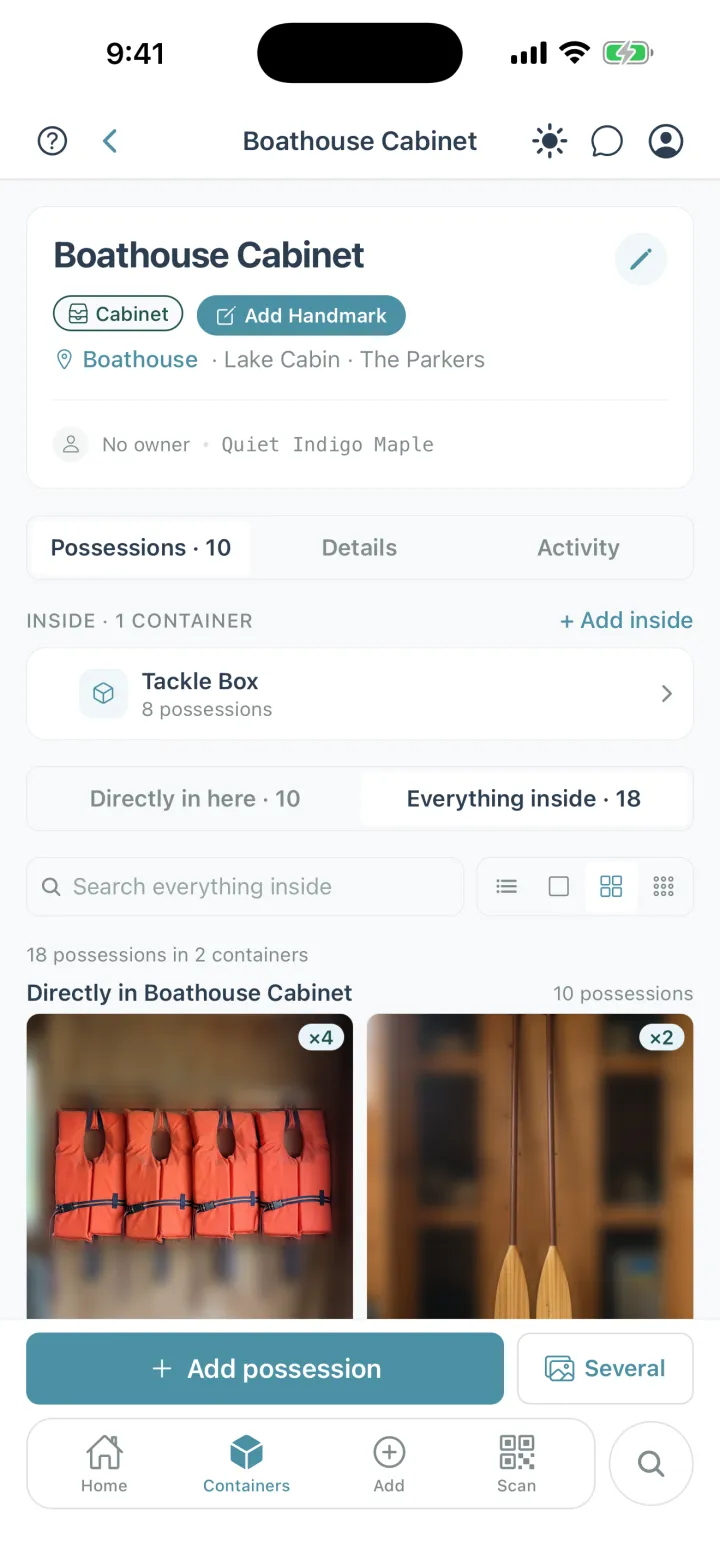
Containers inside containers, with everything inside listed.
Photograph each body and lens, and AI identification fills in a name and category, with a confidence percentage on screen so you can correct either before you save. A receipt can be its own possession, with the amount and the purchase date. Four identical batteries can be one entry with a quantity of four. Search draws on each possession's details and the container it lives in, so searching for the lens tells you which bag it's in. When a lens is out on loan, mark it temporarily removed, with a note saying who has it.
A Collection is a list that spans containers, with a check-off on each entry. Make one for a shoot, add the gear you're bringing, and check it off as it goes into the bag.
The short version
Store camera gear indoors, in a closet or drawer with a steady temperature and moderate humidity, never in the basement, attic, garage or car. Keep silica gel in every bag, take batteries out and store them half charged, cap every lens, and let cold gear warm up in a sealed bag before you open it. Keep a list of every piece with its serial number, receipt and the bag it lives in, and check the kit a day before the next shoot. Cratify is free to try.
Know which bag the lens is in before the shoot
Photograph the kit, nest the bags inside the closet, and search for any lens by name. Cratify is free to try.