How to Store Folding Chairs and Tables Between Gatherings
Dry metal chairs before folding, hang them on studs, stand plastic tables on their edge instead of under a pile, and count your seats a week before guests arrive.

On this page
It's Thanksgiving morning and you're in the garage counting folding chairs. There were ten last year. Seven are leaned against the wall, an eighth is behind the lawn mower with a cobweb across the seat, and a ninth has a hinge that sticks halfway open and pinches whoever tries to fix it. The 6-foot table is where you left it, flat on the concrete under two boxes of paint cans, and the tabletop has a gentle dip in the middle that wasn't there in January. One of the chairs, you're fairly sure, belongs to your neighbor.
Folding chairs and tables spend most of the year unused, which is exactly why they're hard to store well. They're too big to forget and too awkward to put anywhere sensible, so they end up wherever there was room the day after the last party. Here's how to store them so they fold flat, stay dry and come out ready, with enough time before the holidays to fix whatever doesn't.
Clean and dry them before they fold
Put chairs and tables away dirty and the problem waits for you. Spilled drinks go sticky, food residue draws mice and insects, and damp metal rusts where you can't see it: inside the hinges and along the cross braces.
After each gathering:
Wipe down every seat, back and tabletop with warm soapy water, then rinse off the soap.
Let metal chairs dry completely, open, before you fold them. Water trapped in a folded hinge is how rust starts.
Air out padded and fabric seats for a day. A cushion folded while damp will smell of mildew by spring.
Open and close every chair and table once. A hinge that sticks or a leg brace that won't lock is easier to deal with now than with guests at the door.
Put a drop of household oil on stiff metal hinges, and wipe off the extra.
Any chair or table that's broken gets a strip of painter's tape with the problem written on it, like wobbly back leg, so it doesn't get handed to a guest by mistake next year.
Count what you have, and whose it is
Before you decide where they go, take stock. The question next November isn't whether you own folding chairs. It's whether you have enough seats for the guest list, and whether the table actually fits the room.
Write down:
How many chairs, by kind: metal, plastic, wood, padded.
Each table's size and how many it seats. A 6-foot rectangular table is usually 72 by 30 inches and seats six to eight, a 4-foot table seats four to six, and a square card table seats four.
Which chairs and tables are borrowed, and from whom.
Any piece that's broken, missing a foot cap, or past saving.
Borrowed chairs cause the most trouble, because after a year nobody remembers which three came from next door. Put a strip of tape with the owner's name under the seat the day they arrive. The guide to keeping track of what you lend out works the same way in reverse, for what you've borrowed.
Pick the right spot
Where folding furniture should live depends mostly on what it's made of.
Indoors for wood and padded chairs
Wood chairs, and any chair with a fabric or vinyl seat, do best inside the house, where temperature and humidity stay steady. A hall closet, the back of a guest room closet, or the space under the stairs all work. Wood that cycles between a cold garage and a warm room can loosen at the joints and crack its finish.
Garage, shed or basement for metal and plastic
Metal and resin chairs and plastic folding tables handle a garage or shed fine, with two conditions. Keep them off bare concrete, which wicks moisture up into metal feet and leg caps, and keep plastic tabletops out of direct sun from a window, which can fade and warp them over a summer. A shelf, a wall rack or a couple of scrap boards on the floor is enough to keep them dry.
How to store folding chairs
Folded chairs take up very little space when they're upright and in a row, and a lot of space when they're in a pile. A few ways to keep them in a row:
Hang them on the wall. Heavy-duty utility hooks screwed into studs, one or two chairs per hook, keep them off the floor and easy to count. A wall rail with sliding hooks fits as many chairs as the wall is long.
Stand them in a line against a wall, folded, with a strap or bungee cord across the front so the row can't fall like dominoes. Eight folded chairs need roughly two to three feet of wall.
Slide them behind a door or into the gap beside a fridge or a wardrobe, where a few inches of depth is all that's free.
Stack them flat on a low shelf if they're the kind that stack, no more than five or six high, with the heaviest at the bottom.
Use a chair cart or dolly if you have more than a dozen and move them often.
If your house has an awkward space under a staircase, it's often the best spot for folding chairs, because they're one of the few possessions that fit its low, deep end. The guide to organizing under-stairs storage covers how to set it up so you can reach the back.
How to store a folding table
Folding tables are where most storage damage happens, and it's almost always the same mistake: the table is laid flat, and then other possessions get stacked on top of it. A plastic tabletop under weight in a hot garage can bow in a single summer, and it won't flatten back.
Better options:
Store it on its edge against a wall, legs folded and locked, with a strap or a pair of hooks holding it upright.
Hang it on wall brackets made for folding tables, screwed into studs. A 6-foot plastic table can weigh 30 pounds or more, so don't trust drywall anchors with it.
Slide a square card table under a bed or behind a sofa, where a thin, flat shape is exactly what fits.
If it has to lie flat, put it on top of the pile, never under it.
Fold-in-half tables with a carry handle are the easiest of all: close them, latch them, and stand them in a closet like a suitcase. If your folding table lives in the room where guests will sleep, the guide to organizing a guest room that doubles as storage covers how to keep it out of the way until it's needed.
Get them out a week before
A week before a big gathering, bring the chairs and tables out once. That's enough time to fix what's wrong, and the morning of is not.
Count seats against the guest list, and add one or two for the guest who brings a guest.
Set up every table and check that each leg locks with a click.
Open every chair, sit on it, and set aside any that wobble.
Wipe each piece down, since a year in storage collects dust even under a cover.
Return or collect what you borrowed, and borrow more now if you're short.
Then decide where the folded chairs go when the meal is over, so they don't spend the next week in the hallway.
Where an app helps
If you'd rather keep that count on your phone than on a strip of tape, here's how it works in Cratify. The garage is a Room, and the places folding furniture lives are containers: a Closet in the hallway or a Shelf in the garage.
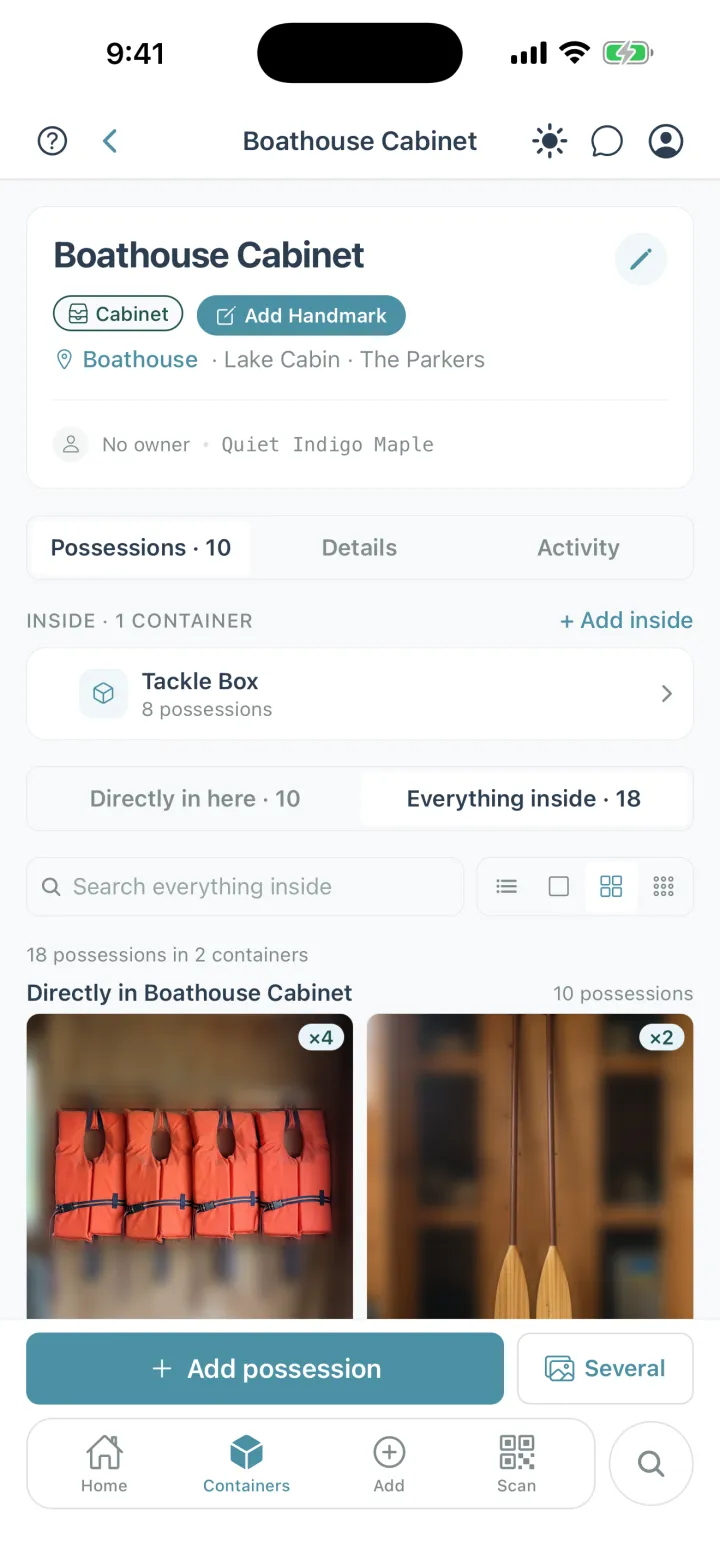
Containers inside containers, with everything inside listed.
Each set of chairs can be one Item possession with its photo and a quantity, so eight matching metal chairs are one entry that shows ×8 instead of eight separate ones. Possession properties include Heavy, which is worth adding to the 6-foot table. Belongs To assigns a possession to a person, so the three chairs from next door can belong to your neighbor and show up on that person's page instead of in your own count.
Search draws on each possession's details and the container it's in, so searching for folding chairs tells you how many you have and which Closet they're in. A Collection is a list that spans containers, with a check-off on each entry, so the setup for Thanksgiving can be one Collection: the tables, the chairs and the tablecloths, checked off as each one comes out.
The short version
Clean and fully dry chairs and tables before you fold them, and oil any stiff hinge. Count what you have, including whose it is. Keep wood and padded chairs indoors, keep metal and plastic off bare concrete, store chairs upright in a row and tables on their edge, and never put a table under a pile. Bring it all out a week before you need it. Cratify is free to try.
Know how many seats you have before guests arrive
Photograph each set of chairs, note the quantity, and see which Closet they're in from your phone. Cratify is free to try.