How to Store Luggage and Keep Your Travel Gear Ready
Store luggage indoors on a closet shelf or under the bed, nest the bags, keep travel-only gear inside, and tape a list to the lid so the next trip starts half packed.

On this page
It's the night before the Thanksgiving drive, and the big suitcase is on the top shelf of the hall closet, behind two comforters and a box of old photos. You get it down. Inside is the carry-on, and inside that is a boarding pass from July, half a bottle of sunscreen and one sock. The plug adapter you bought for the last trip isn't in either of them.
Luggage is an awkward possession to store. It's big, it's empty most of the year, and it's needed on short notice a few times a year. Most of the trouble comes from three habits: storing bags wherever there was room, storing them empty, and storing them with the last trip's leftovers still inside. Fix those three and the night before a trip gets a lot shorter.
Where to store suitcases
The right spot depends on how often you travel and how much room you have. In rough order of preference:
The top shelf of a bedroom or hall closet. It's dry, it's indoors, and it's close to where you pack.
Under the bed, if the bags fit flat with a little clearance. Soft-sided luggage and slim hard cases usually do. The guide to what to store under the bed covers what else earns that space.
A guest room closet, if you have one. Guests need a place to open a suitcase anyway, so the luggage and the room go together.
The back of a wardrobe or the floor of a coat closet, standing upright, in a small apartment with no spare shelf.
A basement or attic, only if it stays dry and doesn't swing between very hot and very cold. Damp brings mildew into fabric linings, and heat is hard on wheels, zippers and the glue that holds linings in place.
The garage is the last resort. Temperature swings, dust and mice all reach a bag stored there, and you end up cleaning it out the night before the flight instead of packing it.
Nest them so they take one footprint
If you have more than one suitcase, store them inside each other: the carry-on goes in the medium bag, and the medium bag goes in the large one. Three bags take the shelf space of one.
Check the fit with the wheels and handles included. Two hard cases that look like they'll nest sometimes don't once the handle housing is inside.
Put an old pillowcase or a dust bag between hard shells so they don't scuff each other.
If one bag travels far more often than the others, keep it on the outside or store it on its own, so a weekend trip doesn't mean unpacking the whole set.
Nesting has one cost: you can't see what's inside. That's the part the rest of this guide deals with.
Store them full of travel gear, not empty
An empty suitcase is wasted storage. Fill the innermost bag with the gear that only gets used on trips, and half the packing is done before you start.
What belongs inside
A travel toiletry bag with empty refillable bottles.
Plug adapters, a spare charging cable and a small power strip.
Packing cubes, a laundry bag and shoe bags.
A luggage lock, with the code written down somewhere you'll find it, plus spare luggage tags.
A neck pillow, an eye mask and earplugs.
A travel umbrella, and a folded duffel for the trip home with more than you left with.
What stays out
Passports, visas and travel documents. They belong with your important papers, where you'll look first; the guide to organizing important documents covers that drawer.
Full bottles of liquid. Sunscreen, shampoo and lotion leak, and in a warm attic they leak sooner.
Medications. Pack them fresh for each trip from what you use day to day, rather than keeping a supply on a shelf nobody checks.
Off-season clothes, unless you rarely travel. A suitcase full of sweaters is fine storage until the morning you need the suitcase and have to find a home for the sweaters first.
Empty and clean them the day you get home
Do this the day you get back, while you still remember what went in the side pockets.
Empty every pocket, including the one behind the lining. Boarding passes, receipts, coins and hotel key cards all turn up there.
Turn the bag upside down and shake it out, vacuum the lining, and wipe the shell and the wheels.
Leave it open for a day so any damp from the trip dries out before you close it up.
Peel off old airline bag tags and barcode stickers so they can't confuse a scanner on the next trip.
Check the wheels, the handle and the zippers. A broken wheel found in November can be fixed or replaced; found at the airport curb, it can't.
Put the travel gear back in, nest the bags, and put them away.
Write down what's in the bags
Once the bags are nested and the kit is inside, the contents are out of sight. A short list fixes that. Tape one inside the lid of the outer suitcase, and keep a copy you can read without climbing to the top shelf: a note on your phone works.
In a household with several travelers, the list also answers whose bag is whose. When a suitcase goes out on loan for a friend's trip, write down who has it and when; keeping track of what you lend out covers that habit. Luggage gets borrowed often and comes back slowly.
Two weeks before the next trip
Pull the bags down a couple of weeks before you leave, not the night before. That's enough time to replace what's missing.
Check that the adapters and the charging cable are still in the kit.
Refill the toiletry bottles.
Test the luggage lock and confirm the code.
Look over the wheels and zippers one more time.
Start the packing list from the list taped inside the lid.
Where an app helps
If you'd rather keep the luggage list somewhere other than the inside of a suitcase lid, here's how it works in Cratify. The hall closet can be a Closet container, and the big suitcase can be a container on its shelf. Containers nest, so the carry-on is a container inside the big suitcase, and the big suitcase's view lists the possessions in it and in every container nested inside it, with totals.
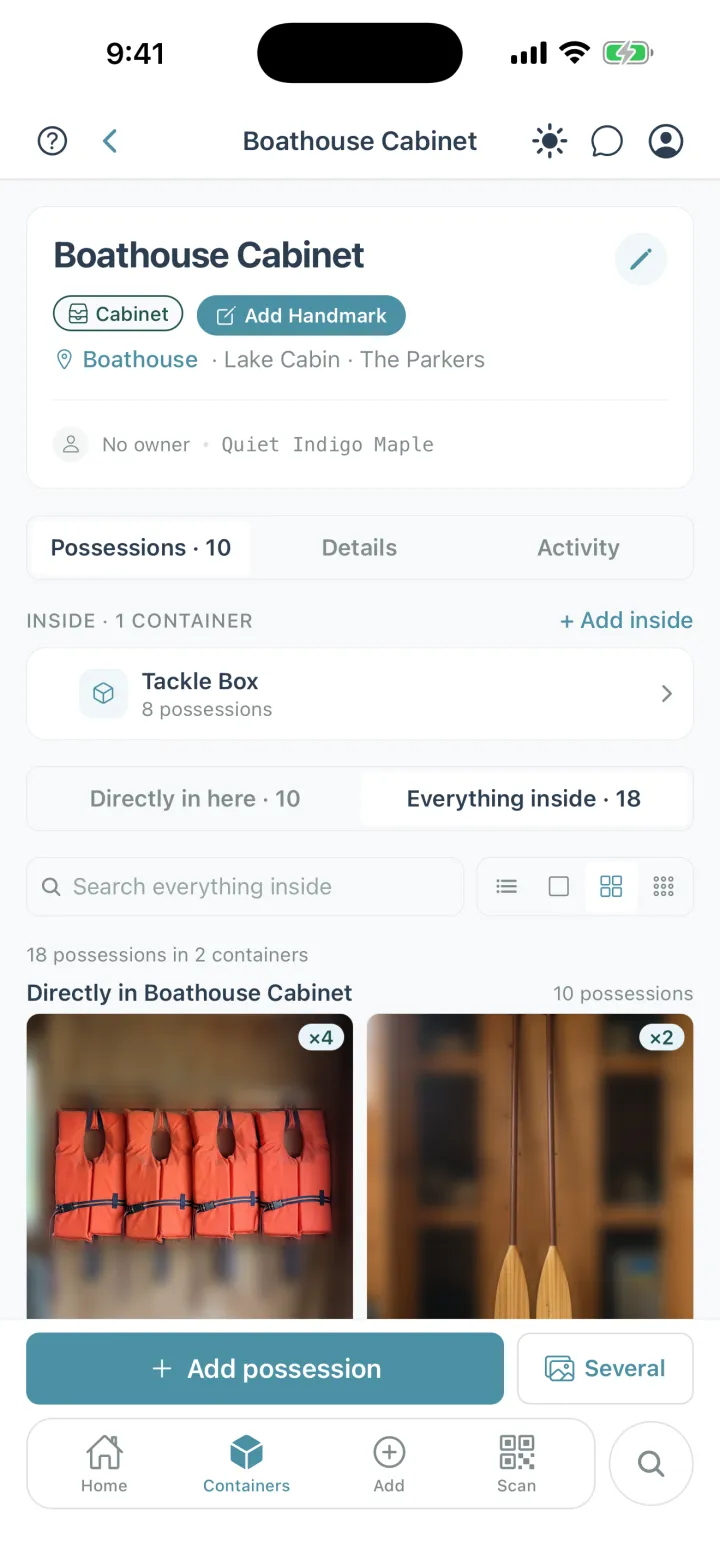
Containers inside containers, with everything inside listed.
Photograph the adapters, the toiletry bag and the lock, and AI identification fills in a name and category, with a confidence percentage on screen so you can correct either before you save. Each bag can belong to a person, so the household knows whose carry-on is whose. When a suitcase goes out on loan, mark it temporarily removed, with a note saying who has it.
A Collection is a list that spans every container, with a check-off on each entry. Make one for the trip, add the possessions you're bringing from wherever they live, and check them off as they go into the bag.
The short version
Store luggage indoors, somewhere dry with a steady temperature: a closet shelf, under the bed or a guest room. Nest the bags inside each other, fill the innermost one with travel-only gear, and keep documents, liquids and medications out. Empty and clean every bag the day you get home, tape a list of what's inside to the lid, and pull the set down two weeks before the next trip. Cratify is free to try.
Know what's in the suitcase before you pull it down
Photograph the travel kit, nest the bags as containers, and check the list before each trip. Cratify is free to try.