How to Organize a Coat Closet Before Winter
Empty the closet floor first, keep only this season's coats by the door, give each person a section, leave room for guests, and swap the seasons twice a year.

On this page
It's the first cold morning of the year, and the coat you want is behind three others on a hook that was never meant to hold four. The closet door won't close because the vacuum and a pile of reusable shopping bags are leaning against it. Somewhere on the shelf above, under a knot of scarves, are the gloves you bought last March.
Organizing a coat closet comes down to five jobs: emptying it, deciding what belongs by the door, giving each person their own section, putting the shelf, the door and the floor to work, and swapping the seasons twice a year. A coat closet also has to work for guests, which most closets forget until the first holiday party. Here's how to do each, in the order it has to be done.
Empty it completely, floor first
Take out every coat, every pair of shoes, every bag and every box on the shelf. Start with the floor, because the floor is where a coat closet's real problems sit: the umbrella that broke in June, the shoes nobody has worn since you moved in, the bag of donations that never left the house.
Lay it all out in the hall and sort it into four piles:
Wear now: coats, shoes and accessories someone in the house uses this season.
Off-season: summer jackets, light rain gear, sandals and sun hats.
Belongs elsewhere: the vacuum, sports gear, wrapping paper, spare light bulbs and the reusable bags.
Let go: coats that don't fit, single gloves, broken umbrellas, and coats nobody has worn in two winters.
The belongs-elsewhere pile is usually the biggest, and it's the reason the coats are crowded. A closet by the front door is some of the most useful storage in the house, and it fills up with whatever needed a home in a hurry.
Decide what earns a place by the door
A coat closet has one job: getting people out the door and back in again. Use that as the test. What earns a spot is what leaves the house most days: coats in current use, the shoes people wear outside, hats, gloves, scarves, umbrellas and the bags that go out every morning.
What doesn't earn a spot: off-season coats, the formal coat worn twice a year, the vacuum and the spare bulbs. They can live one step further away, in a bedroom closet, under the stairs, or in a labeled box in the basement.
Count coats per person before you hang any back up. Two coats per person in season is a good working number: one heavy and one lighter. If four people live in the house and twelve coats go back in, the closet will be full again by Thanksgiving.
Give each person a section
The fastest way to keep a shared closet working is to stop sharing it. Split the rod into sections, one per person, and keep each person's coats together.
Adults get the rod at full height.
Kids get a low hook or a second rod they can reach on their own. If a child can't hang up their own coat, it ends up on the floor.
Guests get the far end of the rod, kept empty, with four or five spare hangers waiting.
The dog gets one hook for the leash and a small box on the shelf for bags and treats.
Wooden or felt hangers with a wide shoulder keep heavy coats in shape. Matching hangers also let the rod hold more than you'd expect, because mismatched hangers sit at different heights and widths and push each other apart.
Put the shelf, the door and the floor to work
Most coat closets use the rod and ignore the rest. The shelf, the back of the door and the floor are where the small, easily lost pieces should live.
The shelf
The shelf above the rod is for hats, gloves and scarves. Give each person one small open box, labeled with their name, so a glove that comes off on the porch goes back to the right place. Keep the boxes open. A lid adds a step, and one extra step is what makes people leave gloves on the floor.
The door
The back of the closet door is space most closets waste. An over-the-door rack holds umbrellas, reusable bags, a lint roller and the spare leash. Measure the gap between the door and the frame first, so the rack doesn't stop the door from closing.
The floor
Keep the floor for shoes, and only the shoes people are wearing outside this week. A two-tier shoe rack doubles the space and keeps the pairs together. Put a boot tray at the front for snow and rain, so wet boots dry where you can see them instead of soaking the shoes behind them.
The full entryway treatment, with hooks set by height and one column per person, is in the guide to organizing a mudroom, and most of it works inside a closet too.
Swap the seasons twice a year
Two swaps a year keep a coat closet from turning into an archive: once in late fall, when the heavy coats come out, and once in spring, when they go away.
When a heavy coat goes into storage:
Clean it first, following the care label. Stains set over the summer, and moths go for dirty wool.
Empty the pockets. Pockets are where lost gloves, receipts and keys turn up.
Hang it in a breathable garment bag rather than plastic, which traps moisture.
Write down where it went.
That last step is the one people skip, and it's why a coat put away in April can't be found in November. The guide to swapping summer and winter clothes covers the whole swap, including how to pack the boxes the off-season clothes go into.
Get it ready before guests arrive
Between Thanksgiving and New Year's, the coat closet is the first storage guests see. Before the first party, clear the guest end of the rod, put out the spare hangers, and move one pair of family boots off the floor to make room for theirs. A small tray on the shelf for guests' hats and gloves stops anyone going home with the wrong pair.
If the closet can't take every coat, the bed in a spare room works as overflow. The guide to organizing a guest room covers getting that room ready for the season as well.
Keep a short record of what's stored away
The coats in the closet don't need a record, because you can see them. The ones in storage do, along with the possessions that were expensive or that you'd hate to lose. For each one, note:
What it is, with a photo
Whose it is
Where it's stored: which closet, which box and which room
The receipt, if it was expensive, and the purchase date
A notebook taped inside the closet door does this job. So does a note on your phone, as long as it's the same note every time.
Where an app helps
If you'd rather the record show where each coat is and whose it is, here's how it works in Cratify. The coat closet is a container (Closet is one of the container types) in the room it sits in, and so is each box on its shelf or down in the basement.
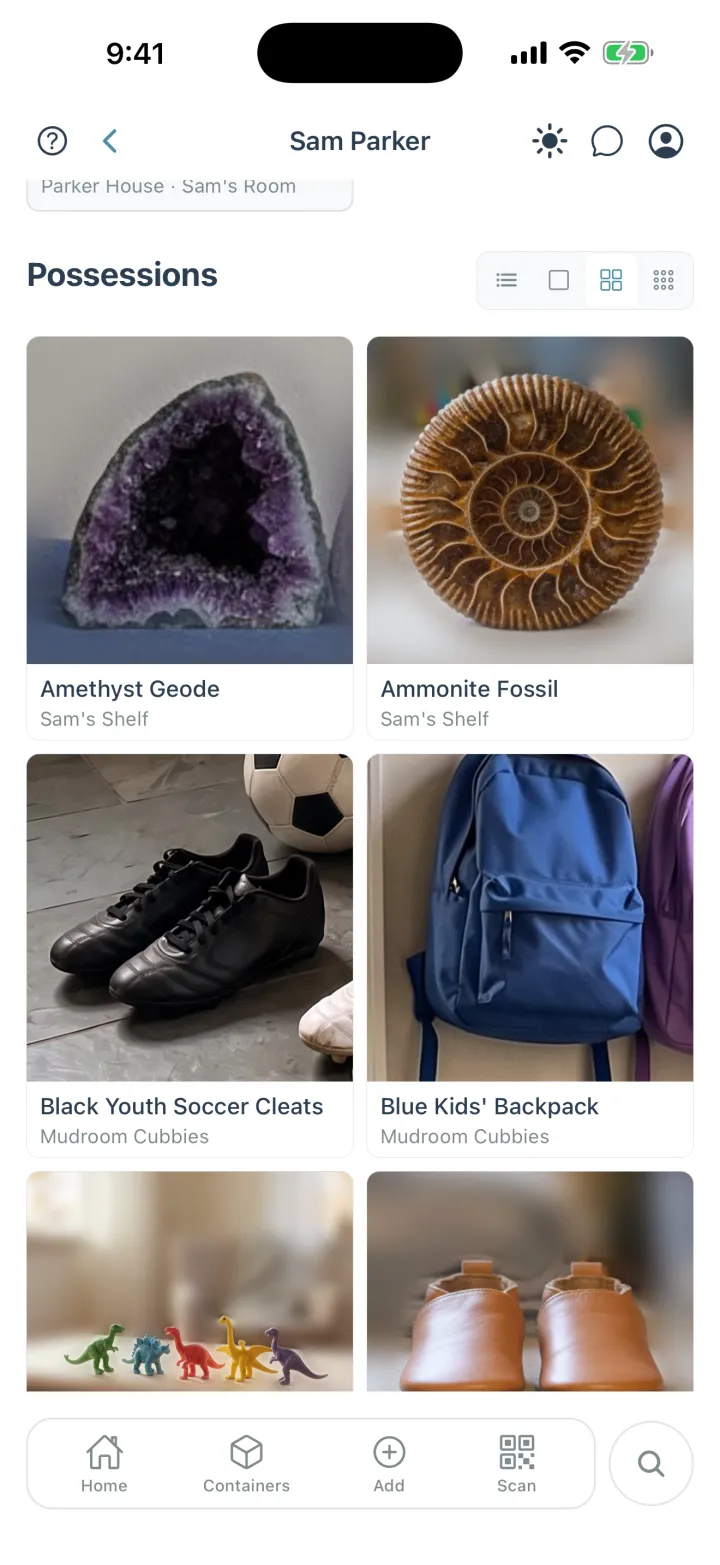
Each person gets a page with what's theirs, kids included.
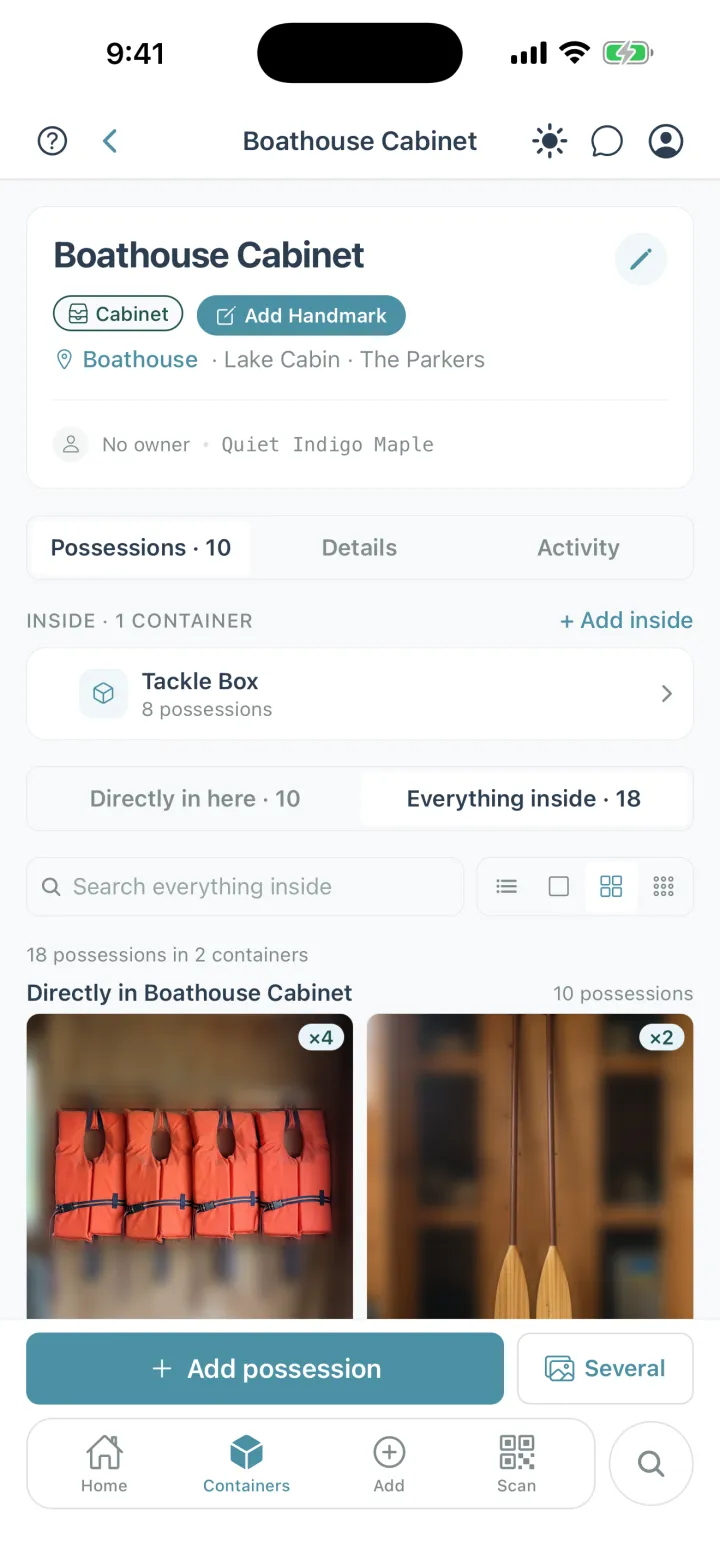
Containers inside containers, with everything inside listed.
Photograph a coat and AI identification fills in a name and category, with a confidence percentage on screen so you can correct either before you save. Each possession can be set to belong to a person, including a child or a pet, so the kids' gloves and the dog's leash land on the right list. A receipt can be saved as its own possession with the amount and the purchase date.
Search draws on each possession's details and the container it's in, so in November, searching for the gray wool coat tells you which box in the basement to open. A Collection is a list that spans every container, with a check-off on each entry: make one called winter coats, and check each coat off as it comes back to the closet.
The short version
Empty the closet, floor first. Keep only what leaves the house this season, and move the rest somewhere further away. Give each person a section of the rod and a box on the shelf, leave the far end for guests, and put the door and a shoe rack to work for the rest. Swap the seasons twice a year and write down where the stored coats went, so the first cold morning goes to getting out the door instead of the search. Cratify is free to try.
Know which box the wool coat is in
Photograph each coat, file it in the closet or box that holds it, and set whose it is. Cratify is free to try.