How to Store a Kayak for Winter
Rinse and dry the kayak, check it for damage, rest it on its side or on wide padded supports out of the sun, and give the paddles and life jackets their own place.

On this page
- Do it right after your last paddle
- Clean the kayak inside and out
- Check it over while there's time to fix it
- Protect the hull from sun and from its own weight
- Choose how the kayak rests
- Indoors if you can, covered if you can't
- Inflatable and folding kayaks
- Put the gear somewhere you'll find it
- Write down where each piece went
- Where an app helps
- The short version
It's the first warm weekend in May and the kayak is coming down off the garage wall. There's a shallow dent in the hull where it rested on two sawhorses all winter, a mouse has been living in the cockpit, and the spray skirt smells like a pond. One paddle is here. The other is at your brother's, probably.
Storing a kayak for winter comes down to five jobs: cleaning and drying the boat, checking it over while you still have time to fix it, supporting the hull so it keeps its shape, covering it from sun and critters, and putting the paddles, life jackets and the rest of the gear somewhere you'll find them again. Here's how to do each, in the order that makes spring easy.
Do it right after your last paddle
The best time is the week after your last trip of the year, before the first hard freeze and before the boat sits in the driveway for a month. A kayak put away wet and sandy in October is the one with mildew in the hatches and grit ground into the seat in May.
Pick a dry day and set up somewhere with a hose, a couple of sawhorses with old towels over them, and room to walk around the boat.
Clean the kayak inside and out
Grit and dried lake water are what wear out seals, buckles and foot pegs over a winter, so the boat gets a proper wash first.
Rinse the hull, deck and cockpit with fresh water. If you paddled in salt water this season, rinse twice and don't skip the hardware.
Wash with a soft sponge and a little mild soap, then rinse again. Pay attention to the cockpit rim, the scupper holes on a sit-on-top and the track that the foot pegs slide in.
Open every hatch, pull out the sponges and float bags, and tip the boat on its side to drain the water you didn't know was in there.
Leave it upside down in the sun for an hour, then leave the hatch covers off overnight in the garage so the inside dries completely.
If the rudder or skeg is retractable, run it up and down a few times while you rinse, so sand isn't left packed into the housing.
Check it over while there's time to fix it
Winter is the cheap time to repair a kayak, because nobody is waiting on it. Go over the boat with a flashlight before it goes into storage:
Look along the hull for deep gouges, cracks and soft spots, especially at the bow and stern where it gets dragged.
Check the hatch gaskets and covers for tears or stretched rims that won't seal next year.
Pull on the deck bungees and grab loops. Frayed cord is easy to replace now and annoying to replace at the launch.
Work the foot pegs, the seat adjustment and any rudder cables, and note what sticks or slips.
Write down whatever needs replacing before spring. A list made in November turns into an order placed in February instead of a scramble the morning of the first trip.
Protect the hull from sun and from its own weight
Two forces ruin a stored kayak: ultraviolet light and long-term pressure on the hull. Plastic kayaks are the most sensitive to both.
Sun breaks down plastic and fades the color, even through a garage window. Many paddlers wipe a UV protectant made for plastics over the hull and deck before storage. Check the maker's care instructions for your boat's material, especially on composite and inflatable kayaks.
Weight is the less obvious problem. A polyethylene kayak left lying on its hull on a flat floor, or resting on two narrow points, can slowly take a dent or a flat spot that doesn't fully come back out. The goal is to spread the weight over wide, padded supports.
Choose how the kayak rests
There are three good ways to store a kayak for winter, and one common way to avoid.
On its side
Resting the boat on its side, on a padded rack or a couple of folded blankets, puts the weight on the strongest part of the hull. It's the simplest option in a garage, and it works well for long-term storage.
Upside down on a rack
Upside down on a wall rack or two padded cradles also works, with the supports about a third of the way in from each end, where the boat is stiffest. Wide nylon straps or foam-padded arms spread the load better than bare metal bars.
Hung in slings
A ceiling hoist or wide hanging slings get the kayak up out of the way, which is the reason most garages end up with one. Use slings at least a few inches wide, placed at the same thirds, and check the hoist rating against the weight of the boat.
What to avoid
Don't hang a kayak by its carry handles or grab loops for months. They aren't designed to hold the full weight of the boat for a season, and the hull can sag between them. And don't store it flat on the concrete, where it sits in the cold and damp and takes the shape of the floor.
Indoors if you can, covered if you can't
A garage, basement or shed is the best place for a kayak over winter: out of the sun, out of the snow and away from big temperature swings. If the boat is near a window, throw a sheet over it.
If it has to stay outside, store it off the ground on a rack, upside down so water and snow can't collect in the cockpit. Cover it with a tarp tented over the boat rather than wrapped tight against it, so moisture can escape. A cockpit cover keeps mice and wasps from moving in. If the rack is visible from the road, run a cable lock through a grab loop and around the rack.
The guide to organizing a garage to park your car covers making wall and ceiling space for a boat without giving up the parking spot.
Inflatable and folding kayaks
Inflatables follow the same cleaning steps, and then the most important rule is that they must be completely dry before they're packed away. Inflate, wash and dry the boat, let the air out, and fold or roll it loosely along its original creases. Store it in its bag indoors, somewhere that stays above freezing, and check the manual for any steps specific to your model. Folding kayaks generally store best folded and dry, in their case, in a dry room.
Put the gear somewhere you'll find it
The boat is the easy part to find in spring. The gear is what scatters. Give each piece a proper place:
Paddles: rinse, dry and store them indoors, on a wall rack or standing in a corner, not under the kayak where they get stepped on. Take two-piece paddles apart so the joint doesn't seize.
Life jackets: rinse, dry fully and hang them on a wide hanger in a closet, out of the sun. Don't crush them under heavy gear, and set aside any with torn straps or broken buckles.
Spray skirts, cockpit covers and dry bags: rinse, dry inside and out, and store them loose rather than folded tight.
Wetsuits and drysuits: rinse and hang them to dry on a wide hanger, then follow the maker's care instructions for zippers and seals.
Small gear: the bilge pump, paddle float, whistle, throw bag and repair kit go together in one labeled box.
Roof rack pads, straps and kayak cradles: take them off the car and keep them with the boat, so you're not hunting for them on launch day.
The guide to organizing camping gear works well alongside this one if the paddling gear shares a shelf with the tent. And if a bike lives in the same corner of the garage, storing a bike for winter covers that side of the wall.
Write down where each piece went
In May the question is rarely whether the kayak survived. It's where the second paddle is, which life jacket fits which kid, and whether the spray skirt is in the basement or the trunk. A short list fixes that. For each piece of gear, note:
What it is, and how many (two paddles, four life jackets)
Where it's stored: the room, and the shelf, cabinet or box
Whose it is, if the family shares gear in different sizes
What needs repairing or replacing before spring
What you lent out, and to whom
Where an app helps
A notebook does this job. If you'd rather the list carry photos and say exactly where each piece is stored, here's how it works in Cratify.
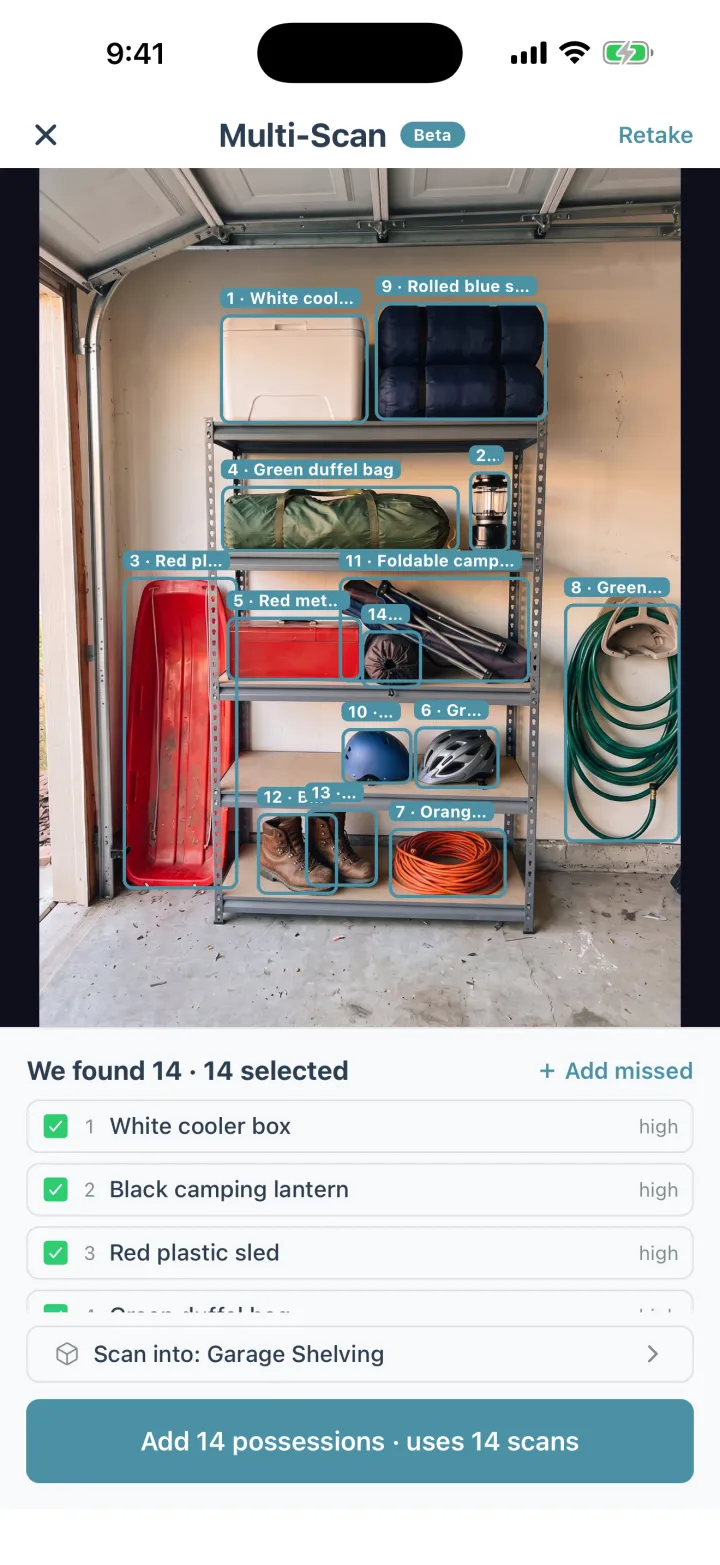
Multi-Scan names up to 15 possessions from one photo.
Each piece of gear can be its own possession inside the container that holds it: the paddles on a garage shelf, the life jackets in the hall closet, the pump and repair kit in a box in the basement. Photograph a life jacket and AI identification fills in a name and category, with a confidence percentage on screen so you can correct either before you save. A quantity covers matching pieces, so four life jackets show as ×4 instead of four separate entries, and each possession can be set to belong to the person it fits.
A Collection is a list that spans every container, with a check-off on each entry. Make one for the first trip of spring and check gear off as it comes back out, wherever it spent the winter. Search draws on each possession's details and the container it's in, so searching for the spray skirt tells you which shelf to check.
The short version
Right after your last paddle, rinse the kayak, wash it, and dry it inside and out with the hatches open. Check it for damage and write down what needs fixing. Protect the hull from sun, rest it on its side or on wide padded supports, and keep it indoors or under a tented tarp, off the ground. Then put the paddles, life jackets and small gear in their own places, and write down where each piece went, so the first warm weekend goes to the water instead of the search. Cratify is free to try.
Know where every paddle spent the winter
Photograph each paddle and life jacket, file it in the container where it's stored, and check it off as it comes back out in spring. Cratify is free to try.