How to Organize a Fridge So Leftovers Don't Get Lost
Learn where the fridge is coldest, give every shelf one job, keep labeled leftovers at the front, and take five minutes a week to reset it before you go shopping.

On this page
- Take it all out first
- Know where it's cold and where it isn't
- Give every shelf one job
- Put leftovers where you'll see them
- Use trays to make shelves work like drawers
- Two drawers, two jobs
- After a big holiday meal
- The five-minute weekly reset
- The second fridge in the garage
- Where an app helps
- The short version
It's the Friday after Thanksgiving, and the fridge is a wall of foil. Three plates of turkey, a bowl of mashed potatoes with the serving spoon still in it, two pies stacked on top of the milk. Somewhere behind all of it is the cranberry sauce you made on Tuesday. You'll find it next Thursday, along with half a lemon and a jar of olives nobody remembers opening.
A fridge gets disorganized faster than any other storage in the house, because it's restocked every few days and cleaned out almost never. The fix isn't a set of matching acrylic organizers. It's three habits: every shelf has one job, leftovers live where you can see them, and once a week someone takes five minutes to reset. Here's how to set that up, starting today, while the leftovers make the case for you.
Take it all out first
Pull out every jar, dish and bottle and set them on the counter, grouped roughly: leftovers, dairy, produce, condiments, drinks. If the job will take more than a few minutes, keep a cooler with ice packs next to you for the dairy and meat.
Throw out what's past its date or has clearly turned, then wipe the shelves and drawers with warm, soapy water while they're empty. Most people find two of the same condiment open at once. Combine them if you can, or put the older one in front so it gets used first.
Know where it's cold and where it isn't
A fridge isn't the same temperature everywhere. The door is the warmest part, because it swings out into room air every time someone opens it. The back of the lower shelves usually runs coldest. The drawers at the bottom hold humidity, which is what produce wants. Where food goes should follow those zones, not just wherever there happens to be room.
If you're not sure the fridge is cold enough, an inexpensive fridge thermometer on the middle shelf will tell you, and the setting is usually a dial on the inside wall.
Give every shelf one job
Once you know the zones, assign them. A layout that works in most fridges:
Top shelf: leftovers and ready-to-eat food, at the front, where you see them every time the door opens.
Middle shelf: dairy and eggs. Keep eggs in their carton on a shelf rather than in the door, where the temperature swings most.
Bottom shelf: raw meat and fish on a rimmed tray, low enough that any drips land on the tray instead of on food below.
Drawers: fruit and vegetables.
Door: condiments, dressings, juice and butter, the foods that handle a little warmth best.
The shelf assignment matters more than any organizer you buy. When the milk always lives in the same spot, you can see at a glance that it's running low, and so can whoever does the shopping.
Put leftovers where you'll see them
Leftovers get lost because they get pushed to the back. Give them the front of the top shelf and keep them there. Store them in clear, lidded dishes rather than on foil-covered plates, so you can see what's inside without lifting a corner.
Keep a roll of masking tape and a marker in the drawer nearest the fridge, and write the name of the dish and the day you made it on every lid. When you open the door on Wednesday, the tape tells you which turkey is from Thursday's dinner and which is from the weekend. If you're not sure how long a dish keeps, check a food-safety guide you trust, and when in doubt, throw it out.
One rule keeps the front of the shelf honest: new leftovers go behind older ones, so the oldest dish is always the next one you reach for.
Use trays to make shelves work like drawers
Deep fridge shelves are where small jars disappear. A few clear trays solve that. Group like with like on one tray, and pull the whole tray out to reach the back.
One tray for small jars: jam, capers, olives, the mustard you use twice a year.
One tray for snacks, on a shelf the kids can reach.
A turntable for sauces on a corner shelf, so the bottle at the back spins to the front.
Label the front edge of each tray, so whoever puts the groceries away knows where the yogurt goes. That's the step that makes the system survive a busy week.
Two drawers, two jobs
Many fridges have two produce drawers, often with a small slider that opens or closes a vent. A drawer with the vent closed holds more humidity, which suits leafy greens and herbs. A drawer with the vent open lets air through, which suits most fruit. If your drawers have sliders, set one each way and sort by that. If they don't, keep fruit in one and vegetables in the other, and look in both before you shop.
After a big holiday meal
A holiday meal fills a fridge in an afternoon. A little planning keeps it from taking over the week:
Before the meal, clear one full shelf and leave it empty for the leftovers.
Divide large amounts into smaller, shallow dishes so they cool faster and stack flat.
Label each one with the dish and the date before it goes in.
Pack leftovers for guests in their own dishes, ready by the door, so the fridge only holds what stays.
The day after, take ten minutes to move the oldest leftovers to the front and freeze what you won't eat this week. The guide to organizing a freezer covers how to label and keep track of what goes in there.
The five-minute weekly reset
A fridge stays organized only if someone resets it. The night before grocery day works well:
Toss what's past its date or no longer good.
Move the oldest leftovers to the front.
Wipe any spill while it's still fresh.
Write the shopping list from what's empty: the milk spot, the egg carton, the gaps on the condiment tray.
Five minutes once a week beats an hour-long clean-out every two months, and it means the list for the store comes from what's actually missing. The same habit works on the shelves next door, and the guide to organizing a pantry shows how to set them up.
The second fridge in the garage
A lot of homes have a second fridge or a chest freezer in the garage or the basement, and that's where the real overbuying happens: three cases of sparkling water, two jars of pickles, a backup gallon of milk that has been there since summer. Give that fridge the same rules as the kitchen one: one zone for drinks, one for backup condiments and dairy, and one empty shelf for holiday overflow. Keep a short list of what's in it on the kitchen fridge, so nobody has to walk to the garage to find out.
Where an app helps
The kitchen fridge turns over too fast to be worth cataloging, and a list on the door does that job well. Cratify is more useful for the parts of a fridge that last. In Cratify, a fridge is a container of the Appliance type, and it can link to a possession that carries its value and its receipt. Put the model number and the water filter it takes in the description, and when the filter needs changing or the ice maker stops working, the details and the receipt are in one place. The guide to appliance warranty and receipt tracking covers that side in more detail.
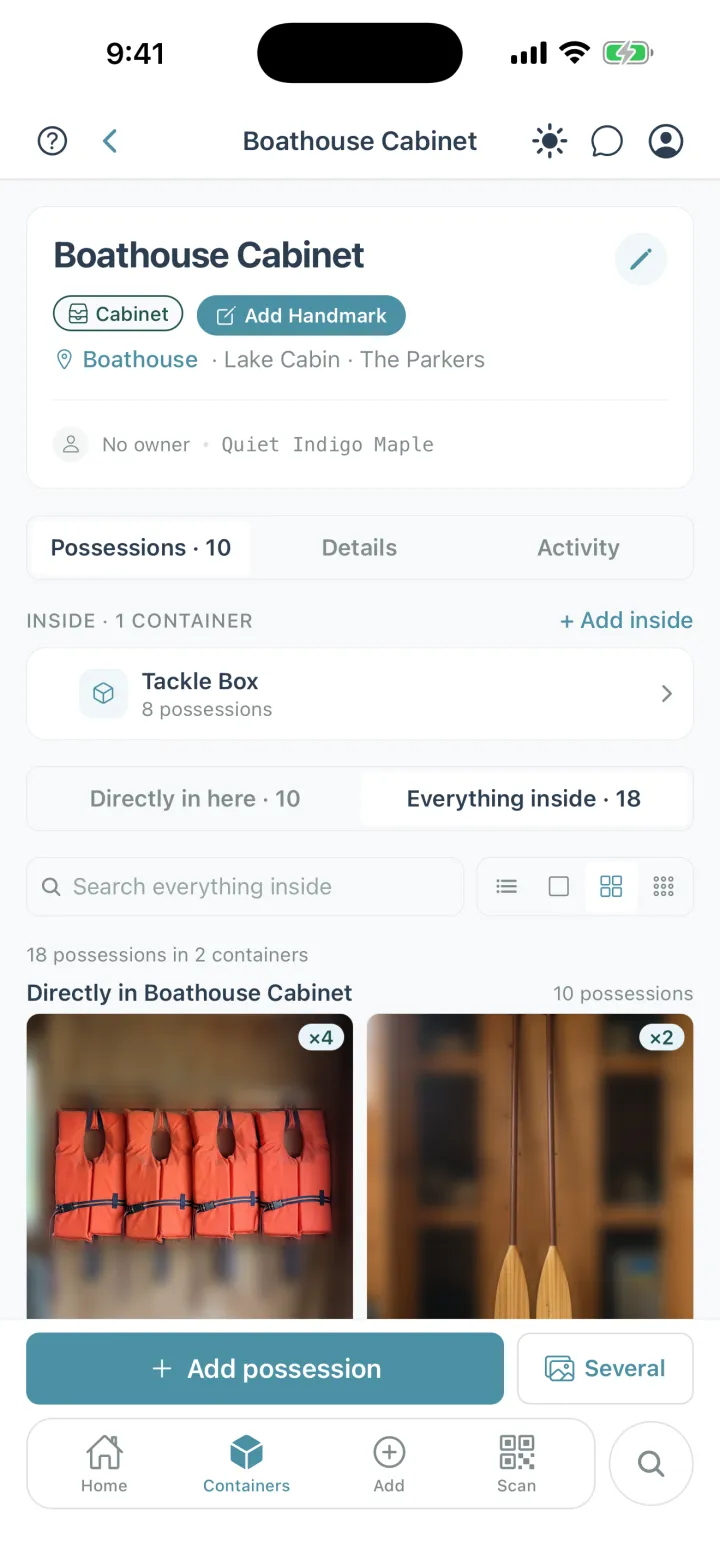
Containers inside containers, with everything inside listed.
For the garage fridge, backup stock can be possessions of the Consumable type, which carry a quantity, a unit and a note on when to restock. Three cases of sparkling water are one entry with a quantity of three. Search draws on each possession's details and the container it sits in, so you can check from the store whether the garage fridge already has what's on your list.
The short version
Empty the fridge, toss what's turned, and wipe it down. Learn where it's cold and where it isn't, give every shelf one job, and keep leftovers in clear, labeled dishes at the front of the top shelf. Use trays for small jars, set the produce drawers for greens and fruit, and take five minutes each week to reset before you shop. Cratify is free to try.
Keep the fridge's details in one place
Record the receipt, the model number and the backup stock in the garage fridge. Cratify is free to try.