How to Organize Cleaning Supplies Around the Whole House
Gather every bottle in one place, sort cleaning supplies by job, give each floor its own caddy, and keep a short count of backup stock so you stop buying doubles.

On this page
It's the day before the guests arrive. You open the cabinet under the kitchen sink for the glass cleaner and find three half-empty bottles of all-purpose spray, a sponge gone stiff, a spray bottle with no label, and a bag of dish soap refills you forgot you bought. The glass cleaner is upstairs in the bathroom, where you left it in September. The mop is in the garage. The vacuum bags are in a drawer, somewhere, probably.
Cleaning supplies drift because they get used all over the house and put back wherever the job ended. Organizing them isn't about matching spray bottles or a label maker. It's about deciding where each kind of job starts, keeping the supplies for that job there, and knowing how many of each product you already have before you buy more. Here's how to do it in an afternoon, in the order that works.
Gather every bottle in one place first
Walk the whole house with a laundry basket: under the kitchen sink, every bathroom, the laundry room, the hall closet, the garage shelf, the trunk of the car. Bring back every cleaning product, sponge, cloth, brush and refill. It feels like overkill, and it's the only way to see what you own. Most homes turn out to have two or three of the same product, opened, in different rooms.
Then sort the pile on a table or the floor:
Empty, dried out or unlabeled: out. A spray bottle you can't identify isn't worth guessing about.
Duplicates: keep the fullest one in use and move the rest to backup stock.
Products nobody has used in a year: decide now whether you'll use them or give them away. If the label says not to put it in the trash, it goes to a household hazardous waste drop-off.
The rest: keep, and move on to the next step.
Sort by job, not by brand
Group what's left by the job it does. Someone cleaning a bathroom wants every bathroom product within reach, and nobody goes looking for all the sprays at once. Six groups cover most homes:
Kitchen: dish soap, dishwasher detergent, degreaser, counter spray, sponges
Bathroom: toilet cleaner and brush, tub and tile cleaner, a cloth that never goes near the kitchen
Floors: floor cleaner, mop heads, vacuum bags and filters
Glass and dusting: glass cleaner, microfiber cloths, a duster
Specialty: wood polish, stainless-steel cleaner, carpet stain remover, oven cleaner
Backup stock: the unopened refills and spares
Give each floor its own caddy
The biggest time-saver is a carry caddy for each floor, or for each bathroom if you have several. A caddy holds the four or five products and the cloths a room actually needs, and it travels with you, so you aren't walking back downstairs for the one bottle you forgot. When the job is done, the caddy goes back to one spot: under that floor's bathroom sink, or on a shelf in the nearest closet.
Keep a caddy light. If it's too heavy to carry with one hand, it gets left on the floor where the last job ended, and that's how bottles migrate. The specialty products and the backup stock don't need to travel. They live in one central spot.
Under the sink: one layer, risky bottles out of reach
The cabinet under the kitchen sink is where most cleaning supplies end up, and it's the worst cabinet in the house for them: dark, damp, cut in half by a pipe, and at a toddler's eye level. A few rules make it work:
Clear it completely and wipe it dry. Check the pipe for drips before you put a bottle back.
Line the base of the cabinet with a washable mat or a tray, so a leaking bottle doesn't soak the wood.
Keep one layer of products, so the bottle at the back is never hidden behind the one in front. A turntable or a pull-out tray helps here.
Use the inside of the door for a slim rack of sponges and brushes, or a hook for rubber gloves.
If children visit or live with you, fit a child-safety latch, or move the strongest products to a high shelf elsewhere.
Keep the backup stock out of the sink cabinet entirely. A closet shelf or a garage shelf holds refills better, and keeping them apart makes it obvious when you're down to the last one.
Where the tools go
The vacuum, mop, bucket and broom take up more room than every bottle combined, and they're the reason a hall closet stops closing. Give them one closet and hang what can hang. A wall rack with clips holds a broom, a mop and a duster upright and off the floor, so mop heads dry instead of turning sour. The bucket stores upside down underneath. Vacuum bags, filters and spare belts go in a labeled box on the shelf above the vacuum they fit, so you aren't hunting for the model number the day one runs out.
Stop buying doubles
Duplicates are the expensive side of cleaning supplies. A product you can't see gets bought again, and the cabinet fills with three opened bottles of the same spray. Two habits stop it:
- Keep one opened bottle of each product per caddy, and one unopened backup in the central spot. Opening the backup is your cue to buy another.
- Keep a short count of the backup stock: what it is, how many, and where it's stored. Check it before you shop, the same way you'd check the shelves before a grocery run.
The pantry works on the same rule, and the guide to organizing a pantry covers the shelf-by-shelf version. The laundry room tends to collect its own pile of detergent and stain removers, and the guide to organizing a laundry room covers that shelf.
Safety rules worth keeping
Cleaning products are chemicals, and organizing them is a good moment to store them safely:
Keep every product in its original container with its label. The label carries the directions and the first-aid instructions.
Store bleach apart from products containing ammonia or acids, and never mix cleaning products. Each label says what that product must not be combined with.
Keep products out of reach of children and pets, on a high shelf or behind a latch.
Store aerosol cans away from heat, including the shelf above the dryer and the corner next to the water heater.
A quick reset before guests arrive
If the holidays are close and an afternoon is too much, do the short version:
Empty the cabinet under the kitchen sink, throw out the empties, and put back one layer.
Fill one caddy for the guest bathroom: glass cleaner, an all-purpose spray, toilet cleaner, cloths and gloves.
Hang the broom and mop, and put the spare vacuum bags on the shelf above the vacuum.
Write down the backup stock you have before you shop for the week.
The bathroom cabinet is its own small project, and the guide to organizing a bathroom with almost no storage covers the rest of that room.
Where an app helps
A list on paper taped inside the closet door works for a small house. If you'd rather keep the count on your phone, here's how it works in Cratify. Each product can be a possession of the Consumable type, which carries a quantity, a unit and a note on when to restock. Photograph a bottle and AI identification suggests a name and category, and you can correct any field it gets wrong.
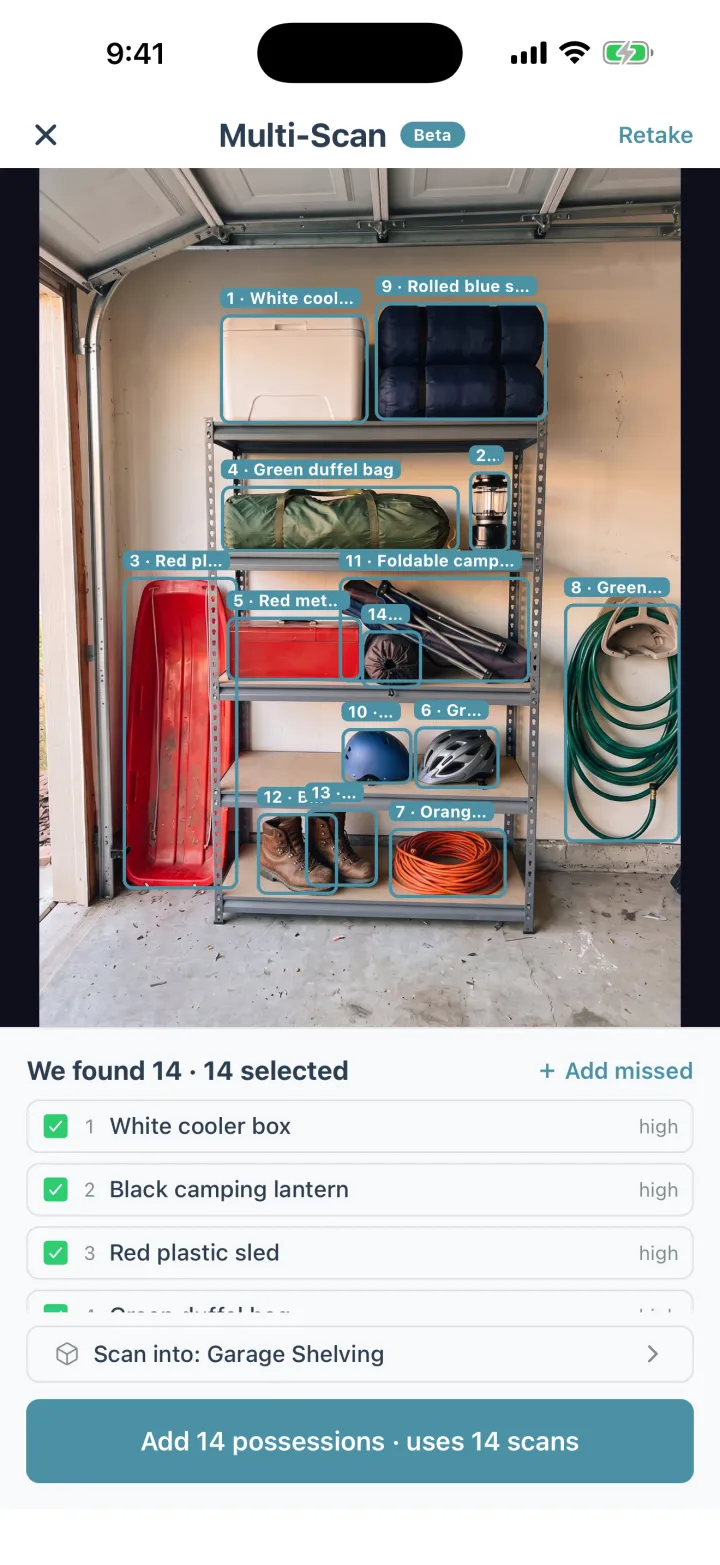
Multi-Scan names up to 15 possessions from one photo.
Containers in Cratify can be a Cabinet, a Shelf or a Closet, so the sink cabinet, the closet shelf and the garage shelf are each recorded where they actually are. Search draws on each possession's details and the container it sits in, so searching for glass cleaner turns up every bottle you've recorded and where it's kept. A collection with check-off works as the shopping list: add what's running low, and check each one off at the store.
The short version
Gather every cleaning product in one place, throw out what's empty or unlabeled, and group the rest by job. Give each floor a light caddy, keep one layer under the sink with the strongest products out of reach, and hang the tools in one closet. Keep one backup of each product in a central spot with a short count, and check it before you shop. Cratify is free to try.
Know what's under every sink
Record each cleaning product, where it's stored and how many you have. Cratify is free to try.