How to Organize Baking Supplies Before Holiday Baking Starts
Sort baking supplies into four groups, test baking powder, soda and yeast before the holidays, give pans and tools one home each, and keep a list so you stop rebuying.

On this page
It's the Saturday before Thanksgiving and the pie crust is chilling in the fridge. The pie weights are not where you left them last November. There are three open bags of powdered sugar in the pantry, no cornstarch at all, and a can of baking powder with a date from two winters ago. The 9-inch tart pan turns up an hour later in the cabinet above the fridge, behind the roasting rack.
Baking supplies sprawl because they're used in bursts. Flour and sugar get used every week, but the cookie cutters, the tart pan and the bottle of almond extract come out for six weeks a year and then scatter across the pantry, a low cabinet, a drawer and a top shelf. The fix is the same every time: sort them, check what's still good, give each group one home, and keep a list you can read from the store.
Start by taking it all out
Before you buy a single organizer, pull every baking supply onto the counter or the kitchen table. Then sort it into four groups:
Everyday ingredients: flour, white and brown sugar, baking powder, baking soda, salt, vanilla, chocolate chips.
Holiday ingredients: sprinkles, colored sugar, food coloring, molasses, extracts other than vanilla, candied fruit, pie spices.
Pans and sheets: cake pans, loaf pans, muffin tins, pie plates, baking sheets, cooling racks.
Tools: measuring cups and spoons, whisks, spatulas, a rolling pin, a bench scraper, cookie cutters, piping tips.
This is where the duplicates show up. Two open bags of brown sugar, gone hard. A third bottle of vanilla. Four round cutters in nearly the same size. Combine what you can, and set aside what you'll donate before anything goes back in a cabinet.
Check what's still good
Most baking ingredients don't spoil in a way you can see, they just stop working. A cake made with tired baking powder comes out flat and nobody knows why. Spend ten minutes on this before the season starts.
Baking powder: stir a teaspoon into a little hot water. It should fizz right away. If it barely bubbles, replace it.
Baking soda: add a splash of vinegar to a pinch of it. Same test, same answer.
Yeast: proof a packet in warm water with a pinch of sugar. If it isn't foamy after about 10 minutes, it won't raise a loaf.
Whole wheat flour, nut flours and nuts: they carry oils that turn rancid faster than white flour. Smell them. A bitter or stale smell means they've gone. If you bake rarely, keep them in the fridge or freezer.
Ground spices: rub a pinch between your fingers. If you can barely smell it, it won't taste of much either.
When you open something new, write the date on it with a marker. Next November you'll know at a glance which bag is the old one.
Give each group one home
Everyday ingredients
Keep these at the front of a pantry shelf at eye level, in airtight containers with the name and the open date on the front. Flour and sugar go in containers wide enough to scoop from. Brown sugar needs a tight lid, or it hardens into a brick by spring.
Holiday ingredients
Put everything you only reach for in November and December into one lidded Box on a higher pantry shelf, and label it. When the season ends, it all goes back in the same Box, with a note of what ran low. That one Box is what stops the third bottle of food coloring.
Pans and sheets
Store baking sheets, cooling racks and cutting boards on their edges in a cabinet, held upright with a few dividers, so you can pull one out without lifting the rest. Nest round cake pans and loaf pans by size. Stand muffin tins on their edges too. The pans you use once a year, like the tart pan or the Bundt pan, can go on the high shelf, as long as they're on the list.
Tools and decorating
Give the tools one drawer: whisks, spatulas, measuring cups and spoons, the bench scraper. Small parts are the ones that vanish. Keep piping tips, couplers and cookie cutters in a small lidded case, so they come out together and go back together.
The stand mixer and its attachments
If the mixer lives in a low cabinet, keep its bowl, beaters and attachments in one labeled Box right beside it. An attachment stored in a different room is an attachment you'll buy again.
Keep a list of what you have
Duplicates happen because you decide what to buy in the store, not in front of the pantry. A list you can read from your phone fixes that. Write down:
Ingredients, with the amount on hand and the date you opened them.
Pans by size, like two 9-inch rounds and one 9x13, because recipes ask for a specific size.
The once-a-year tools: pie weights, the tart pan with the removable bottom, the cutter shaped like a leaf.
Where each one lives: which shelf, which cabinet, which Box.
The rest of the pantry works the same way, and the guide to organizing a pantry covers it shelf by shelf. If the whole kitchen needs the same treatment, start with how to organize a kitchen.
A check before baking day
Do this two or three days before a big bake, not the morning of.
Read each recipe through and write down every ingredient and every pan it calls for.
Check that list against what you have, and buy what's missing in one trip.
Test the baking powder and baking soda if they've been open a while.
Pull the holiday Box down and set out the cutters, the decorations and the pans.
When you're done, put it all back and note what ran low.
The serving side of the holiday has the same problem, and storing holiday dishes and serving pieces covers the platters and the gravy boat.
Where an app helps
If you'd rather keep the list somewhere other than the inside of a cabinet door, here's how it works in Cratify. The pantry can be a Closet or a Shelf container, the cabinet above the fridge a Cabinet, and the holiday baking Box a Box on the pantry's top shelf. Containers nest, so the Box can sit inside the pantry, and the pantry's view lists the possessions in it and in every container nested inside it, with totals.
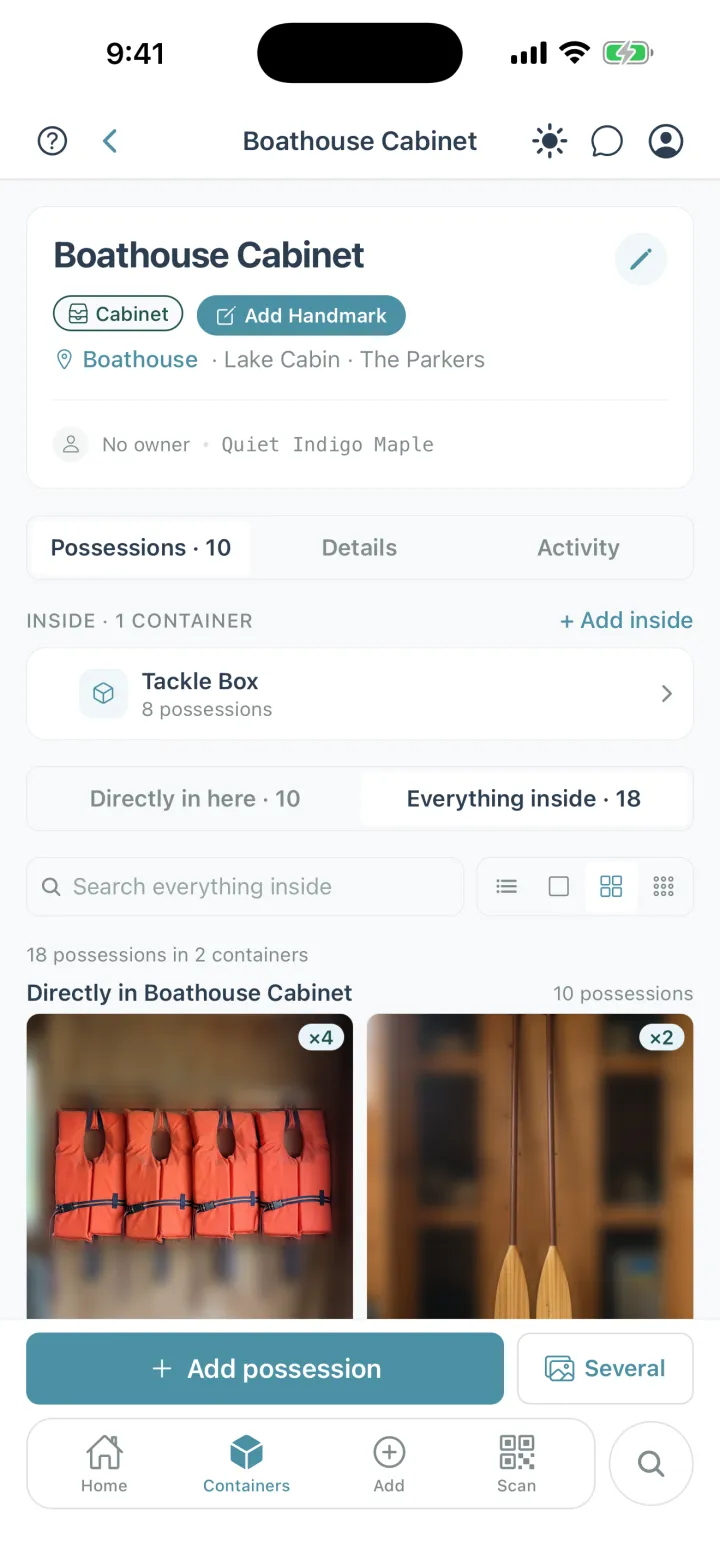
Containers inside containers, with everything inside listed.
Ingredients fit the Consumable possession type, which carries a quantity, a unit and a restock-when-below note, so the vanilla can read two bottles with a note to buy more below one. Pans and tools can be Items: photograph each one, and AI identification fills in a name and category, with a confidence percentage on screen so you can correct either before you save. Two identical 9-inch rounds can be one entry with a quantity of two. Search draws on each possession's details and the container it lives in, so searching for the tart pan tells you which cabinet it's in.
A Collection is a list that spans containers, with a check-off on each entry. Make one for the Thanksgiving pies, add the pans, the pie weights and the rolling pin, and check each one off as it comes out.
The short version
Take every baking supply out and sort it into everyday ingredients, holiday ingredients, pans and tools. Test the baking powder, baking soda and yeast, and smell the nut flours and spices. Give each group one home, keep the holiday supplies in one labeled Box, and store pans on their edges. Keep a list of what you have, with sizes and where each piece lives, and check it a few days before the next big bake. Cratify is free to try.
Know which cabinet the tart pan is in
Photograph the pans, track ingredients as Consumables, and search before you shop. Cratify is free to try.