How to Store Tablecloths and Table Linens Before the Holidays
Wash out every stain before storing, tag each tablecloth with the table it fits, roll or hang the good ones to stop creases, and keep napkins with their cloth.

On this page
It's the Wednesday before Thanksgiving. The leaf is in the dining table for the first time since last year, the table is three feet longer than it was this morning, and you're at the linen closet pulling out tablecloths one at a time. The first is the everyday round. The second is the right length but has last year's gravy stain, the one you were sure came out. The third fits, mostly, if nobody minds a crease down the middle sharp enough to set a ruler against.
Table linens get used a few times a year and stored for the rest of it, which is exactly why they go wrong. Stains that looked gone in November turn yellow by the next one, folds set into lines, and the one tablecloth that fits the extended table turns out to be in a different closet from its napkins. Here's how to store them so they come out clean, flat and together, with a few days to spare before the holidays.
Wash every piece before it goes away
The biggest mistake with table linens happens before they're stored: putting them away with a stain you can't see. Food and wine residue that looks gone after a quick wash keeps oxidizing in storage, and by next year it shows up as a yellow or brown mark that's much harder to lift.
So after the meal:
Treat stains the same day or the next, while they're fresh. Wine, gravy, candle wax and cranberry are the usual ones.
Wash in the warmest water the care label allows, and check each stain before drying. Dryer heat can set a stain that a second wash would have removed.
Let every piece dry completely. Linens folded while slightly damp are how mildew gets started.
Skip the starch for linens going into long storage. Starch can attract silverfish and leaves the fabric stiff along the folds.
Iron only when you're about to use them, not before they go away. A pressed tablecloth that sits for eleven months just trades wrinkles for sharp creases.
Know what you have, and what it fits
Before you decide where linens go, lay them out and take stock. The question you'll have next November isn't whether you own a tablecloth. It's whether you own one that fits the table with the leaf in.
Measure each tablecloth and note:
Shape and size, like 60 by 102 inches oblong or a 70-inch round.
Which table it fits, with or without the leaf.
Color and fabric, so you can match it with napkins and runners.
Any stain, tear or missing napkin you already know about.
If you're not sure what fits, measure the table and add twice the drop you want. Most people like a drop of 8 to 12 inches on each side, so a 40-by-80-inch table with a 10-inch drop needs a cloth of about 60 by 100 inches, and a standard 60 by 102 covers it. Pin a small tag to a corner of each tablecloth with its size, or write it on the shelf edge where it's kept.
This is also the moment to let go of the linens you never use: the round cloth from a table you no longer own, or the napkins with three left out of eight. The guide to where to donate household items covers where they can go.
Store tablecloths so they come out flat
There are three good ways to store a tablecloth, and the right one depends on how often you use it and how much space you have.
Roll the ones you care about most
Rolling is the best way to avoid creases. Wrap a cardboard tube, like the one left from a roll of wrapping paper, in acid-free tissue or a clean cotton cloth, then roll the tablecloth around it smoothly, lengthwise. Store the rolls lying flat on a shelf or standing in a tall Box at the back of a closet. It works especially well for long holiday tablecloths and pieces with lace or embroidery.
Hang the ones you use often
A tablecloth you use every few weeks can hang. Drape it over a padded hanger or a pants hanger with a bar, folded once or twice lengthwise, in a closet with a little room around it. Avoid wire hangers, which leave a hard line and can rust onto damp fabric.
Fold the rest, and change the fold
Folding is fine for everyday cloths and the ones you use a few times a year, as long as the folds don't land in the same place forever. Fold loosely, put a layer of acid-free tissue in the folds of delicate pieces, and refold along different lines once or twice a year. Store folded tablecloths flat, on a shelf or in a Drawer, with the heaviest at the bottom.
Keep them dark, dry and clean
Linens in storage have four enemies: light, damp, plastic and pests.
Light fades color along exposed folds and can yellow white cotton and linen. Keep them in a closed cabinet, a closet or a covered box.
Damp leads to mildew. Avoid basements, attics and garages, where temperature and humidity swing with the seasons.
Sealed plastic traps moisture and can yellow fabric over time. Use cotton pillowcases, fabric garment bags, or boxes that let air move.
Silverfish go after starch and food residue, and moths go after wool. Clean linens stored without starch are much less interesting to both.
Keep white linens off bare, unfinished wood shelves, too, which can leave brown marks over the years. A clean pillowcase or a layer of tissue between the cloth and the shelf solves it.
Keep each set together
The other half of holiday linens is the set: the tablecloth, the napkins that match it, the runner, the placemats and the napkin rings. Stored in different places, they never all turn up on the same day.
Pick one shelf or drawer for table linens, close to where you'll use them. A sideboard or a dining room cabinet is ideal, and a linen closet shelf works too.
Group each set: fold the napkins and tuck them inside the folded tablecloth, or keep them in a labeled pillowcase next to the roll.
Count the napkins and write the number on the tag, so you know before the meal if one went missing.
Keep seasonal sets toward the back and everyday sets in front.
After each use, wash the whole set and put it back together.
If the linen closet also holds sheets and towels, the guide to organizing a linen closet covers how to divide the shelves. And if your holiday tablecloths live near the holiday china, the guide to storing holiday dishes applies the same rule to serving pieces: what's used together gets stored together.
Check them a week before, not the morning of
A week or two before a big meal, pull out the linens you plan to use. That's enough time to rewash a stain that reappeared, press out a crease, replace a missing napkin or borrow a larger cloth if the guest list grew. The morning of is not the time to find out last year's gravy stain came back.
Make a short list for each occasion: which tablecloth, which napkins and how many, which runner. Next year, the list does the remembering.
Where an app helps
If you'd rather keep that list on your phone, here's how it works in Cratify. The dining room is a Room, and the places linens are kept are containers: a Cabinet in the sideboard, a Drawer, a Shelf in the linen closet, or a Box for the seasonal sets.
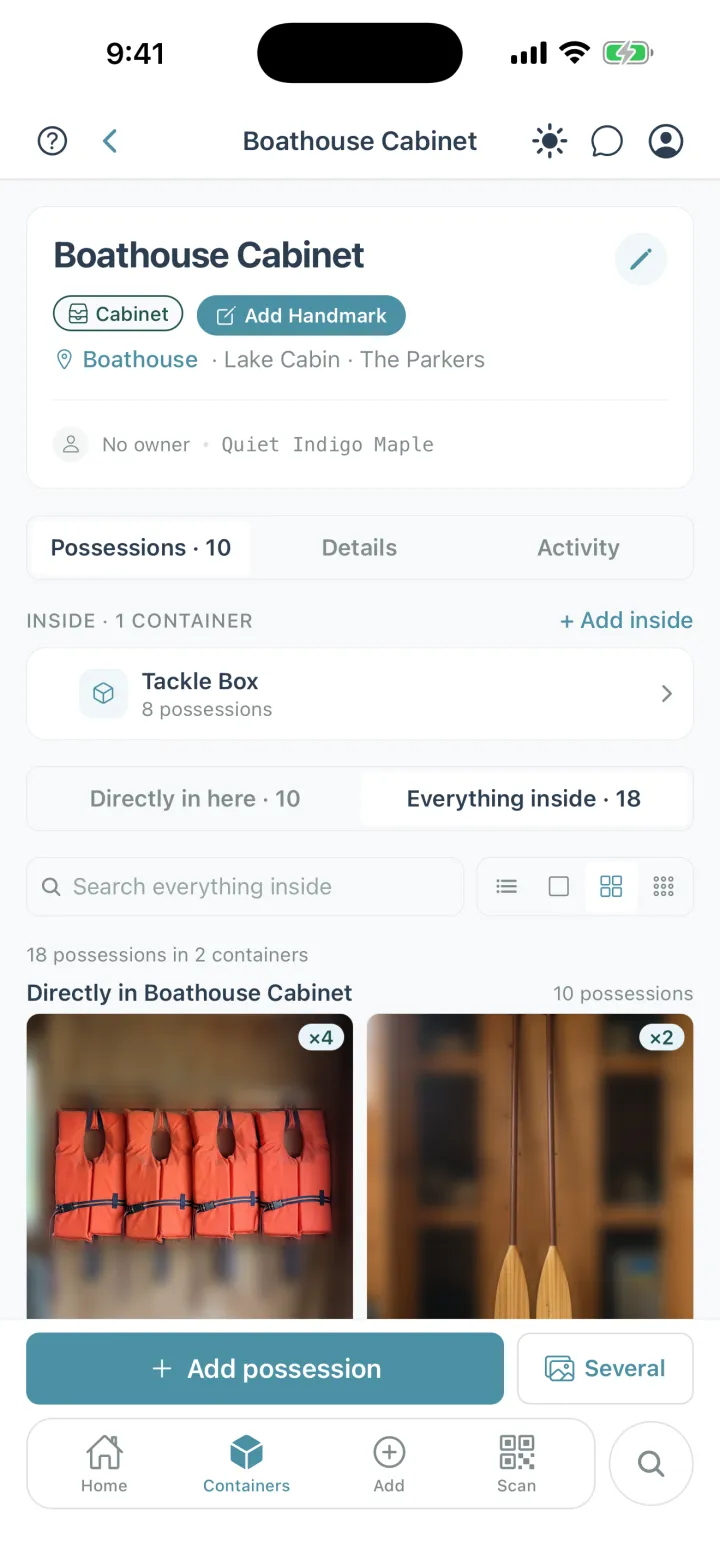
Containers inside containers, with everything inside listed.
Each tablecloth can be an Item possession with its photo. Photograph it, and AI identification suggests a name and category, with a confidence percentage on screen, so you can rename it to what you'd search for, like ivory linen tablecloth 60 x 102, before you save. Categories and tags are yours to set, so a Table linens category and a Thanksgiving tag can work the way your house does, and identification prefers the categories and tags you already use. A set of 12 matching napkins can be one possession with a quantity of 12 instead of 12 separate entries.
Search draws on each possession's details and the container it's in, so searching for the size you need tells you which tablecloth fits the extended table and which Shelf it's on. A Collection is a list that spans containers, with a check-off on each entry, so the linens for Thanksgiving dinner can be one Collection, checked off as you pull each piece.
The short version
Wash and fully dry every piece before it's stored, and treat stains while they're fresh. Measure each tablecloth and tag it with the table it fits. Roll the good ones on a tube, hang the everyday ones, and refold the rest along new lines. Keep linens dark, dry and out of sealed plastic, keep each set together, and pull them out a week before the meal. Cratify is free to try.
Know which tablecloth fits before the guests arrive
Photograph each tablecloth, note its size, and search your linens from your phone. Cratify is free to try.