How to Organize Ski Gear Before the First Trip of the Season
Check what still fits in the fall, give every skier one labeled bag, give skis and boots a home for the season, and the first ski trip starts on time.

On this page
It's the first Saturday with real snow, it's 6:15, and the car is running. One glove is on the mudroom floor and the other is nowhere. The goggles turn up at the bottom of a duffel, scratched from a summer under a camp stove. Your youngest's boots went on fine in March and now won't close over the instep, and the closest shop that could fix that opens at nine.
None of that is bad luck. It's what happens to ski gear that spends seven months in four different places with nobody keeping track. The fix is a one-evening check in the fall, a home for every piece during the season, and a short list of what each person owns. Here's how to organize ski gear so the first trip of the season starts on time.
Do the fall check now, not the night before
Late October and early November are the right time. Shops aren't busy yet, there's time to replace what's missing, and fall ski swaps are when outgrown gear is easiest to sell and replacements are easiest to find.
Pull out everything for one person at a time and lay it on the floor in one row:
Skis or snowboard, with poles
Boots, with their liners
Helmet and goggles
Gloves or mittens, as a pair
Base layers, mid layer, jacket and pants
Socks, neck gaiter and hat
Working one person at a time matters. If you empty the whole family's gear into one pile, you'll spend the evening deciding whose blue mitten that is.
Check what still fits
Kids grow between seasons, and boots are where it shows first. Have each child put on their boots with ski socks, buckle them and stand in a ski stance. Toes should touch the front lightly when standing straight and pull back when they flex forward. If toes are curled or the buckles won't close, the boots are done.
Helmets should sit level and snug without pressing, and goggles should seal against the helmet with no gap at the forehead. Gloves are the easiest to miss: a glove that's half a size small is cold by the second run.
When boots change size, the bindings need adjusting to match. That's a job for a shop technician, not a garage, so book it now while it's quick. If you keep kids' clothes in sized boxes, the same system works for ski layers; the guide to organizing kids' clothes by size covers how to set it up.
Check what's worn out
Look for frayed glove seams, cracked goggle lenses, broken zippers and boot liners packed flat. Replace a helmet after any hard impact, and check the maker's guidance on how many seasons it should last. Skis and boards that went into storage without a tune will want edges and a fresh wax before the first day.
Give each person one bag
The single change that saves the most mornings is a dedicated gear bag for every skier, holding everything except the skis or board and the poles. Boots, helmet, goggles, gloves, layers, socks, hat. When a run ends, everything goes back into that person's bag and nowhere else.
Label each bag with the person's name on the outside, where you can read it from the doorway. A bag per person turns the morning question from "where are the goggles" into "is your bag in the car", which a seven-year-old can answer.
Keep a small shared pouch in the car as well: hand warmers, lip balm, sunscreen, a spare pair of gloves and a few snacks. It lives in the car all season, so it's never left on the counter.
Give everything a home for the season
A bag is only useful if it has a spot. Decide where each part lives from now until spring.
Skis and snowboards
Store them on a wall rack in the garage or a closet, off the floor and out of the way of the car door. A simple rack of padded hooks keeps edges from knocking into each other and makes it obvious when one pair is missing. Keep poles in the same spot, strapped together by person.
Boots
Boots belong indoors during the season. Warm boots are far easier to get on, and boots left in a cold car or garage overnight are stiff and miserable at 7am. After a wet day, pull the liners out and let them dry at room temperature, away from direct heat, before they go back in the bag.
Wet layers
Jackets, pants and gloves come out of the bag the moment you're home and hang to dry. A row of hooks by the door, one per person, is enough. If your entry already has a system, the guide to organizing a mudroom shows how to give each person their own hook and shelf.
Keep a short list of what each person owns
A list sounds like overkill until you're at a fall swap trying to remember whether last year's helmet was a small or a medium. For each person, write down:
Every piece of gear, with its size
Where it lives during the season and in summer
When it was bought, and roughly what it cost
When skis or a board were last tuned
Anything that needs replacing before next season
Update it during the fall check and again in spring. Two updates a year is all it takes to know what you have, what fits, and what to look for at next year's swap.
Pack the car from a checklist
Keep a short checklist on your phone and run it at the door every trip:
One gear bag per skier, with boots and helmet inside.
Skis or boards and poles, counted by person.
Season passes or tickets.
The shared car pouch.
A dry change of clothes for the drive home.
The list takes thirty seconds and catches whatever would have ended the day early.
Store it properly in spring
At the end of the season, everything gets dried, cleaned and put away once, in the same place it will come out of in the fall. Have skis and boards waxed for storage, or wax them yourself, so edges don't rust over the summer. Buckle boots loosely so the shells keep their shape, and keep them somewhere dry and out of the heat. Wash base layers and gloves before they go into the bag, not after.
Seasonal gear all follows the same rule: put it away clean, labeled and in one spot. The guide to organizing camping gear covers the same idea for the other half of the year.
Where an app helps
A notebook or a note on your phone works for the list above. If you'd rather keep it with photos, here's how it looks in Cratify.
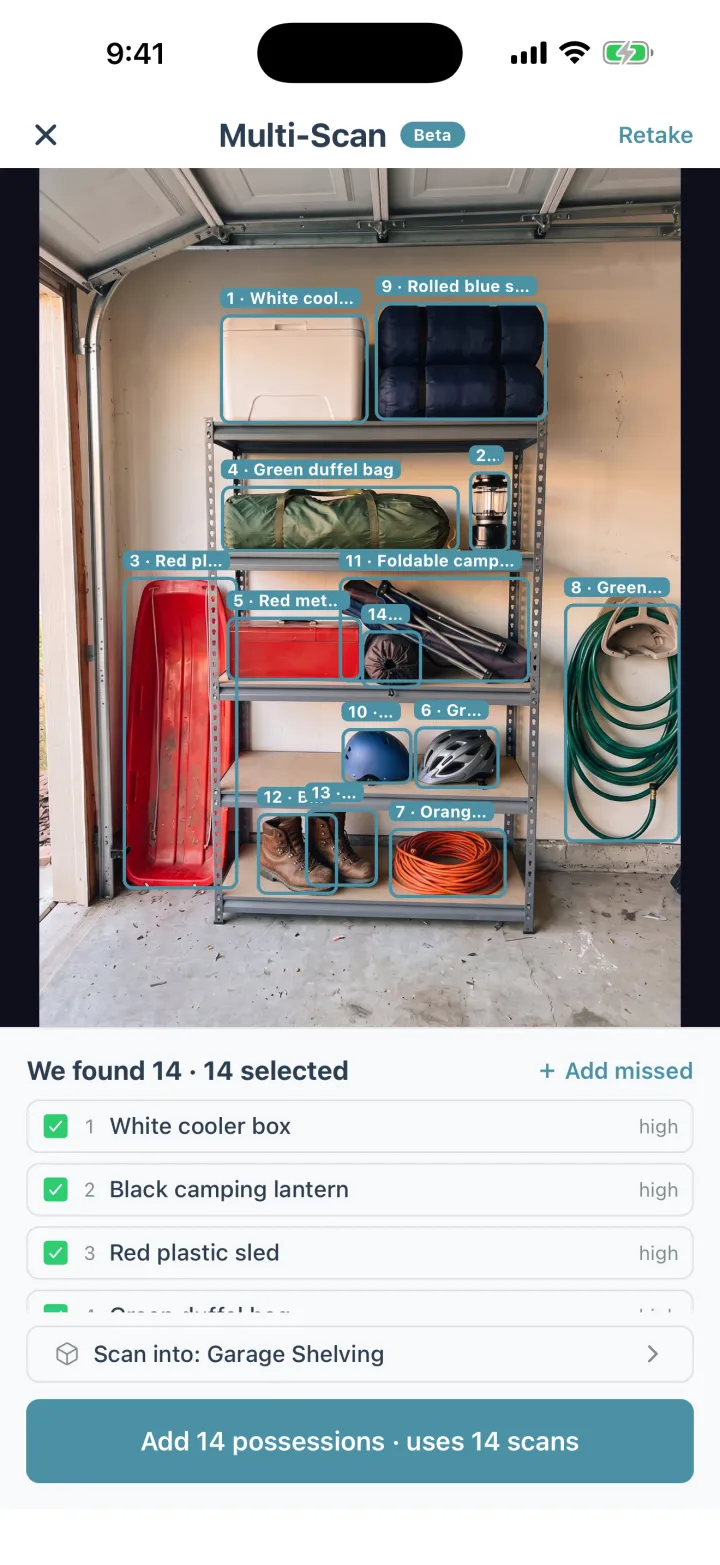
Multi-Scan names up to 15 possessions from one photo.
Each piece of gear is a possession with its photo, size and purchase date in its details, and each one can belong to a person, so the list for each skier is already sorted. Every person, including a child, has their own page listing what belongs to them. Each gear bag can be a container in the mudroom, and the wall rack a Shelf in the garage, so a search for "goggles" shows whose they are and where they live.
The car checklist can be a collection you check off as you load the car. And when a pair of skis goes to the shop for a tune, mark it temporarily removed with a note, so nobody spends a morning looking for skis that are on a workbench across town.
The short version
Do the fall check one person at a time, and check fit before anything else. Give each skier one labeled bag, and give skis, boots and wet layers a fixed home for the season. Keep a short list of what each person owns, with sizes, and update it twice a year. Pack from a checklist, and put everything away clean in spring. Cratify is free to try.
Ready before the first snow
Record each skier's gear with a photo and size, and find any piece of it with a search. Cratify is free to try.