How to Store a Grill for Winter
Clean the grates, empty the grease and ash, keep the propane tank outside and upright, cover the grill or move it in, and write down where the tools went for spring.

On this page
The first Saturday in May that's warm enough to cook outside, you pull the cover off the grill. A mouse has spent the winter in the warming rack. The grates are orange with rust. The igniter clicks and the burners don't catch, and when you go to swap the propane tank, you can't remember whether the spare is full, empty, or around which side of the house it went.
Storing a grill for winter comes down to five jobs: cleaning the cooking parts, emptying what holds moisture, handling the fuel safely, covering or moving the grill, and writing down where the small parts went. It's one afternoon in October or November, and it decides whether spring starts with a cookout or a trip to the hardware store.
Clean it after the last cook
Grease and food left on the grates hold moisture against the metal all winter, and they draw mice and insects looking for a sheltered meal. The easiest time to clean is right after the last cook of the season, while the grill is still warm.
Grates: run the burners on high for 10 to 15 minutes with the lid closed to burn off residue, let the grill cool until it's warm, then scrub the grates with a grill brush.
Inside the lid and firebox: scrape off loose carbon and grease with a plastic scraper.
Grease tray and drip cup: empty them, wash them in warm soapy water, and dry them.
Outside: wipe the lid and side shelves with warm soapy water and towel them dry.
Once the grates are clean and dry, a thin coat of cooking oil on cast iron grates helps keep rust off until spring.
Charcoal and pellet grills
A charcoal grill needs its ash emptied completely. Ash pulls moisture out of the air, and a kettle sitting on a layer of damp ash all winter rusts from the bottom up. On a pellet grill, empty the hopper as far as the manual says you can, and vacuum out the fire pot. Pellets left in a hopper absorb moisture, swell, and can jam the auger by spring.
Deal with the fuel first
The fuel is the part of grill storage with real safety rules, so decide where it goes before the grill moves anywhere.
Propane tanks stay outside
Close the tank valve and disconnect the tank from the grill. If the grill is going into a garage or shed for the winter, the tank doesn't go with it. Propane cylinders belong outdoors, upright, in a ventilated spot away from doors, windows and vents, and never in a garage, shed, basement or the house. Cold doesn't hurt a propane tank. A small leak in a closed space can. Your propane supplier or local fire department can tell you what applies where you live.
Write down whether the tank is full or close to empty. A tank that went into winter half full is the one that runs out halfway through the first cookout.
Charcoal and pellets stay dry
Bagged charcoal and pellets both go bad when they get damp. Fold the bag shut and put it in a lidded plastic container, or move it to a dry shelf indoors, off any concrete floor.
Cover it or move it
Where the grill spends the winter matters less than keeping water and animals out of it.
Leaving it outside
Use a cover that fits and breathes, so condensation can escape instead of collecting underneath.
Tie or clip the cover down so the first windstorm can't lift it off.
Close the lid and any side burner covers before the cover goes on.
Park the grill out of the wind, against the house or a fence, on a hard surface where its wheels won't sink.
Moving it into a garage or shed
A gas grill without its tank can winter in a garage or shed. Make sure it's completely cool and the tank is disconnected and left outside. Roll it against a wall where the car won't bump it, and cover it anyway, because a garage gets dusty and a shed gets damp. The guide to organizing a shed covers making room for large possessions like this one.
Portable and tabletop grills
A portable grill can come all the way inside once it's clean and dry. Its small propane cylinder stays outside, under the same rules as a full-size tank.
Gather the small parts in one place
The grill is easy to find in spring. The tools are what scatter: the spatula and tongs end up in a kitchen drawer, the thermometer ends up in the junk drawer, and the brush stays on its hook all winter and rusts.
Grill tools: wash and dry them, and keep them together in one box.
Thermometers and timers: take the batteries out so they can't leak over the winter.
The igniter battery: take it out too, and tape it to the box lid so it comes back with the grill.
Spare parts: replacement grates, a new burner, or the rotisserie kit you bought and never set up.
The manual and receipt: they matter the day a part fails.
Put the box on a shelf close to wherever the grill lives. It's the same approach as storing patio furniture for winter, and the guide to storing summer gear for winter covers the rest of the deck and yard gear that goes away at the same time.
Write down where it all went
In May you'll want the grill, and also the tools, the spare tank, the cover's storage bag and the manual. Write down, for each one:
What it is, with a photo
Where it's stored: which shelf, which box and which room
For the fuel: how full the tank is, or how much charcoal or pellets are left
For the grill: the model number, the receipt and the purchase date
On many gas grills the model number is on a label inside the cabinet door or under a side shelf. A photo of that label means you can order the right replacement part in a minute instead of guessing.
Where an app helps
If you'd rather the record show where each piece of grill gear is, here's how it works in Cratify. The shelf in the garage and the box of grill tools on it are each a container, each in the room it sits in.
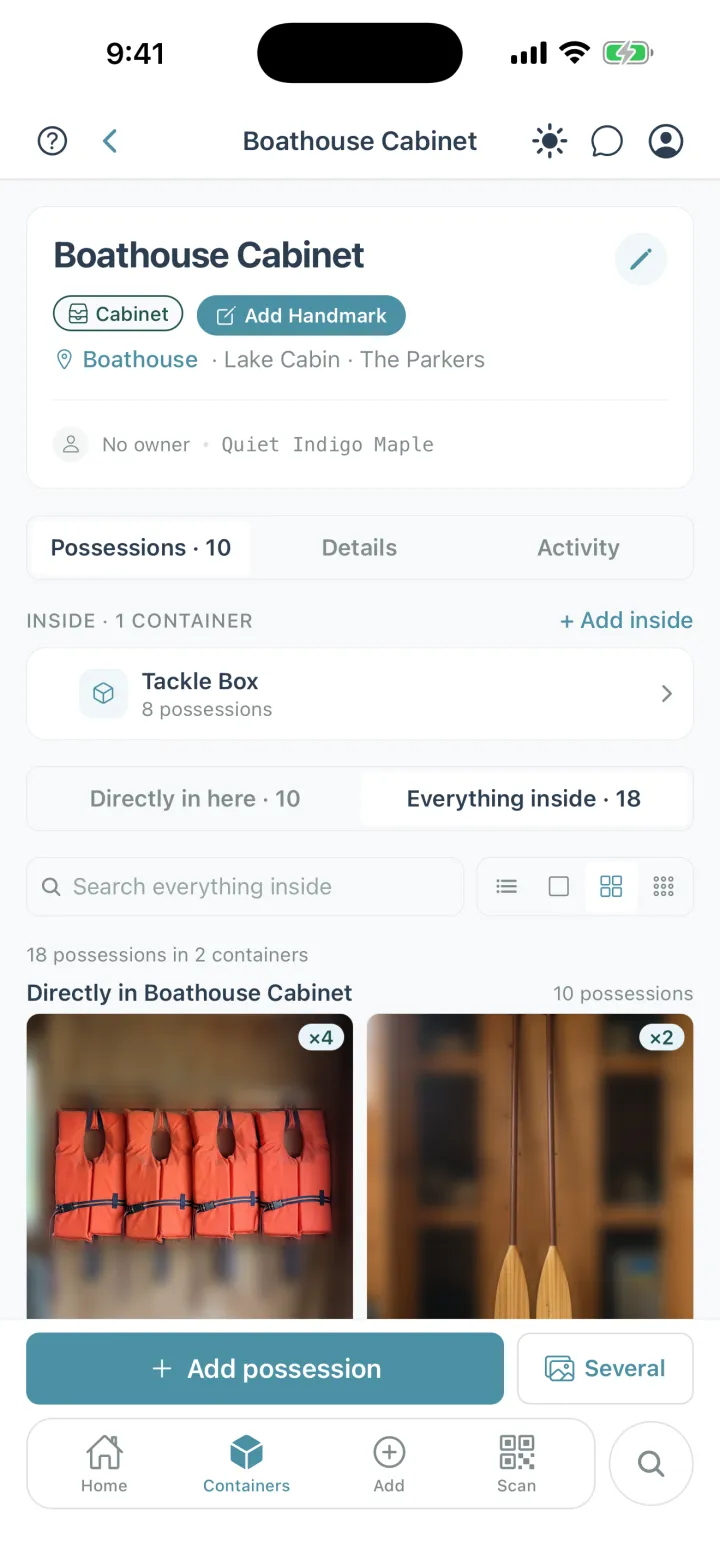
Containers inside containers, with everything inside listed.
Photograph the grill and AI identification fills in a name and category, with a confidence percentage on screen so you can correct either before you save. The receipt can be saved as its own possession with the amount and the purchase date, and the manual can be saved as a Document. A bag of charcoal or pellets can be a Consumable, with a quantity, a unit and a note for when to restock.
Search draws on each possession's details and the container it's in, so in spring, searching for the thermometer tells you which box to open. A Collection is a list that spans every container, with a check-off on each entry: make one called first cookout, and check each piece off as it comes back out.
Getting it ready in spring
Before the first cook of the year, give the grill 20 minutes:
Look inside the burner tubes and the grill body for nests or webs, and clear them before lighting.
Reconnect the tank and brush soapy water over the hose and connections. Bubbles mean a leak, and the grill doesn't get lit until it's fixed.
Put the batteries back in the igniter and the thermometer.
Run the burners on high for 15 minutes with the lid closed, then brush the grates.
The short version
Burn off and clean the grates, empty the grease tray and the ash, and dry it all. Disconnect the propane tank and keep it outside, upright, wherever the grill spends the winter. Cover the grill with a fitted, breathable cover or roll it into the garage or shed, keep the tools and spare parts together in one box, and write down where they went, so the first warm Saturday goes to the cookout instead of the search. Cratify is free to try.
Know which box the grill tools are in
Photograph the grill, its tools and the receipt, and file each in the box or shelf that holds it. Cratify is free to try.